
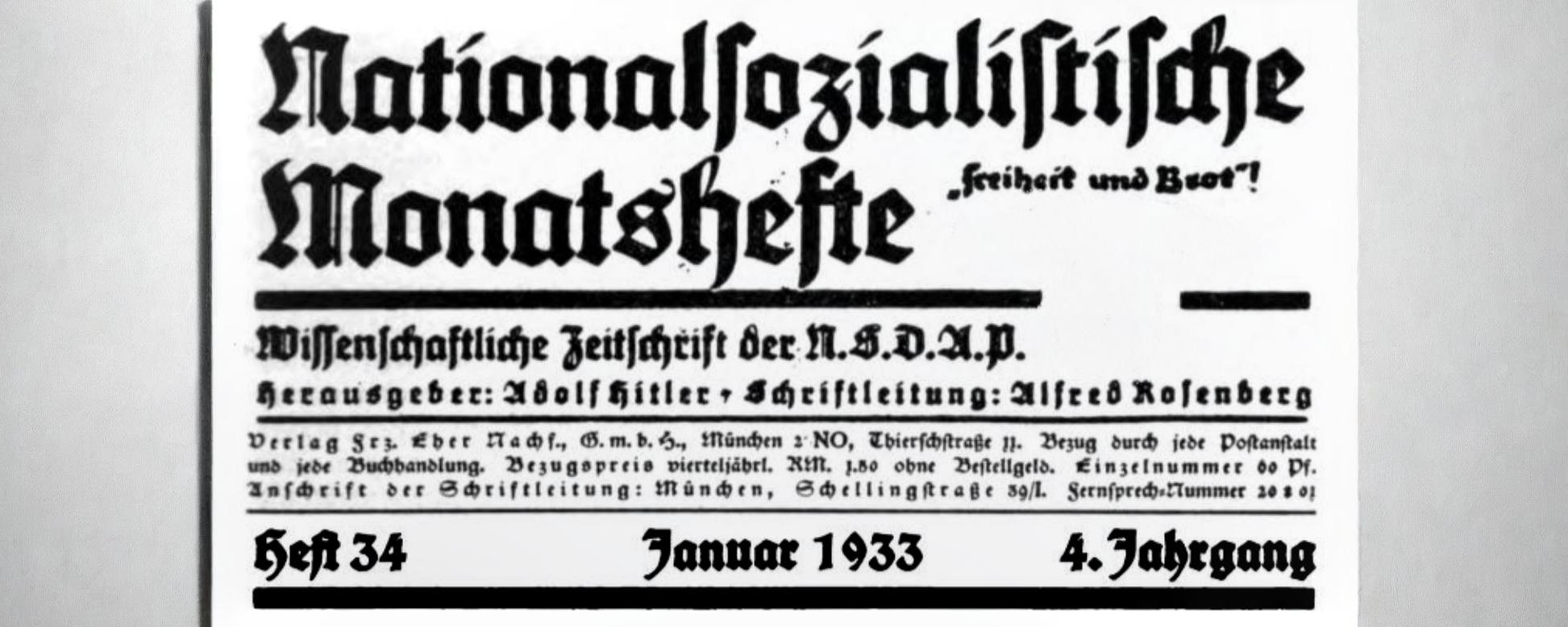
Editor’s note: The text and image here were copied from an X post by Ahnenkrieger dated 21 March 2026.
The Formation of Judaism
According to modern genetic theory, the environment is a decisive factor in the formation of races, not in the sense of environmental theory that it itself exerts a direct influence on the given genetic material, but only as the sum of all selection and elimination conditions that determine the selection or elimination process and give it a specific direction.
The second factor is the alteration of the genetic material through interbreeding or through as yet unexplained internal processes, which constantly stimulates the interaction between the environment and the given genetic makeup.
Thus, through the interbreeding of two given races over a sufficiently long period of time in complete isolation, a third race can emerge, as the environment favors the reproduction of the individuals best adapted to it and eliminates those unable to cope with the given conditions.
Therefore, the statement can also be reversed: that it is not the individuals who choose their habitat, but rather that the landscape selects the individuals best adapted to it.
This process of race formation, as well as that determined by spontaneous changes in the genetic material, can be described as primary.
Up to now, all racial and ethnological studies, insofar as they are based on the current state of heredity research, have been of the opinion that only such a primary process has been and is conceivable in the formation of human groups.
However, nature knows other groups of living beings whose formation can only have occurred in a secondary way.
These are the so-called parasites, and among their manifold manifestations, the so-called species parasites in particular, which, even when living in associations with one another, feed on the communal organisms of their hosts, who, unlike in symbiosis, naturally bear the sole harm, as, for example, among ants.
Scholars are not yet entirely in agreement about the exact development of such ant species that parasitize the communal organisms of their free-living relatives, whose parasitic lifestyle is already betrayed by the physical changes that have occurred.
The previously dominant view that these ant species were “generated predators or slaveholders”—drawing an interesting parallel to nomadic human desert dwellers—has been challenged.
According to current understanding, both “slaveholders” and “parasites” among ant species are the product of distinct evolutionary processes.
While they exhibit similarities and commonalities, they ultimately follow different paths, and direct transitions from the predatory to the parasitic stage are not excluded.
However, it remains undisputed that all parasitic species can be traced back to non-parasitic ancestors.
Furthermore, the transition is so gradual, involving so many intermediate stages, that it is often difficult, if not impossible, to distinguish the lifestyles of free-living species from those of their parasitic counterparts.
The transition is so gradual, involving so many intermediate stages, that it is often difficult, if not impossible, to distinguish the lifestyles of free-living species from those of their parasitic counterparts.
Furthermore, the more complex and developed a species is, the more difficult it becomes to adapt to a purely parasitic lifestyle, unless the communal organizations of various organisms open up new possibilities for parasitism, as is the case with ants.
In any event, this species-specific parasitism also originated from occasional parasitism, which included the possibility of free self-preservation within the environment.
Only through the constitutional changes that occurred and were supported by a shift in the direction of natural selection have parasitic ant species become bound to their free-living hosts.
However science attempts to explain the beginning of species parasitism, one thing remains: that it must originate from a psychological, or in this case, an instinctual change that causes those species to increasingly turn to a parasitic lifestyle.
Whether “experience” plays a role in this can be disregarded, since it is not inherited, as the environmental theory assumed.
At this stage, of course, there can be no talk of any morphological or constitutional changes.
With this turn to parasitism, however, a simultaneous change in the direction of selection also begins for the future species parasites.
For them, the entirety of the environment no longer plays the same role as for their completely free-living closest relatives; rather, from their various factors, the ‘social factor’ of similar beings gains paramount importance, to which the others increasingly recede into the background.
From similar free-living creatures, species parasites develop into a caste subject to special conditions, until this long-lasting development is also expressed in their external form.
This would be the secondary process in large groups.
The parasitic ant species, which can only exist in the states or cities of its closest relatives, can also very well be described as an “urban race.”
Regarding the effects of social parasitism among ants, K. Escherich reports the following:
“We now know of a whole series of permanent social parasites among the ants, each belonging to a particular genus.
Not long ago, Santschi discovered the small, workerless Wheeleriella santschii Forel near Kairouan (Tunis).
It always lives in mixed colonies with the very common Monomorium salominis.
According to the discoverer’s very precise observations, these colonies come about because the (usually nest-fertilized) Wheeleriella females invade Monomorium nests.
The workers of the latter initially try to stop the intruders (Santschi frequently found the Wheeleriella females ‘arrested’ by a number of workers in front of the gates of a Monomorium nest), but after a short time their resistance weakens and they calmly allow the foreign female to proceed.
They now even beginning to treat the foreign queen amicably, like their own.
The colonies queen is initially still present in the nest; the foreign queen shows very little interest in her and certainly does not appear hostile towards her rival.
In contrast, a peculiar perversion of instinct occurs among the workers.
To the extent that they turn to the foreign queen, their animosity towards their own queen grows, eventually reaching such a degree that they attack and kill her.
We have here, therefore, a veritable matricide, a phenomenon that, at least among animals, is likely to be quite rare in this form.
The killing of the host ant’s queen is, of course, a disadvantage for the mixed colony in this case, since no more workers can be born and there is no other way to replace the queen to replace gradually disappearing auxiliary forces.”
If one considers the possibility of species parasitism among the families of Homo sapiens, one is inclined to deny it from the outset.
The complex structure, as with the lower and primitive organisms among which parasitism is most widespread, almost completely precludes any transformation such as that seen, for example, in snails, since such a transformation would immediately deprive the individual in question of its viability.
At most, it can extend to psychological changes somehow related to the nervous system, which are not expressed in the appearance itself, with social human community formations providing the basis for this.
As long as humans led a hunter-gatherer lifestyle and had to assert themselves against the environment in larger or smaller groups, this bitter struggle with the natural forces precluded the preservation of one at the expense of the other.
Only with its domestication and the formation of certain communal systems did the situation change; more precisely, with the beginning of the division of labor and the progressive differentiation of means of subsistence, this possibility arose in conjunction with the increasing density of settlement.
The emerging barter system, and even more so the much later appearance of money, favored the increasing influence of the social factor, since only with both did the preservation of life in a community, and even of gradually forming caste-based communities, at the expense of others, come to its full effect.
Sombart once wrote in his study on, The Jews and Economic Life:
“Even in barter, but even more so in the case of money, the possibility of earning money through economic activity without one’s own sweat becomes quite clear for the first time: the possibility of having strangers work for oneself without an act of violence appears quite clear.”
With barter and money lending, the preconditions were in place under which a parasitic form of existence adapted to the human way of life could develop freely, dependent on increasing population density.
Such a development may have been prevented and counteracted in the vast majority of human societies by customs and traditions that took the place of later laws, so that dangerous tendencies in this direction may never have arisen, as is also precluded by the way of life of today’s so-called primitive peoples.
Nevertheless, even among them, far-reaching differentiations are already evident, in whose genetic makeup the “social” selection factor of the human community of the same species has played a significant role.
Even scientific terminology recognizes robber states, robber hordes, and tribes that base their existence, at least in part, on the exploitation of other, closely related human communities through violence, in contrast to other groups that remain dependent on a more direct means of survival through nature.
However, a systematization and summarization from broad perspectives, which is very necessary and desirable in the field of human racial studies, tends all too easily to disregard differentiations that appear in the lifestyles of smaller or perhaps even the smallest groups, or to subsume them under unsuitable terms for the sake of a desirable schematization.
It was no different in the study of ants, and only meticulous observations, taking into account all relevant circumstances, led to the discovery of the very remarkable parasitic species and various transitional forms, which was all the easier because the readily apparent constitutional changes pointed the way.
The extent to which ongoing interbreeding between human races already established in different regions played a decisive role in triggering the still unexplained spontaneous changes in the genetic material may remain an open question.
These changes are, in fact, subject to a very narrow limit in human beings from the outset, which could manifest itself externally in a particularly difficult-to-grasp way in a small group, since so-called degenerative phenomena, beginning with the domestication of man and the changes in his way of life caused by his own life activity, which amount to a mitigation of the harsh extermination by nature, can be demonstrated in all races.
The question arises as to what constitutes degeneration and how to evaluate transformations that can simultaneously encompass progress and regression and can always only be assessed in relation to their adaptation to given life circumstances.
Indeed, it is highly questionable whether such transformations have even taken hold, or whether they merely represent a specific new combination of existing genetic traits, as occurs in the formation of a new race from two existing ones, taking into account modified selection and elimination conditions, which then multiplied through increasing inbreeding.
This is irrelevant for the assessment of Judaism.
What is decisive for its evaluation are solely the conclusions drawn from its way of life and its expressions regarding its position in relation to other human races, peoples, and groups.
For even if the study of humankind is disadvantaged in many respects compared to the study of nature, it nevertheless possesses the advantage of being able to consider intellectual creations and the philosophy of life expressed through them, which in turn allows for inferences about the nature of a particular community.
If the historical facts coincide with the meaning of the views expressed by the same group, then all doubt is eliminated.
The proof of social parasitism practiced by a human group is thus provided, since its possibility cannot be denied from the outset.
The world may argue at most about the manner of its origin, but the fact itself can no longer be denied.
It is not without reason that popular wisdom has called the Jews “sons of chaos.”
They emerged from the racial chaos of the Near East through a lawful development, remaining true to the path once laid out for them.
The judgment as to how many human races contributed to their formation will always remain appropriate to the current state of racial research.
Current racial studies view them as a mixed-race product, primarily of mixed origin, that is, a people in which traits of the Near Eastern, Oriental, Western, Ethiopian, Negro, and Nordic races can be demonstrated, with a strong predominance of the first-mentioned.
This is a makeshift solution, partly driven by consideration for the current position of power and a reluctance to take positions that could lead to personal attacks and persecution.
For such a general view, which relegates Jews to the ranks of other peoples, fails to do justice to the crucial realities of Jewish life and the understanding expressed in Jewish law.
Furthermore, in connection with the aforementioned fact, it disregards the fact that from the Near Eastern racial mush, in which hundreds of peoples disappeared, only the Jews emerged and, despite their voluntary dispersal, have preserved themselves to this day in a manner that is very unpleasant for the world.
To refer to their “hybridity,” however, would only be to reverse the facts, for the Jew first had to come into being before he could establish such norms corresponding to his predispositions.
Even among other peoples, to whom a far greater racial uniformity is attributed, draconian prohibitions against the mixing of their blood were enacted, which, as the facts prove, were not observed because racial mixing among them had already progressed too far.
How much sooner, then, should this natural law have revealed its validity among the Jews, who themselves are practically presented as a concentrated product of mixed race, if another law had not precluded its effect from the outset.
Another piece of evidence, albeit negative, can be used to interpret the explanation of the “Jewish phenomenon” presented above.
As often as attempts have been made throughout history to resettle Jews in the countryside in order to reintegrate them into productive work, they have ended in complete failure.
Within a short time, the Jews had learned to lease or sell the land given to them free of charge in order to return to their natural occupations.
A secondary form of parasitism cannot simply be returned to primary conditions of preservation.
Even if it happened out of necessity, and the Jews were forced to at least feign compliance with the orders of the rulers, moved by their constant complaints, and to submit to the procedure of relocation to the land, they very quickly had to repeatedly escape the intolerable conditions of supposedly misunderstood farmers and attribute the blame to the unfavorable circumstances, supported by a thousand reasons, in order to maintain the falsehood of their forced exclusion from all creative activity for the future.
The largest such endeavor in history—with the exception of the Zionist efforts in Palestine—was undertaken by the Soviets in Russia, which initially sparked tremendous jubilation throughout the Jewish community.
The Soviets provided 300,000 acres of the so-called “famous black earth” in southern Russia and Crimea free of charge, valued at over 12 million dollars.
They also supplied timber and allocated 1 million dollars in long-term loans for the purchase of machinery.
The entire Jewish community supported this endeavor by collecting further funds.
For several years, judging by their press reports, everything went exceptionally well.
Then, this attempt by these urban parasites to settle down became increasingly quiet, until the laments began: the experiment had failed due to the special circumstances in the much-lauded Soviet state.
Similarly, the Soviets’ experiences with large-scale Jewish settlement in Biro-Bidzhan some time later also ended in near failure.
Only in present-day Palestine does it not yet seem to have manifested itself.
However, the files on this are not yet closed, because in the final assessment of this experiment, all the current conditions under which the very modest return of Jews to Palestine took place must be taken into account.
And it can already be said that the transplantation of the “urban race” to the countryside in Palestine has a rather peculiar nature.
Either they remain in the cities from the outset or they proceed according to the pattern of their ancestors.
Those arriving are mostly Jews from South Arabia, who, as is known, adhere to the Mosaic faith, but, as already explained, cannot be considered part of the Jewish people.
The Jewish Type
The dispute over the Jewish question is also simultaneously a dispute over the Jewish type.
Passionately defended by some, it is just as passionately opposed by others.
Even within Judaism, these opposing views exist and are emphasized according to the prevailing advantage.
At times, every “Jewish characteristic” is denied; at other times, this very “Jewish characteristic” demands special considerations and privileges.
It must be borne in mind that the Jews, as “guest colonies” living within a different population, naturally differed from their host peoples.
They did so the more uniform this population was and the more the various racial groups from which it was composed deviated from the racial characteristics combined and selected within Judaism.
Günther has examined this question most thoroughly to date in his “Racial Science of the Jewish People.”
He, too, points to the difficulties arising from this, particularly in finding inherited and heritable traits among Jews that occur only within Judaism and are not, in part, also found in those peoples and tribes composed of a racial mixture similar to Judaism.
This was to be expected from the outset.
For what is primarily perceived and described as “typically Jewish” in Europe belongs to the non-European racial characteristics that are especially striking to its southern inhabitants.
Günther presents a whole array of physical characteristics, each of which can be assigned to one of the races scattered throughout the Near East, but whose combination is already more conspicuous.
The same can be said of the accumulation of various phenomena based on hereditary principles in Judaism, some of which might perhaps be interpreted as degenerate traits and are also found in other peoples, albeit not with this frequency.
Despite all this, something definable as “Jewish” remains, something that eludes direct determination by measuring tape and compass and all other methods, such as blood group research.
Feist sums it up well in his work, The Tribal History of the Jews:
“So, too, the Jew usually has his characteristic traits, which, of course, are difficult to grasp anthropologically.”
Günther also emphasizes this point:
“The racial formation process has given rise to something ‘Jewish’—one must not only think of the processes of heredity, whose laws have been researched, but also of the appearance of certain ‘bloodlines’ known to animal breeders, in which, in a way that has not yet been sufficiently researched, the individual characteristics of the crossed races are no longer inherited independently of one another, but appear connected in the same way as, for example, a branch of the Habsburgs inherited a specific combination of features of the lower lip and the mouth—through such inheritance in ‘bloodlines’ something ‘Jewish’ must have spread in the Jewish race.”
This typically Jewish trait would also be the typically parasitic one that is possible among humans.
Precisely because this secondary formation is subject to such narrow limits among the highly complex Homo sapiens, its manifestation in external appearance is all the more striking.
Generally, one might have assumed that the secondary process extends more or less exclusively to the psychological realm and is somehow connected with changes or alterations of the nervous system.
That this is also the case is indicated by numerous testimonies from the Jewish community, as well as by medical examinations.
For example, Stigler published the following on this topic in his work, The Racial Physiological Significance of Secondary Sexual Characters:
“Particular attention seems to be paid to the strikingly frequent occurrence of sexual applanation among Jews.
This is especially noticeable in the subtlest reagent for the influence of the internal secretion of the gonads, namely the psychological sexual characteristics.
However, the somatic sexual characteristics are also strikingly often blurred in Jews.
It seems that among Jews, women with relatively narrow pelvises and relatively broad shoulders, and men with broad hips and narrow shoulders, are particularly common.
Lecturer Dr. Thaler pointed out to me that hirsutism (male-like features) with menstrual disorders and funneling of the pelvis are especially frequent among Jews.
Professor Pilcz confirmed, based on his experience, the relative frequency of homosexuality among Jews.
However, their psychological behavior is particularly characteristic.
Jewish women frequently exhibit a blurring of their psychological femininity and the emergence of psychological qualities considered unfeminine, especially a suppression of specifically feminine instincts, feminine passivity, and the typical female characteristics of psychomotor impulses (e.g., shyness about public appearances), which explains the relative disregard shown by Jewish women among the political agitators.
Of particular importance among Jews is the persistent endeavor to compensate for the social and professional differences between men and women, while misjudging the significance of secondary sexual characteristics, which are instinctively retained and promoted in normal people.
For Jewish men, a characteristic feature in many cases is the inability to recognize psychological sexual characteristics, something that normal men, despite far lower intelligence, are often instinctively better able to do.
Women deemed unfeminine are very frequently considered particularly desirable by Jews.
This seems to form the basis for the infantilism that is also relatively common among Jews.
Feminist aspirations find a particularly strong echo among the Jewish intelligentsia.
World-weary hypersensitivity in Jewish men often contrasts sharply with unfeminine traits and an uninhibited striving for personal recognition in public life in Jewish women.
This appears to involve a far-reaching inhibition of instinctive, unconscious processes in the cerebral cortex and subcartical centers by purely intellectual processes in the cerebral cortex.
An endless series of examples could be cited to demonstrate the almost obtrusive blurring of secondary sexual characteristics among Jews.”
The secondary educational process, through the totality of all circumstances, in the racial Babylon of Palestine, over a much longer period than previously assumed, fostered the reproduction of the most “Jewish” individuals and hindered the reproduction of the less Jewish ones.
This incipient secondary racialization of a particular caste was promoted by social motives that, for purely material reasons, led those belonging to the privileged class to practice a kind of inbreeding, as can still be observed today among all peoples.
A deliberate restriction of offspring, such as occurred among the upper classes of European peoples for material and other reasons related to the overall structural transformation of society during the time of liberalism, did not occur in Palestine at that time.
On the contrary, offspring increased the wealth of the family, as many biblical passages express and as the Talmud later demanded.
Even in Solomon’s time, the class of moneyed people intertwined with the temple service, who ruled the land, resided in Jerusalem.
These were the mature groups whom the so-called “Prophets” repeatedly accused of the most serious moral offenses through the exploitation of the rest of the population, and who were threatened with God’s judgment.
But in the bitter social struggles, that stratum prevailed which, in conjunction with the priesthood, increasingly distorted the tradition according to its own inclinations.
The later measures, especially after Ezra and Nehemiah, then led to an ever sharper segregation of this caste, to an ever more exclusive inbreeding, which was best supported by the ghetto.
Naturally, such a separation of Judaism was never entirely hermetic.
Blood flows from other populations always occurred during the long period of Judaism’s voluntary dispersal.
That is why Judaism is surrounded by a wall of “fundamental phenomena” that cannot be attributed to it or to its host peoples.
But the social selection conditions supported by Jewish “law” repeatedly favored the reproduction of the most “Jewish” and inhibited the reproduction of the most “non-Jewish,” thus precluding any fundamental change in Judaism.
Even a change in racial components, as can be observed to a certain extent in the Jewish population that migrated to Egypt in contrast to that that migrated to South Russia, and which is reflected in their appearance, could not bring about change because the Jewish orientation of even the geographically separated groups always remained the same.
Günther in his work, Racial Studies of the Jewish People arrives at roughly the same conclusion:
“The many similarities in physical and mental traits between Southern and Eastern Jews, two groups thus corresponding to two differently composed mixtures from the same races, these ‘transitions’ between the two groups separated for centuries seem to be best explained if one assumes selection processes for both groups that proceeded in the direction of the same ‘breeding goal’—in order to apply a term from conscious animal breeding to such processes of unconscious ‘natural selection’ within a people.”
So, despite the division into Southern and Eastern Jews, Sephardim and Ashkenazim, consistent features can be recognized throughout Judaism, which are related to its secondary origins.
As one jewish writer puts it:
“The Jews, although different among themselves, nevertheless have a special facies which allows anyone with a little experience to recognize them immediately.”
The early voluntary dispersion, beginning with the crystallization of Judaism in Palestine, led, through the great historical upheavals in Western Asia and the neighboring countries, to a division of Judaism into southern and eastern Judaism.
Centuries before the Common Era, the Jews may have reached the caucasus region and also southern Russia via the Euphrates and Tigris plains, where they probably first acquired knowledge in the Greek colonies that still existed there.
The exodus there may have been particularly strong from Mesopotamia, which in the fifth to third centuries BCE was perhaps of greater importance to Judaism than Palestine.
The upheaval and decline of the Diadochi period, caused by the turmoil and conflicts of that era, and the subsequent decline of those countries in which they may have contributed, along with the shift in the center of gravity to neighboring regions, compelled the Jews to adapt to the changed circumstances and, relying on their consistently accurate reports, to turn their attention to the territories they had not yet explored.
Following the trade route leading from Mesopotamia, the Jews spread across Persia, reached India, established colonies in the then-flourishing Central Asian kingdoms, and penetrated China.
The larger flow, later augmented by the Jews who had migrated to Central Asia and Persia, may well have flowed directly across the caucasus to southern Russia.
Overall, it seems that trade in antiquity has been extraordinarily underestimated.
That it was much more active and widespread than previously assumed is indicated by a number of accounts and still unknown reports that have received too little attention.
For example, the Jewish traveler Solimann from Andalusia reported in the 9th century that on his journey in China he found Jews in all the major cities who also understood Hebrew.
Of these colonies, however, only that of Rai-Seng-Fu survived the longest.
Judaism must have achieved wealth and influence, unaffected by all the storms and upheavals that swept over them.
In the Khazar Empire, which existed from the 6th century CE until the 10th century CE along the lower reaches of the Volga and the Don, we find the Jews again as wealthy merchants who facilitated trade to Central Asia, India, and probably as far as China.
Their influence at the court of the Khazar Khan was so powerful that the dynasty adopted Judaism And the example of the dynasty may well have found many imitators, especially among the most distinguished families of the Khazar tribe.
These Khazars, who had converted to Judaism, gradually merged into the Jewish community there, which was not insignificant in number, thereby giving Eastern European Jewry racial characteristics that distinguished it from Southern Jewry.
As already mentioned above, these characteristics did not bring about a fundamental change in Eastern European Jewry, since the specific selective pressures that applied to Judaism remained in effect, and the breeding goal did not change.
The flourishing territories in the West and the Tatar invasion from the East led to an expansion of Eastern European Jewry into Galicia and Poland.
There, they were reached by the influx of Southern Jewish blood in the 14th and 18th centuries, which very quickly mingled with their own.
The southern Jewish group had spread from Palestine through Egypt and North Africa.
During the Hellenistic period, they were established in colonies scattered throughout the Mediterranean and continued to expand westward and northward within the Roman Empire.
By the time of the destruction of Jerusalem by Titus in 70 CE, Palestine had long been considered by this group to be merely a political and economic power center.
Through the money and exchange transactions associated with the Temple or synagogue service, Judaism exerted a kind of financial dominance in all its colonies, closely resembling the present-day position and importance of Jewish high finance within the economic machinery of its host nations.
The only difference was that at that time, financial power was concentrated around the Temple in Jerusalem, as if at a focal point.
The first Jews arrived in Germany with the Roman legions, which they accompanied as money changers, traders, peddlers, and suppliers.
By the 2nd century, they were already quite numerous in the Alsace-Lorraine region and the Rhenish-Franconian area, as far north as Trier and Cologne.
From there, they advanced further as the importance of northern Europe declined and that of southern Europe diminished.
In connection with the forced eastward migration of the first southern Jewish colonies, a consequence of the gradually awakening self-defense of the peoples, the eastern Jewish group gradually advanced from the 16th century onward, slowly moving westward across the Hungarian Plain, the Danube Valley, Moravia, and Bohemia.
In practice, southern Jewry in Central Europe has now been replaced by eastern Jewry.
Certain racial differences between these two Jewish groups, which did not always harmonize, have been repeatedly observed.
The Middle Eastern Jewish group considers itself the more refined and, in the dispute over the best exploitation sites, has even demanded the expulsion of the Eastern European Jews settled in their territory, citing their alleged “inferiority.” Despite these differences, however, as already explained, the shared Jewishness associated with the secularization process prevails.
And finally, it is of secondary importance for the assessment of Judaism whether one divides it into two similarly formed and extremely closely related species with a common root, or considers it as a single, only slightly differing whole.
The Jewish type, as one different from the others, whether one defines its range of variation as narrower or wider, cannot be denied.
Zionism
With the French Revolution, the liberal era, prepared by the ideas of the Enlightenment, came to full power.
The rigid and fragile estate-based organizations of social life in the European peoples, which lacked the internal strength to transform themselves according to the changed living conditions, fell victim to the ever-advancing democratization, behind which the most brutal rule of money was concealed.
The Jews, as the bearers of the money business, embarked on their triumphal march by mobilizing all forms of property ownership, a process best characterized by the title of a book published in France more than half a century ago: “Les juifs, roi de l’epoque” (The Jews, King of the Age).
As in the time of the Roman Empire, before the fall of Jerusalem, the Jews ruled not only provinces and regions, but countries and empires, except that they lacked the financial priestly center in Jerusalem, which had been lost due to historical events.
The international high finance, under Jewish leadership, had overrun local life and threatened to completely stifle the organically developed ways of life and norms of its host peoples, insofar as they still existed, and to replace them with those that seemed more suitable to it.
Through Karl Marx-Mardochai, Judaism had appropriated the suffering and hardship of the fourth estate, which had emerged with industrialization and the redistribution of property relations, and thus distorted the legitimate demands in a way that suited it.
By asserting an “exploitation that always exists in itself,” based on his materialist interpretation of history, Karl Marx created a front running across all peoples, stamping it with the mark of “internationalism” and the Jewish spirit
His doctrine tore apart national communities; their unified, outward-directed force fractured into two factions bitterly at war with each other internally: the class of the exploited and the class of exploiters, which included all those not belonging to the class of manual laborers.
It is remarkable enough that it has not yet been noticed that Karl Marx-Mardochai based his teachings on Judaism.
Raised as the son of a rabbi in the Talmudic tradition, he was essentially only familiar with the parasitic way of life of this uninvited guest people among its host nations.
He did nothing more than believe that, through a materialistic interpretation of history, he could extend the exploitative way of life of the Jewish people to all classes and backgrounds within all other peoples.
His starting point was Judaism (see his early writings); the materialist interpretation of history was merely an attempt at a violent explanation for a process that Marx himself could not explain.
With full justification, the Jew Bernard kazare wrote about him in his book ‘L’Antisemitisme’:
“There is no doubt that the Jews, through their gold, their energy, their talent, supported and seconded the European revolution.
Over the course of these years, their bankers, their industrialists, their “poets,” their “writers,” their “people’s leaders,” albeit driven by different ideas, all gravitated toward the same goal.
In general, even the revolutionary Jews preserved their Jewish faith.
This is especially true of Heinrich Heine and Karl Marx; this descendant of a line of rabbis inherited all the logical power of his forefathers: he became a clear and luminous Talmudist; a Talmudist who went into sociology.”
With the assertion of an “inherent exploitation,” the “chosen people,” dependent solely on a parasitic way of life, was simultaneously deprived of the perspective of the peoples and of the class grasped by Marxism.
They now enthroned both as leaders of speculative finance capital, bound to no landscape or other ethnic community than Jewish, and as leaders of Marxist organizations transcending all national and ethnic boundaries, over everything, like “Yahweh” over the universe.
It does not speak well of the economic theologians, who, in their preoccupation with abstractions of supposedly lawful processes, can no longer find their way in the bare facts, that they have so far been unable to identify the “crudest of the matter” in the writings and teachings of Marx-Mordochai.
No wonder that this “barbaric science” never became “astronomy” but always remained merely “astrology,” as Friedrich List already described it.
(The best information on the close relationship between Jewish high finance and Marxism can be found in Alfred Rosenberg’s short work: “Social Finance as Mistress of the Workers’ Movement in All Countries.”)
The Jewish campaign of plunder, with its necessity of adapting as closely as possible to the social conditions of its host peoples, the increasing wealth and the influential, elevated position of the Jews associated with it in the age of money rule, also led to a certain loosening of Jewish cohesion: Conversions from the Mosaic faith to Christianity for purely material reasons, in order to obtain further advantages, became more frequent.
Reasons for gaining further advantages increased.
Judaism began to suffer losses among its most “successful” representatives.
Intermarriages to establish or solidify advantageous relationships, as well as to overcome the justified social stigma that continued to cling to Judaism despite legal equality, began and increased.
Slowly and, despite everything, relatively insignificantly, the blood of their host peoples seeped into Central European Jewry, breaking through the strict separation of the “chosen people”; although Günther greatly overestimated the importance of this process.
Judaism was not only on the path to becoming a “second-order racial community,” as Günther, who did not fully accept the secondary process of Jewish education, assessed Jewish nationality, but it also remained on this path.
For although mixed marriages did occur, conversions to the Jewish faith as a consequence of such marriages were extremely rare.
Rather, mixed marriages led to a departure from the Mosaic faith, and the offspring of these marriages were considered part of the host nation and assimilated into it, not into Judaism.
While Judaism certainly suffered losses, its distinctive character remained unaffected; only the barrier of “borderline phenomena” grew.
The “dissolution phenomenon” cited by Günther was, in the case of Judaism, limited to the purely spiritual realm, although its symptomatic significance should not be denied.
With increasing contact, intellectual influences from the European host peoples began to spread to Judaism, with the exception of its eastern reservoir in Russia and Galicia, where it remained in isolation.
Indeed, even currents originating from Judaism to promote its activities and intended solely for its host peoples radiated back to Judaism via those host peoples.
Its influence on the liberal era was passed down from the liberal era itself, almost secondhand.
Strict adherence to the law gave way to a more relaxed interpretation, without altering the aforementioned, naturally occurring mode of acquisition within Judaism.
A so-called “assimilationist” and also a “liberal” Judaism emerged, which accepted the precepts of Jewish doctrine insofar as they were beneficial and convenient, but rejected all those provisions that became inconvenient, without leaving Judaism.
Even the teachings of Marx found their reflection in the Jewish organization “Paole Zion” among the poorer Jews, found only in the East, who had not achieved anything.
Zionism arose from reflections on the position of Jews within their host nations, from the recognition of their financial and political power, in the endeavor to combine these powers and at the same time to counter the intellectually burgeoning tendencies within Judaism.
Herzl, its founder, expressed this more or less openly in various places in his diaries:
“Nevertheless, the legal equality of Jews, where it exists, can no longer be abolished. Not only because it would go against modern consciousness, but also because that would immediately drive all Jews, rich and poor, into the arms of the revolutionary parties.
There is actually nothing effective that can be done against us.
Previously, Jews were deprived of their jewels; how can one seize their movable assets today?
They rest in printed pieces of paper, locked away somewhere in the world, perhaps in Christian vaults.
Of course, one can target the shares and priorities of railways, banks, and industrial enterprises of all kinds through taxes, and where progressive income tax exists, the entire complex of movable assets can also be seized.
But all such attempts cannot be directed solely against the Jews, and wherever one tries to do so, one immediately experiences severe economic crises that are by no means limited to the Jews who were initially affected.
This impossibility of targeting the Jews only intensifies and embitters the hatred.
Anti-Semitism is growing daily, hourly, and must continue to grow among the population because the underlying causes persist and cannot be remedied.
The causa remota is the loss of our assimilability that occurred in the Middle Ages; the causa proxima is our overproduction of middle intelligence, which has no downward drainage and no upward ascent—namely, no discovered drainage and no discovered ascent.
We are proletarianized downwards into revolutionaries, forming the non-commissioned officers of all revolutionary parties, while at the same time our terrible financial power elects upwards.
I will not go into the history of the Jews, with which I wanted to begin.
It is well known.
I must only emphasize one thing: due to our two thousand years of dispersion, we have lacked a unified direction for our policies and I consider that our main misfortune.”
And to remedy this “misfortune,” Herzl founded political Zionism.
It is therefore not accurate, as is often explained by non-Jewish observers and viewers of Zionism, to see in the attempt to establish a kind of unified Jewish leadership and at the same time Jewish supremacy over the world through political Zionism a “national renewal wave within Judaism.”
The entire conflation of political Zionism with Palestine can only be understood in light of the Jewish promises, in which Judaism is assured of dominion over all the goods of this world.
Recognizing that this time was approaching, the final fulfillment of which depended on the Jewish taking possession of Palestine, Zionism concocted the cunning nonsense of a historical claim to the Promised Land.
And for the same reason, other Zionist leaders like Ahad Ha’am and Shmarya Levin pointed to the financial supremacy exercised by the Temple in Jerusalem:
“A Jewish thinker, who is not only a strict believer, as some believe, but also a great ancestor of our future, Ahad Ha’am, dreamed of a Temple on Mount Zion, where the representatives of all nations will dedicate a Temple to eternal peace”
In the ideology of political Zionism, Palestine plays only the role of an indispensable means for the fulfillment of the promises, just as adherence to certain precepts guarantees the success of the magical ceremonies of primitive peoples.
Political Zionism never intended to open up Palestine as a place of return migration for the Jewish people, but merely to make Palestine the center of Jewish world politics, which, of course, was to be protected within the country itself by a strong Jewish elite.
In the future, Palestine would then be much more easily able to assume the function of a lifeline for all the growing Jewish colonies, as had been the case thousands of years ago.
But these were wishes and hopes that went beyond the scope of the promises proclaimed by the Jewish priestly oligarchy and were not decisive for political Zionism either.
“Never, at no time and not by any word has it been said that all Jews living today should or could migrate to Palestine,” wrote the Zionist organ, the “Jüdische Rundschau”
(Jewish Review).
Nahum Sokolov, Weizmann’s associate and current chairman of the Zionist Committee, expressed this unequivocally as early as 1921:
“The Jewish people want to return to Palestine; Jewish nationality will have its center in Palestine. Large segments of the Jewish population will live as Jewish peripheries in the world; they must be cared for, their dignity and their national rights must be secured. There is no contradiction between these postulates; no contradiction has been found in the political world.”
This is also evident from the wording of the treaty concluded between the Jewish community and England, the so-called Balfour Declaration:
“His Majesty’s Government regards with favor the establishment in Palestine of a national home for the Jewish people, and we will make the greatest efforts to facilitate the attainment of this goal, it being clearly understood that nothing shall be done which may impair the civil and religious rights of existing non-Jewish communities in Palestine, or the rights and political position of Jews in any other country.”
And finally, Herzl, the founder and driving force of Zionism, gave a definition of the Jewish people that fully confirms the above statements.
Before the British Commission on Foreigners’ Immigration, he declared in August 1902:
“I will give my definition of a nation, and you may add the adjective ‘Jewish.’
In my view, a nation is a historical group of people of recognizable cohesion, held together by a common enemy.
That, in my opinion, is a nation.
If you add the word ‘Jewish,’ then you have what I understand by ‘Jewish nation.”
This definition, as can be seen from it, applies only to a kind of parasitism that sees itself as surrounded by “enemies” who simultaneously represent its objects of exploitation.
~Arno Shickedanz~
Nationalsozialistiche Monatshefte
Heft 34, Jahragang 4, Jan, Page 23.
Franz Eher Nachf Verlag München 1933.