
Tag Archives: nsdap ideology

A Final Word on the jewish Question (Part 2)

Editor’s note: The text and image here were copied from an X post by Ahnenkrieger dated 21 March 2026.

The Formation of Judaism

According to modern genetic theory, the environment is a decisive factor in the formation of races, not in the sense of environmental theory that it itself exerts a direct influence on the given genetic material, but only as the sum of all selection and elimination conditions that determine the selection or elimination process and give it a specific direction.

The second factor is the alteration of the genetic material through interbreeding or through as yet unexplained internal processes, which constantly stimulates the interaction between the environment and the given genetic makeup.

Thus, through the interbreeding of two given races over a sufficiently long period of time in complete isolation, a third race can emerge, as the environment favors the reproduction of the individuals best adapted to it and eliminates those unable to cope with the given conditions.

Therefore, the statement can also be reversed: that it is not the individuals who choose their habitat, but rather that the landscape selects the individuals best adapted to it.

This process of race formation, as well as that determined by spontaneous changes in the genetic material, can be described as primary.

Up to now, all racial and ethnological studies, insofar as they are based on the current state of heredity research, have been of the opinion that only such a primary process has been and is conceivable in the formation of human groups.

However, nature knows other groups of living beings whose formation can only have occurred in a secondary way.

These are the so-called parasites, and among their manifold manifestations, the so-called species parasites in particular, which, even when living in associations with one another, feed on the communal organisms of their hosts, who, unlike in symbiosis, naturally bear the sole harm, as, for example, among ants.

Scholars are not yet entirely in agreement about the exact development of such ant species that parasitize the communal organisms of their free-living relatives, whose parasitic lifestyle is already betrayed by the physical changes that have occurred.

The previously dominant view that these ant species were “generated predators or slaveholders”—drawing an interesting parallel to nomadic human desert dwellers—has been challenged.

According to current understanding, both “slaveholders” and “parasites” among ant species are the product of distinct evolutionary processes.

While they exhibit similarities and commonalities, they ultimately follow different paths, and direct transitions from the predatory to the parasitic stage are not excluded.

However, it remains undisputed that all parasitic species can be traced back to non-parasitic ancestors.

Furthermore, the transition is so gradual, involving so many intermediate stages, that it is often difficult, if not impossible, to distinguish the lifestyles of free-living species from those of their parasitic counterparts.

The transition is so gradual, involving so many intermediate stages, that it is often difficult, if not impossible, to distinguish the lifestyles of free-living species from those of their parasitic counterparts.

Furthermore, the more complex and developed a species is, the more difficult it becomes to adapt to a purely parasitic lifestyle, unless the communal organizations of various organisms open up new possibilities for parasitism, as is the case with ants.

In any event, this species-specific parasitism also originated from occasional parasitism, which included the possibility of free self-preservation within the environment.

Only through the constitutional changes that occurred and were supported by a shift in the direction of natural selection have parasitic ant species become bound to their free-living hosts.

However science attempts to explain the beginning of species parasitism, one thing remains: that it must originate from a psychological, or in this case, an instinctual change that causes those species to increasingly turn to a parasitic lifestyle.

Whether “experience” plays a role in this can be disregarded, since it is not inherited, as the environmental theory assumed.

At this stage, of course, there can be no talk of any morphological or constitutional changes.

With this turn to parasitism, however, a simultaneous change in the direction of selection also begins for the future species parasites.

For them, the entirety of the environment no longer plays the same role as for their completely free-living closest relatives; rather, from their various factors, the ‘social factor’ of similar beings gains paramount importance, to which the others increasingly recede into the background.

From similar free-living creatures, species parasites develop into a caste subject to special conditions, until this long-lasting development is also expressed in their external form.

This would be the secondary process in large groups.

The parasitic ant species, which can only exist in the states or cities of its closest relatives, can also very well be described as an “urban race.”

Regarding the effects of social parasitism among ants, K. Escherich reports the following:

“We now know of a whole series of permanent social parasites among the ants, each belonging to a particular genus.

Not long ago, Santschi discovered the small, workerless Wheeleriella santschii Forel near Kairouan (Tunis).

It always lives in mixed colonies with the very common Monomorium salominis.

According to the discoverer’s very precise observations, these colonies come about because the (usually nest-fertilized) Wheeleriella females invade Monomorium nests.

The workers of the latter initially try to stop the intruders (Santschi frequently found the Wheeleriella females ‘arrested’ by a number of workers in front of the gates of a Monomorium nest), but after a short time their resistance weakens and they calmly allow the foreign female to proceed.

They now even beginning to treat the foreign queen amicably, like their own.

The colonies queen is initially still present in the nest; the foreign queen shows very little interest in her and certainly does not appear hostile towards her rival.

In contrast, a peculiar perversion of instinct occurs among the workers.

To the extent that they turn to the foreign queen, their animosity towards their own queen grows, eventually reaching such a degree that they attack and kill her.

We have here, therefore, a veritable matricide, a phenomenon that, at least among animals, is likely to be quite rare in this form.

The killing of the host ant’s queen is, of course, a disadvantage for the mixed colony in this case, since no more workers can be born and there is no other way to replace the queen to replace gradually disappearing auxiliary forces.”

If one considers the possibility of species parasitism among the families of Homo sapiens, one is inclined to deny it from the outset.

The complex structure, as with the lower and primitive organisms among which parasitism is most widespread, almost completely precludes any transformation such as that seen, for example, in snails, since such a transformation would immediately deprive the individual in question of its viability.

At most, it can extend to psychological changes somehow related to the nervous system, which are not expressed in the appearance itself, with social human community formations providing the basis for this.

As long as humans led a hunter-gatherer lifestyle and had to assert themselves against the environment in larger or smaller groups, this bitter struggle with the natural forces precluded the preservation of one at the expense of the other.

Only with its domestication and the formation of certain communal systems did the situation change; more precisely, with the beginning of the division of labor and the progressive differentiation of means of subsistence, this possibility arose in conjunction with the increasing density of settlement.

The emerging barter system, and even more so the much later appearance of money, favored the increasing influence of the social factor, since only with both did the preservation of life in a community, and even of gradually forming caste-based communities, at the expense of others, come to its full effect.

Sombart once wrote in his study on, The Jews and Economic Life:

“Even in barter, but even more so in the case of money, the possibility of earning money through economic activity without one’s own sweat becomes quite clear for the first time: the possibility of having strangers work for oneself without an act of violence appears quite clear.”

With barter and money lending, the preconditions were in place under which a parasitic form of existence adapted to the human way of life could develop freely, dependent on increasing population density.

Such a development may have been prevented and counteracted in the vast majority of human societies by customs and traditions that took the place of later laws, so that dangerous tendencies in this direction may never have arisen, as is also precluded by the way of life of today’s so-called primitive peoples.

Nevertheless, even among them, far-reaching differentiations are already evident, in whose genetic makeup the “social” selection factor of the human community of the same species has played a significant role.

Even scientific terminology recognizes robber states, robber hordes, and tribes that base their existence, at least in part, on the exploitation of other, closely related human communities through violence, in contrast to other groups that remain dependent on a more direct means of survival through nature.

However, a systematization and summarization from broad perspectives, which is very necessary and desirable in the field of human racial studies, tends all too easily to disregard differentiations that appear in the lifestyles of smaller or perhaps even the smallest groups, or to subsume them under unsuitable terms for the sake of a desirable schematization.

It was no different in the study of ants, and only meticulous observations, taking into account all relevant circumstances, led to the discovery of the very remarkable parasitic species and various transitional forms, which was all the easier because the readily apparent constitutional changes pointed the way.

The extent to which ongoing interbreeding between human races already established in different regions played a decisive role in triggering the still unexplained spontaneous changes in the genetic material may remain an open question.

These changes are, in fact, subject to a very narrow limit in human beings from the outset, which could manifest itself externally in a particularly difficult-to-grasp way in a small group, since so-called degenerative phenomena, beginning with the domestication of man and the changes in his way of life caused by his own life activity, which amount to a mitigation of the harsh extermination by nature, can be demonstrated in all races.

The question arises as to what constitutes degeneration and how to evaluate transformations that can simultaneously encompass progress and regression and can always only be assessed in relation to their adaptation to given life circumstances.

Indeed, it is highly questionable whether such transformations have even taken hold, or whether they merely represent a specific new combination of existing genetic traits, as occurs in the formation of a new race from two existing ones, taking into account modified selection and elimination conditions, which then multiplied through increasing inbreeding.

This is irrelevant for the assessment of Judaism.

What is decisive for its evaluation are solely the conclusions drawn from its way of life and its expressions regarding its position in relation to other human races, peoples, and groups.

For even if the study of humankind is disadvantaged in many respects compared to the study of nature, it nevertheless possesses the advantage of being able to consider intellectual creations and the philosophy of life expressed through them, which in turn allows for inferences about the nature of a particular community.

If the historical facts coincide with the meaning of the views expressed by the same group, then all doubt is eliminated.

The proof of social parasitism practiced by a human group is thus provided, since its possibility cannot be denied from the outset.

The world may argue at most about the manner of its origin, but the fact itself can no longer be denied.

It is not without reason that popular wisdom has called the Jews “sons of chaos.”

They emerged from the racial chaos of the Near East through a lawful development, remaining true to the path once laid out for them.

The judgment as to how many human races contributed to their formation will always remain appropriate to the current state of racial research.

Current racial studies view them as a mixed-race product, primarily of mixed origin, that is, a people in which traits of the Near Eastern, Oriental, Western, Ethiopian, Negro, and Nordic races can be demonstrated, with a strong predominance of the first-mentioned.

This is a makeshift solution, partly driven by consideration for the current position of power and a reluctance to take positions that could lead to personal attacks and persecution.

For such a general view, which relegates Jews to the ranks of other peoples, fails to do justice to the crucial realities of Jewish life and the understanding expressed in Jewish law.

Furthermore, in connection with the aforementioned fact, it disregards the fact that from the Near Eastern racial mush, in which hundreds of peoples disappeared, only the Jews emerged and, despite their voluntary dispersal, have preserved themselves to this day in a manner that is very unpleasant for the world.

To refer to their “hybridity,” however, would only be to reverse the facts, for the Jew first had to come into being before he could establish such norms corresponding to his predispositions.

Even among other peoples, to whom a far greater racial uniformity is attributed, draconian prohibitions against the mixing of their blood were enacted, which, as the facts prove, were not observed because racial mixing among them had already progressed too far.

How much sooner, then, should this natural law have revealed its validity among the Jews, who themselves are practically presented as a concentrated product of mixed race, if another law had not precluded its effect from the outset.

Another piece of evidence, albeit negative, can be used to interpret the explanation of the “Jewish phenomenon” presented above.

As often as attempts have been made throughout history to resettle Jews in the countryside in order to reintegrate them into productive work, they have ended in complete failure.

Within a short time, the Jews had learned to lease or sell the land given to them free of charge in order to return to their natural occupations.

A secondary form of parasitism cannot simply be returned to primary conditions of preservation.

Even if it happened out of necessity, and the Jews were forced to at least feign compliance with the orders of the rulers, moved by their constant complaints, and to submit to the procedure of relocation to the land, they very quickly had to repeatedly escape the intolerable conditions of supposedly misunderstood farmers and attribute the blame to the unfavorable circumstances, supported by a thousand reasons, in order to maintain the falsehood of their forced exclusion from all creative activity for the future.

The largest such endeavor in history—with the exception of the Zionist efforts in Palestine—was undertaken by the Soviets in Russia, which initially sparked tremendous jubilation throughout the Jewish community.

The Soviets provided 300,000 acres of the so-called “famous black earth” in southern Russia and Crimea free of charge, valued at over 12 million dollars.

They also supplied timber and allocated 1 million dollars in long-term loans for the purchase of machinery.

The entire Jewish community supported this endeavor by collecting further funds.

For several years, judging by their press reports, everything went exceptionally well.

Then, this attempt by these urban parasites to settle down became increasingly quiet, until the laments began: the experiment had failed due to the special circumstances in the much-lauded Soviet state.

Similarly, the Soviets’ experiences with large-scale Jewish settlement in Biro-Bidzhan some time later also ended in near failure.

Only in present-day Palestine does it not yet seem to have manifested itself.

However, the files on this are not yet closed, because in the final assessment of this experiment, all the current conditions under which the very modest return of Jews to Palestine took place must be taken into account.

And it can already be said that the transplantation of the “urban race” to the countryside in Palestine has a rather peculiar nature.

Either they remain in the cities from the outset or they proceed according to the pattern of their ancestors.

Those arriving are mostly Jews from South Arabia, who, as is known, adhere to the Mosaic faith, but, as already explained, cannot be considered part of the Jewish people.

The Jewish Type

The dispute over the Jewish question is also simultaneously a dispute over the Jewish type.

Passionately defended by some, it is just as passionately opposed by others.

Even within Judaism, these opposing views exist and are emphasized according to the prevailing advantage.

At times, every “Jewish characteristic” is denied; at other times, this very “Jewish characteristic” demands special considerations and privileges.

It must be borne in mind that the Jews, as “guest colonies” living within a different population, naturally differed from their host peoples.

They did so the more uniform this population was and the more the various racial groups from which it was composed deviated from the racial characteristics combined and selected within Judaism.

Günther has examined this question most thoroughly to date in his “Racial Science of the Jewish People.”

He, too, points to the difficulties arising from this, particularly in finding inherited and heritable traits among Jews that occur only within Judaism and are not, in part, also found in those peoples and tribes composed of a racial mixture similar to Judaism.

This was to be expected from the outset.

For what is primarily perceived and described as “typically Jewish” in Europe belongs to the non-European racial characteristics that are especially striking to its southern inhabitants.

Günther presents a whole array of physical characteristics, each of which can be assigned to one of the races scattered throughout the Near East, but whose combination is already more conspicuous.

The same can be said of the accumulation of various phenomena based on hereditary principles in Judaism, some of which might perhaps be interpreted as degenerate traits and are also found in other peoples, albeit not with this frequency.

Despite all this, something definable as “Jewish” remains, something that eludes direct determination by measuring tape and compass and all other methods, such as blood group research.

Feist sums it up well in his work, The Tribal History of the Jews:

“So, too, the Jew usually has his characteristic traits, which, of course, are difficult to grasp anthropologically.”

Günther also emphasizes this point:

“The racial formation process has given rise to something ‘Jewish’—one must not only think of the processes of heredity, whose laws have been researched, but also of the appearance of certain ‘bloodlines’ known to animal breeders, in which, in a way that has not yet been sufficiently researched, the individual characteristics of the crossed races are no longer inherited independently of one another, but appear connected in the same way as, for example, a branch of the Habsburgs inherited a specific combination of features of the lower lip and the mouth—through such inheritance in ‘bloodlines’ something ‘Jewish’ must have spread in the Jewish race.”

This typically Jewish trait would also be the typically parasitic one that is possible among humans.

Precisely because this secondary formation is subject to such narrow limits among the highly complex Homo sapiens, its manifestation in external appearance is all the more striking.

Generally, one might have assumed that the secondary process extends more or less exclusively to the psychological realm and is somehow connected with changes or alterations of the nervous system.

That this is also the case is indicated by numerous testimonies from the Jewish community, as well as by medical examinations.

For example, Stigler published the following on this topic in his work, The Racial Physiological Significance of Secondary Sexual Characters:

“Particular attention seems to be paid to the strikingly frequent occurrence of sexual applanation among Jews.

This is especially noticeable in the subtlest reagent for the influence of the internal secretion of the gonads, namely the psychological sexual characteristics.

However, the somatic sexual characteristics are also strikingly often blurred in Jews.

It seems that among Jews, women with relatively narrow pelvises and relatively broad shoulders, and men with broad hips and narrow shoulders, are particularly common.

Lecturer Dr. Thaler pointed out to me that hirsutism (male-like features) with menstrual disorders and funneling of the pelvis are especially frequent among Jews.

Professor Pilcz confirmed, based on his experience, the relative frequency of homosexuality among Jews.

However, their psychological behavior is particularly characteristic.

Jewish women frequently exhibit a blurring of their psychological femininity and the emergence of psychological qualities considered unfeminine, especially a suppression of specifically feminine instincts, feminine passivity, and the typical female characteristics of psychomotor impulses (e.g., shyness about public appearances), which explains the relative disregard shown by Jewish women among the political agitators.

Of particular importance among Jews is the persistent endeavor to compensate for the social and professional differences between men and women, while misjudging the significance of secondary sexual characteristics, which are instinctively retained and promoted in normal people.

For Jewish men, a characteristic feature in many cases is the inability to recognize psychological sexual characteristics, something that normal men, despite far lower intelligence, are often instinctively better able to do.

Women deemed unfeminine are very frequently considered particularly desirable by Jews.

This seems to form the basis for the infantilism that is also relatively common among Jews.

Feminist aspirations find a particularly strong echo among the Jewish intelligentsia.

World-weary hypersensitivity in Jewish men often contrasts sharply with unfeminine traits and an uninhibited striving for personal recognition in public life in Jewish women.

This appears to involve a far-reaching inhibition of instinctive, unconscious processes in the cerebral cortex and subcartical centers by purely intellectual processes in the cerebral cortex.

An endless series of examples could be cited to demonstrate the almost obtrusive blurring of secondary sexual characteristics among Jews.”

The secondary educational process, through the totality of all circumstances, in the racial Babylon of Palestine, over a much longer period than previously assumed, fostered the reproduction of the most “Jewish” individuals and hindered the reproduction of the less Jewish ones.

This incipient secondary racialization of a particular caste was promoted by social motives that, for purely material reasons, led those belonging to the privileged class to practice a kind of inbreeding, as can still be observed today among all peoples.

A deliberate restriction of offspring, such as occurred among the upper classes of European peoples for material and other reasons related to the overall structural transformation of society during the time of liberalism, did not occur in Palestine at that time.

On the contrary, offspring increased the wealth of the family, as many biblical passages express and as the Talmud later demanded.

Even in Solomon’s time, the class of moneyed people intertwined with the temple service, who ruled the land, resided in Jerusalem.

These were the mature groups whom the so-called “Prophets” repeatedly accused of the most serious moral offenses through the exploitation of the rest of the population, and who were threatened with God’s judgment.

But in the bitter social struggles, that stratum prevailed which, in conjunction with the priesthood, increasingly distorted the tradition according to its own inclinations.

The later measures, especially after Ezra and Nehemiah, then led to an ever sharper segregation of this caste, to an ever more exclusive inbreeding, which was best supported by the ghetto.

Naturally, such a separation of Judaism was never entirely hermetic.

Blood flows from other populations always occurred during the long period of Judaism’s voluntary dispersal.

That is why Judaism is surrounded by a wall of “fundamental phenomena” that cannot be attributed to it or to its host peoples.

But the social selection conditions supported by Jewish “law” repeatedly favored the reproduction of the most “Jewish” and inhibited the reproduction of the most “non-Jewish,” thus precluding any fundamental change in Judaism.

Even a change in racial components, as can be observed to a certain extent in the Jewish population that migrated to Egypt in contrast to that that migrated to South Russia, and which is reflected in their appearance, could not bring about change because the Jewish orientation of even the geographically separated groups always remained the same.

Günther in his work, Racial Studies of the Jewish People arrives at roughly the same conclusion:

“The many similarities in physical and mental traits between Southern and Eastern Jews, two groups thus corresponding to two differently composed mixtures from the same races, these ‘transitions’ between the two groups separated for centuries seem to be best explained if one assumes selection processes for both groups that proceeded in the direction of the same ‘breeding goal’—in order to apply a term from conscious animal breeding to such processes of unconscious ‘natural selection’ within a people.”

So, despite the division into Southern and Eastern Jews, Sephardim and Ashkenazim, consistent features can be recognized throughout Judaism, which are related to its secondary origins.

As one jewish writer puts it:

“The Jews, although different among themselves, nevertheless have a special facies which allows anyone with a little experience to recognize them immediately.”

The early voluntary dispersion, beginning with the crystallization of Judaism in Palestine, led, through the great historical upheavals in Western Asia and the neighboring countries, to a division of Judaism into southern and eastern Judaism.

Centuries before the Common Era, the Jews may have reached the caucasus region and also southern Russia via the Euphrates and Tigris plains, where they probably first acquired knowledge in the Greek colonies that still existed there.

The exodus there may have been particularly strong from Mesopotamia, which in the fifth to third centuries BCE was perhaps of greater importance to Judaism than Palestine.

The upheaval and decline of the Diadochi period, caused by the turmoil and conflicts of that era, and the subsequent decline of those countries in which they may have contributed, along with the shift in the center of gravity to neighboring regions, compelled the Jews to adapt to the changed circumstances and, relying on their consistently accurate reports, to turn their attention to the territories they had not yet explored.

Following the trade route leading from Mesopotamia, the Jews spread across Persia, reached India, established colonies in the then-flourishing Central Asian kingdoms, and penetrated China.

The larger flow, later augmented by the Jews who had migrated to Central Asia and Persia, may well have flowed directly across the caucasus to southern Russia.

Overall, it seems that trade in antiquity has been extraordinarily underestimated.

That it was much more active and widespread than previously assumed is indicated by a number of accounts and still unknown reports that have received too little attention.

For example, the Jewish traveler Solimann from Andalusia reported in the 9th century that on his journey in China he found Jews in all the major cities who also understood Hebrew.

Of these colonies, however, only that of Rai-Seng-Fu survived the longest.

Judaism must have achieved wealth and influence, unaffected by all the storms and upheavals that swept over them.

In the Khazar Empire, which existed from the 6th century CE until the 10th century CE along the lower reaches of the Volga and the Don, we find the Jews again as wealthy merchants who facilitated trade to Central Asia, India, and probably as far as China.

Their influence at the court of the Khazar Khan was so powerful that the dynasty adopted Judaism And the example of the dynasty may well have found many imitators, especially among the most distinguished families of the Khazar tribe.

These Khazars, who had converted to Judaism, gradually merged into the Jewish community there, which was not insignificant in number, thereby giving Eastern European Jewry racial characteristics that distinguished it from Southern Jewry.

As already mentioned above, these characteristics did not bring about a fundamental change in Eastern European Jewry, since the specific selective pressures that applied to Judaism remained in effect, and the breeding goal did not change.

The flourishing territories in the West and the Tatar invasion from the East led to an expansion of Eastern European Jewry into Galicia and Poland.

There, they were reached by the influx of Southern Jewish blood in the 14th and 18th centuries, which very quickly mingled with their own.

The southern Jewish group had spread from Palestine through Egypt and North Africa.

During the Hellenistic period, they were established in colonies scattered throughout the Mediterranean and continued to expand westward and northward within the Roman Empire.

By the time of the destruction of Jerusalem by Titus in 70 CE, Palestine had long been considered by this group to be merely a political and economic power center.

Through the money and exchange transactions associated with the Temple or synagogue service, Judaism exerted a kind of financial dominance in all its colonies, closely resembling the present-day position and importance of Jewish high finance within the economic machinery of its host nations.

The only difference was that at that time, financial power was concentrated around the Temple in Jerusalem, as if at a focal point.

The first Jews arrived in Germany with the Roman legions, which they accompanied as money changers, traders, peddlers, and suppliers.

By the 2nd century, they were already quite numerous in the Alsace-Lorraine region and the Rhenish-Franconian area, as far north as Trier and Cologne.

From there, they advanced further as the importance of northern Europe declined and that of southern Europe diminished.

In connection with the forced eastward migration of the first southern Jewish colonies, a consequence of the gradually awakening self-defense of the peoples, the eastern Jewish group gradually advanced from the 16th century onward, slowly moving westward across the Hungarian Plain, the Danube Valley, Moravia, and Bohemia.

In practice, southern Jewry in Central Europe has now been replaced by eastern Jewry.

Certain racial differences between these two Jewish groups, which did not always harmonize, have been repeatedly observed.

The Middle Eastern Jewish group considers itself the more refined and, in the dispute over the best exploitation sites, has even demanded the expulsion of the Eastern European Jews settled in their territory, citing their alleged “inferiority.” Despite these differences, however, as already explained, the shared Jewishness associated with the secularization process prevails.

And finally, it is of secondary importance for the assessment of Judaism whether one divides it into two similarly formed and extremely closely related species with a common root, or considers it as a single, only slightly differing whole.

The Jewish type, as one different from the others, whether one defines its range of variation as narrower or wider, cannot be denied.

Zionism

With the French Revolution, the liberal era, prepared by the ideas of the Enlightenment, came to full power.

The rigid and fragile estate-based organizations of social life in the European peoples, which lacked the internal strength to transform themselves according to the changed living conditions, fell victim to the ever-advancing democratization, behind which the most brutal rule of money was concealed.

The Jews, as the bearers of the money business, embarked on their triumphal march by mobilizing all forms of property ownership, a process best characterized by the title of a book published in France more than half a century ago: “Les juifs, roi de l’epoque” (The Jews, King of the Age).

As in the time of the Roman Empire, before the fall of Jerusalem, the Jews ruled not only provinces and regions, but countries and empires, except that they lacked the financial priestly center in Jerusalem, which had been lost due to historical events.

The international high finance, under Jewish leadership, had overrun local life and threatened to completely stifle the organically developed ways of life and norms of its host peoples, insofar as they still existed, and to replace them with those that seemed more suitable to it.

Through Karl Marx-Mardochai, Judaism had appropriated the suffering and hardship of the fourth estate, which had emerged with industrialization and the redistribution of property relations, and thus distorted the legitimate demands in a way that suited it.

By asserting an “exploitation that always exists in itself,” based on his materialist interpretation of history, Karl Marx created a front running across all peoples, stamping it with the mark of “internationalism” and the Jewish spirit

His doctrine tore apart national communities; their unified, outward-directed force fractured into two factions bitterly at war with each other internally: the class of the exploited and the class of exploiters, which included all those not belonging to the class of manual laborers.

It is remarkable enough that it has not yet been noticed that Karl Marx-Mardochai based his teachings on Judaism.

Raised as the son of a rabbi in the Talmudic tradition, he was essentially only familiar with the parasitic way of life of this uninvited guest people among its host nations.

He did nothing more than believe that, through a materialistic interpretation of history, he could extend the exploitative way of life of the Jewish people to all classes and backgrounds within all other peoples.

His starting point was Judaism (see his early writings); the materialist interpretation of history was merely an attempt at a violent explanation for a process that Marx himself could not explain.

With full justification, the Jew Bernard kazare wrote about him in his book ‘L’Antisemitisme’:

“There is no doubt that the Jews, through their gold, their energy, their talent, supported and seconded the European revolution.

Over the course of these years, their bankers, their industrialists, their “poets,” their “writers,” their “people’s leaders,” albeit driven by different ideas, all gravitated toward the same goal.

In general, even the revolutionary Jews preserved their Jewish faith.

This is especially true of Heinrich Heine and Karl Marx; this descendant of a line of rabbis inherited all the logical power of his forefathers: he became a clear and luminous Talmudist; a Talmudist who went into sociology.”

With the assertion of an “inherent exploitation,” the “chosen people,” dependent solely on a parasitic way of life, was simultaneously deprived of the perspective of the peoples and of the class grasped by Marxism.

They now enthroned both as leaders of speculative finance capital, bound to no landscape or other ethnic community than Jewish, and as leaders of Marxist organizations transcending all national and ethnic boundaries, over everything, like “Yahweh” over the universe.

It does not speak well of the economic theologians, who, in their preoccupation with abstractions of supposedly lawful processes, can no longer find their way in the bare facts, that they have so far been unable to identify the “crudest of the matter” in the writings and teachings of Marx-Mordochai.

No wonder that this “barbaric science” never became “astronomy” but always remained merely “astrology,” as Friedrich List already described it.

(The best information on the close relationship between Jewish high finance and Marxism can be found in Alfred Rosenberg’s short work: “Social Finance as Mistress of the Workers’ Movement in All Countries.”)

The Jewish campaign of plunder, with its necessity of adapting as closely as possible to the social conditions of its host peoples, the increasing wealth and the influential, elevated position of the Jews associated with it in the age of money rule, also led to a certain loosening of Jewish cohesion: Conversions from the Mosaic faith to Christianity for purely material reasons, in order to obtain further advantages, became more frequent.

Reasons for gaining further advantages increased.

Judaism began to suffer losses among its most “successful” representatives.

Intermarriages to establish or solidify advantageous relationships, as well as to overcome the justified social stigma that continued to cling to Judaism despite legal equality, began and increased.

Slowly and, despite everything, relatively insignificantly, the blood of their host peoples seeped into Central European Jewry, breaking through the strict separation of the “chosen people”; although Günther greatly overestimated the importance of this process.

Judaism was not only on the path to becoming a “second-order racial community,” as Günther, who did not fully accept the secondary process of Jewish education, assessed Jewish nationality, but it also remained on this path.

For although mixed marriages did occur, conversions to the Jewish faith as a consequence of such marriages were extremely rare.

Rather, mixed marriages led to a departure from the Mosaic faith, and the offspring of these marriages were considered part of the host nation and assimilated into it, not into Judaism.

While Judaism certainly suffered losses, its distinctive character remained unaffected; only the barrier of “borderline phenomena” grew.

The “dissolution phenomenon” cited by Günther was, in the case of Judaism, limited to the purely spiritual realm, although its symptomatic significance should not be denied.

With increasing contact, intellectual influences from the European host peoples began to spread to Judaism, with the exception of its eastern reservoir in Russia and Galicia, where it remained in isolation.

Indeed, even currents originating from Judaism to promote its activities and intended solely for its host peoples radiated back to Judaism via those host peoples.

Its influence on the liberal era was passed down from the liberal era itself, almost secondhand.

Strict adherence to the law gave way to a more relaxed interpretation, without altering the aforementioned, naturally occurring mode of acquisition within Judaism.

A so-called “assimilationist” and also a “liberal” Judaism emerged, which accepted the precepts of Jewish doctrine insofar as they were beneficial and convenient, but rejected all those provisions that became inconvenient, without leaving Judaism.

Even the teachings of Marx found their reflection in the Jewish organization “Paole Zion” among the poorer Jews, found only in the East, who had not achieved anything.

Zionism arose from reflections on the position of Jews within their host nations, from the recognition of their financial and political power, in the endeavor to combine these powers and at the same time to counter the intellectually burgeoning tendencies within Judaism.

Herzl, its founder, expressed this more or less openly in various places in his diaries:

“Nevertheless, the legal equality of Jews, where it exists, can no longer be abolished. Not only because it would go against modern consciousness, but also because that would immediately drive all Jews, rich and poor, into the arms of the revolutionary parties.

There is actually nothing effective that can be done against us.

Previously, Jews were deprived of their jewels; how can one seize their movable assets today?

They rest in printed pieces of paper, locked away somewhere in the world, perhaps in Christian vaults.

Of course, one can target the shares and priorities of railways, banks, and industrial enterprises of all kinds through taxes, and where progressive income tax exists, the entire complex of movable assets can also be seized.

But all such attempts cannot be directed solely against the Jews, and wherever one tries to do so, one immediately experiences severe economic crises that are by no means limited to the Jews who were initially affected.

This impossibility of targeting the Jews only intensifies and embitters the hatred.

Anti-Semitism is growing daily, hourly, and must continue to grow among the population because the underlying causes persist and cannot be remedied.

The causa remota is the loss of our assimilability that occurred in the Middle Ages; the causa proxima is our overproduction of middle intelligence, which has no downward drainage and no upward ascent—namely, no discovered drainage and no discovered ascent.

We are proletarianized downwards into revolutionaries, forming the non-commissioned officers of all revolutionary parties, while at the same time our terrible financial power elects upwards.

I will not go into the history of the Jews, with which I wanted to begin.

It is well known.

I must only emphasize one thing: due to our two thousand years of dispersion, we have lacked a unified direction for our policies and I consider that our main misfortune.”

And to remedy this “misfortune,” Herzl founded political Zionism.

It is therefore not accurate, as is often explained by non-Jewish observers and viewers of Zionism, to see in the attempt to establish a kind of unified Jewish leadership and at the same time Jewish supremacy over the world through political Zionism a “national renewal wave within Judaism.”

The entire conflation of political Zionism with Palestine can only be understood in light of the Jewish promises, in which Judaism is assured of dominion over all the goods of this world.

Recognizing that this time was approaching, the final fulfillment of which depended on the Jewish taking possession of Palestine, Zionism concocted the cunning nonsense of a historical claim to the Promised Land.

And for the same reason, other Zionist leaders like Ahad Ha’am and Shmarya Levin pointed to the financial supremacy exercised by the Temple in Jerusalem:

“A Jewish thinker, who is not only a strict believer, as some believe, but also a great ancestor of our future, Ahad Ha’am, dreamed of a Temple on Mount Zion, where the representatives of all nations will dedicate a Temple to eternal peace”

In the ideology of political Zionism, Palestine plays only the role of an indispensable means for the fulfillment of the promises, just as adherence to certain precepts guarantees the success of the magical ceremonies of primitive peoples.

Political Zionism never intended to open up Palestine as a place of return migration for the Jewish people, but merely to make Palestine the center of Jewish world politics, which, of course, was to be protected within the country itself by a strong Jewish elite.

In the future, Palestine would then be much more easily able to assume the function of a lifeline for all the growing Jewish colonies, as had been the case thousands of years ago.

But these were wishes and hopes that went beyond the scope of the promises proclaimed by the Jewish priestly oligarchy and were not decisive for political Zionism either.

“Never, at no time and not by any word has it been said that all Jews living today should or could migrate to Palestine,” wrote the Zionist organ, the “Jüdische Rundschau”

(Jewish Review).

Nahum Sokolov, Weizmann’s associate and current chairman of the Zionist Committee, expressed this unequivocally as early as 1921:

“The Jewish people want to return to Palestine; Jewish nationality will have its center in Palestine. Large segments of the Jewish population will live as Jewish peripheries in the world; they must be cared for, their dignity and their national rights must be secured. There is no contradiction between these postulates; no contradiction has been found in the political world.”

This is also evident from the wording of the treaty concluded between the Jewish community and England, the so-called Balfour Declaration:

“His Majesty’s Government regards with favor the establishment in Palestine of a national home for the Jewish people, and we will make the greatest efforts to facilitate the attainment of this goal, it being clearly understood that nothing shall be done which may impair the civil and religious rights of existing non-Jewish communities in Palestine, or the rights and political position of Jews in any other country.”

And finally, Herzl, the founder and driving force of Zionism, gave a definition of the Jewish people that fully confirms the above statements.

Before the British Commission on Foreigners’ Immigration, he declared in August 1902:

“I will give my definition of a nation, and you may add the adjective ‘Jewish.’

In my view, a nation is a historical group of people of recognizable cohesion, held together by a common enemy.

That, in my opinion, is a nation.

If you add the word ‘Jewish,’ then you have what I understand by ‘Jewish nation.”

This definition, as can be seen from it, applies only to a kind of parasitism that sees itself as surrounded by “enemies” who simultaneously represent its objects of exploitation.

~Arno Shickedanz~

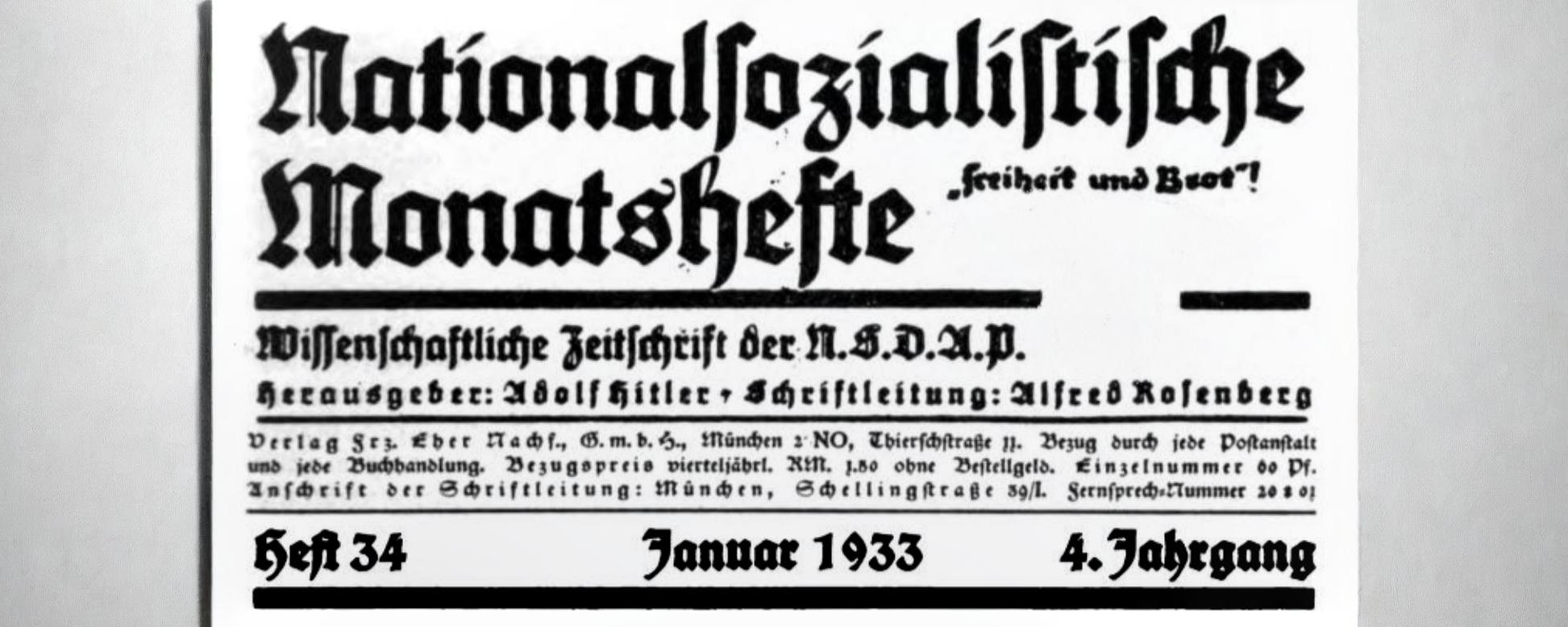
Nationalsozialistiche Monatshefte
Heft 34, Jahragang 4, Jan, Page 23.
Franz Eher Nachf Verlag München 1933.

A Final Word on the jewish Question (Part 1)

A Final Word on the jewish Question (Part 1)

Editor’s note: The text and image here were copied from an X post by Ahnenkrieger dated 21 March 2026.

Introduction

Recognizing that a national renewal of Germany after its spiritual and material collapse could only occur on an idealistic foundation, one corresponding to the inherent character of the German people and the nature innate to its rule, National Socialism was compelled from the outset to take a stand against all foreign influences.

If it wished to achieve a rebirth of Germany, it had to draw upon its eternally renewing racial and spiritual forces, help them to victory, and, as far as possible, suppress and eliminate all those foreign racial and spiritual influences that prevented or distorted the development of its own.

It was thus forced to nationalize the nation in order to save it, and in doing so encountered the resistance of those forces that were internationalizing the nation in order to corrupt it, consciously or unconsciously, for their own benefit.

National or international are the slogans to which all others recede; under which the fate of the German people will be decided.

With this, however, the conflict between the nation reawakened in National Socialism and Judaism is inevitable.

In Judaism—strange as it may sound—the most nationalistic people par excellence embodied all the internationalizing tendencies that constantly influenced other peoples, and especially the German people, both intellectually and materially.

Already in the French Revolution, which distorted a misunderstood and unhappy ideal of humanity into the equality of all human beings and contrasted its pacifist declarations of liberation with a bloody dictatorship at home, this influence gained dominance, only to increase in scope and significance with growing prosperity and the exploitation of all technological advances right up to the recent past.

On the one hand, under Jewish leadership, international interstate financial obligations grew into sprawling tangles and threatened to strangle national economies.

This process was supported by contemporaneous, yet unidentified, parallel phenomena within individual economies, in which Jewish-controlled or directed industrial and commercial behemoths grew, forming cartels or waging their competitive battles in disregard of national necessities or even in direct opposition to them.

On the other hand, an internal front formed under Jewish leadership, cutting across all national communities and fracturing them under the pretext of combating these parasitic phenomena.

While the battle cry that intoxicated the masses during the French Revolution was “Liberty, Equality, Fraternity,” which in practice manifested itself on the scaffold, the next stage, built upon the heretical doctrine of the Jew Marx Madochai, calls for “class rule” and the annihilation of everything native, organically conditioned, and naturally grown, for the sake of a shadowy constructed international community of interest of all those supposedly exploited by “capitalism in itself.”

Thus, through this intellectual falsification of real life, the German people, like every other, are threatened from two sides, both under an international slogan and Jewish leadership: by Jewish speculative capitalism and by Marxism.

The final victory, regardless of which side, means the complete downfall of Germany.

In the first case, through a slowly worsening decline that includes the final decay of all remaining healthy life forces and vital energies of the nation, which can be aided by artificial measures such as the export of slave labor, emigration, etc., while other, stronger peoples occupy the vacated space.

In the second case, through an unparalleled internal bloodbath that would mean the extermination of the most racially valuable elements, the creative, the inventive, the independent, those most German in character and essence, who could never submit to such a rule of alien delusions.

In both cases, Germany’s fate would be sealed.

It would be erased from the history of nations, and Judaism would then have experienced not its first, but certainly its greatest triumph.

In this sense, the struggle against Judaism meant an attack on the opposing central power.

Naturally, it could only be won after overcoming Jewish support, especially its protective wing, Marxism.

But to have immediately taken it up and proclaimed it as a programmatic point of its demands, without deviating from it despite unprecedented resistance from the enemy at the height of its power, is in itself an immense historical achievement of National Socialism, one that only later generations will fully appreciate.

The realization, already awakened in the broadest circles of the German people, that without the elimination of Judaism and overcoming its delusions there can be no recovery of the German people, no liberation from the rule of the inferior, no redemption from the phrase used as a cloak for anti-national aspirations, is already a consequence of this struggle for German rebirth.

Thus, the NSDAP program states:

“Only those of German blood, regardless of religious affiliation, can be citizens.

Therefore, no Jew can be a member of the German people.”

To which the next demand is added:

“Those who are not citizens should only be able to live in Germany as guests and must be subject to alien laws”

The Phenomenon of Judaism

The fundamental question for arriving at a critical analysis of the phenomenon of Judaism is extremely simple:

Does Judaism occupy a special position within the diverse peoples, or not?

All further questions depend on the answer to this one.

For if Judaism is different from all other peoples and tribes, then the further question arises: how is it to be evaluated?

What does such a distinct community signify in relation to other peoples, tribes, and associations?

With what similar phenomena in nature might it be compared, and how can the emergence of such a special group be explained in a natural and unforced way?

For Judaism did not fall from the sky.

Nor did it suddenly appear through a miracle, but rather arose in the course of a long racial-biological process, which is reflected, in part, in a distorted and falsified form in historical traditions.

Since its entry into history, Judaism has always claimed to be something quite special, sharply distinguished from all other ethnic communities: “the chosen people.”

It based its position on alleged divine revelations, subsequently laid down by its priests in scriptures declared holy for Judaism, from which it derived the right to a special calling and also to a special position.

Outwardly, it was a religious community, a congregation that claimed a priesthood in contrast to all other peoples, a community whose laws were divinely ordained, and in which it also inwardly anchored its national identity.

In short, it can be described as a priestly people, with a mission to other peoples defined as “divine” by its own priestly caste.

Nothing has contributed more to the obscuring and concealment of the Jewish phenomenon, and thus to the endless suffering of the European peoples in particular, than the fact that uncritical followers of a religious renewal linked to local events, but whose foundations reached back to the depths of prehistoric conditions, combined it with doctrines that were entirely contrary to it, and even partly traced it back to these.

This conflation of the precepts, solely related to Jewish necessities and compiled and summarized over centuries by priests, with a later doctrine of revelation that emerged in the collapsing antiquity, prevented the understanding of Judaism, to the detriment of the peoples among whom they settled.

Despite the ever-present natural instinct for resistance among the peoples, the Jews were still clothed in a false halo of reverence, a recourse to the later victorious doctrine of revelation, thus preventing the necessary measures against them.

While the Jews were considered former enemies of the new doctrine of salvation, which very quickly conquered the European world, perhaps partly through suffering and then by fire and sword, since it was based on ancient racial ideas, this led to occasional actions against them on confessional grounds, once the new doctrine had established its own priestly organization.

This organization obscured and distorted the true reasons and deeper causes more than it helped.

The Jewish question was thus put on the wrong track and repeatedly ran itself into a tailspin, to the advantage of Judaism, since the ruling Church in the West claimed the same rights for itself as divine revelation and, in part, referred to Judaism to enforce them.

Judaism, in turn, asserted these rights for itself, so that ultimately the common ground bridged the confessional differences.

This also temporarily suppressed those differences that arose from the different lifestyles of the host peoples and their Jewish guests, which were the actual, though not clearly understood, causes of the ever-present aversion.

They needed only a trigger to erupt into open hostility.

Therefore, an unprejudiced examination of the Jewish phenomenon will disregard denominational differences entirely, focusing solely on the interactions between Judaism and other nations over the longest possible period, extending into recent times, in order to draw its conclusions.

Should it then turn out that, over a long period, the same events repeatedly occur with an almost frightening uniformity among the most diverse peoples, the cause is likely not to be found in the profound wickedness of the non-Jewish peoples, which Judaism has attributed to them with rare unanimity throughout the centuries, but rather in Judaism itself.

And these are the very facts whose revelation and evaluation Judaism so fears.

However, one crucial point must be emphasized here: Jewish religious laws are simultaneously the lifeblood of his people.

It was not the law that made the Jew, but rather the Jew who, over the course of a long period of development, created the law, even as these laws later exerted a formative influence on the salvation of Jewish generations.

This constitutes a unique fusion within Judaism.

And insofar as these laws seek to establish the lifeblood of Judaism in a fixed and enduring way, they belong within the scope of these considerations because they contain the key to an epistemological solution to the Jewish question.

More generally, it can be said that an objective investigation of the Jewish problem encounters not so much the actual difficulties of the historical and racial-biological process perceptible to all, but rather the resistance of prejudices carried through the centuries and gradually cherished, thereby shaking the foundations of institutions that, partly built upon these prejudices, persist into the present like living fossils.

Historical Overview

Palestine

A schoolmasterly tradition still popular today portrays Palestine around the first year of our era as a land inhabited and cultivated by Jews.

This is one of the erroneous views that prevents a clarification of the Jewish question.

The Jews in Palestine have never been anything other than a minority, more or less indistinguishable within the tribal and ethnic mix of Palestine.

According to their inherited traits, which still define them today, they were city dwellers in which they formed the ruling class, perhaps not even numerically superior.

At their head at that time was a priesthood that derived its income from temple services and, apart from a very extensive participation in community administration, engaged in all kinds of trade, or rather, financial transactions, for which it used the temple income.

The synagogue then replaced the stock exchange and the banns.

It was a closed market where Judaism, with the participation of the synagogue administration, conducted its business as the dominant group.

This state of the land, based on earlier beginnings, had developed since the renewal of the covenant with Yahweh (Yaho, Yahu) by Ezra and Nehemiah and continued despite the changing overlordships of the Babylonians, Persians, Macedonians, and the later Diadochi, until the Romans finally put an end to this priestly and temple rule, which by that time had already become a financial world power.

With the proclamation of the Law by Ezra, we can truly establish the entry of the Jews into world history as a population group, as it becomes known from the later course of its destiny, even though their formation extends far back into prehistory.

However, the proclamation of this new covenant with Persian approval, the recognition of which the population of the land was forcibly compelled to accept, did not yet transform the inhabitants of Palestine and the surrounding territories into Jews.

They remained what they were: farmers, cattle breeders, mountain hunters, and nomadic hordes in that motley mix of cultures, a mix that history had created through continuous conquests.

This class was grouped around the priesthood, which itself had emerged from this class: the Jews.

Even then, in 480 BCE, they were a force, the capitalists of the past, who, based on their predispositions developed over a long biological process, now imposed the laws of their social origins on the entire population.

Palestine has never been a remote landscape of tranquil serenity and steady development, but for millennia a transit, battleground, and settlement area for the most diverse human tribes, who fought, defeated, and intermingled there during their migrations.

Until the last great Arab migrations to Palestine, which alternated with waves of conquest from the north until the later Mongol invasions, there can never be any talk of a homogenous population by European standards.

A mere enumeration of the peoples who have touched Palestine in historical times would exceed the scope of this treatise.

From the dolmen builders, who streamed across Palestine from the west or northwest on their prehistoric conquests reaching as far as Malacca, to the Gauls, almost all European peoples left their mark on Palestine and contributed to a constant racial chaos through mixing with a population that was perhaps initially more Negro, later replaced by one of a more Oriental Near Eastern composition.

The land may have been ruled by a perpetual unrest since ancient times.

In the more inaccessible mountain regions, the displaced so-called indigenous people may have continued to lead their distinct lives for a long time, until gradually the blood of the victorious stragglers permeated their ranks and they underwent a slow racial-biological transformation.

In the more open plains bordering the deserts, nomadic peoples may have long waged wars among themselves over the best grazing lands, often joining forces to raid each other’s settlements.

And across this diverse, fragmented population of farmers, divided into small groups, tribes, and peoples, seemingly in perpetual turmoil, the most varied waves of conflict from the most diverse peoples from west, north, east, and south frequently swept through, bringing with them a constantly shifting and ever-changing rule, strongly divided according to landscape and local conditions.

In historical times, Palestine also became the stage for the power struggles waged between the emerging world powers in the Euphrates and Tigris plains to the east and its southern neighbor, Egypt.

Furthermore, with the increasing population density, bartering took on ever greater scope.

Trade in the Near East was already flourishing at that time, and the exchange of goods along the caravan routes, which had been common until recently, continued for extended periods through Palestine.

The transition from the arduous barter system to a monetary system, which perhaps originated in Sumeria, must also be considered, as Babylon already exhibited a highly developed system of money and lending.

All these circumstances favored, over a long period, the emergence of a class that ruthlessly exploited the advantages of such lawless places in individual fortified or difficult-to-access locations, and which was closely connected with the priestly class, who also engaged in money and trade transactions.

While general insecurity was the prevailing state of affairs, robbery, murder, and their associated vices flourished, and the most violent and warlike among the perpetually feuding groups, lands, and tribes exterminated one another, this class, which had risen to prominence through the ruthless pursuit of its personal advantage, flourished and multiplied, defying occasional setbacks.

Unnoticed by the ruling powers, it became the true ruler of the land through material power acquired by all manner of cunning and trickery.

It is in this social elite, disappearing into the mists of history, of a land constantly shaken by unrest, that the so-called Jewish ancestors are to be sought, their numbers growing through the continuous influx of those endowed with similar traits into this mixed-race mix.

And only after this state had occurred did this race lay down in its collections of laws the norms of action valid for it, which were also the conditions for its own emergence, thus consolidating the formative influence on later generations.

The Jewish scholar Ullmann aptly called the Jews an “urban race” which, it must be added, came into being under special, unique circumstances in the course of a long historical development.

The Jews have remained an “urban race” to this day, in contrast to which the attempts at transplantation to the countryside or to other races and peoples undertaken in later historical times in various countries, in comparison to corresponding living conditions, invariably ended in complete failure.

It is therefore inaccurate to attribute the formation of Judaism solely to specific human tribes, peoples, or races, and to disregard the particular structure of the prevailing conditions in the process of Judaism’s emergence.

These conditions also exerted their influence precisely in the process of selection, even in prehistoric times, which led to the appearance of that “Jewish phenomenon” as it gradually emerges in historical times and then becomes ever more clearly distinguishable from all other phenomena.

The Israelites

A reprehensible backwardness, even today, despite better knowledge, traces the Jews back to the Israelites, whose descendants they claim to be.

This refers to the alleged twelve tribes of Israel, grouped together in the so-called “Old Testament,” who, as latecomers to the first large wave from the East and South, known as the Hebrew-Canaanite, partially conquered Palestine over the course of centuries, mixed with the Israelite population, and disappeared in the racial chaos of Western Asia and especially Palestine, leaving no further trace.

An approximate, though later revised many times and increasingly aligned with the Jewish promise, picture of this conquest is given by the “time of the Judges” in the so-called Old Testament.

The entire incursion of these desert tribes appears as a chaos of mass murders, raids, and battles of all against all, for there is no mention of any cohesion among these individuals, each nomadic horde acting independently.

This process may have spanned several hundred years, during which the then very loose Egyptian rule was increasingly shaken and finally dissolved.

The name “Israel” appears for the first and only time in an Egyptian inscription around 1230 BC, a quarter of a millennium later.

Following the defensive battles against the Philistines, who were advancing impetuously from the west and probably arrived from Crete, a gradual unification of these individual tribal kingdoms took place, accompanied by a slow merging with the existing population.

Then came the founding of two kingdoms, known to this day, erroneously as Jewish history: in the north by the extremely legendary tribal leader Saul, and in the south by the no less legendary David.

Both kingdoms eked out a meager, yet all the more mythically enigmatic existence until their demise, an existence whose deceptive veneer even deceit, betrayal, murder, and mayhem could not dispel.

The Israelites, advancing from the desert regions, were always merely a superimposed, intermediary people within the Palestinian racial chaos, systematically inserting themselves among the defeated older population.

And they, like other peoples, were erased from history through unrestrained intermingling with the motley human mass of this racial chaos.

There can be no question of equating the Israelites, who briefly emerged in the mass grave of Palestine, with their tribal chiefs, leaders, and warriors, with the Jews.

This falsification of history, facilitated by the plagiarism of a term and reinforced by a disastrous connection with a doctrine of salvation that arose later in that racial chaos, is just as disastrous as the experiences of so-called Jewish “patriarchs” that are still presented as true events today.

Perhaps these accounts contain the later personalized and often revised narratives of the migrations and fates of individual nomadic tribes, adapted to Jewish narratives.

They are revealing and interesting solely because of this Jewish reworking, in which the innate characteristics of Judaism gradually found their increasingly concise expression.

The same could be said of the alleged sojourn of the Jewish people in Egypt and their miraculous rescue from this enslavement.

While these accounts are also based on historical events of a different nature, such as the invasion and expulsion of the Hyksos from Egypt, they too have nothing to do with Judaism.

The Jewish people, whose name derives from a highly dubious desert tribe distinguished by no particular characteristics, had at that time entered history no more than the German people.

However, they were likely already slumbering within those strata and circles of the urban population who, in close collusion with a pre-existing priesthood belonging to it, had become a scourge of the land through their ruthlessly acquired financial power.

Ezekiel, among countless other pronouncements scattered throughout the Jewish religious texts, already aptly describes this:

“They expose the shame of fathers and oppress women in their sickness.

And they commit abominations with their friends’ wives, they defile their own daughters-in-law with fornication, they abuse their own sisters, their father’s daughters.

They accept bribes to shed blood.

They practice usury, and they swindle one another, and they are greedy against their neighbors and they do violence to one another, and forget me, so spoke Lord Jehovah.”

Judaism

Through the establishment of the new covenant with Yahweh under Ezra and Nehemiah in Jerusalem (based on the Priestly Code written 180 years earlier), the Jews rose for the first time to become the dominant powers in the land, even outwardly.

Characteristic of this event is that it represents the first known instance of Old Religious intolerance in history, something that has been conveniently ignored until now.

The merchant-priesthood forced the acceptance of the statutes in the land, which had been transformed according to their principles over a longer period of development.

Thus, the various racially diverse segments of the mixed-race population became adherents of their doctrine, just as Christian missions in Africa led to the conversion of Black people to Christianity, without thereby classifying them as English or German based on their ethnicity.

Judaism also engaged in very zealous missionary work during the first centuries of its historical existence, which explains the numerous conversions of all sorts of Arab tribes, even deep into the Sahara, as well as likely various Ethiopian-Black peoples who, in their migrations, reached far into Africa, e.g., Abyssinia.

However, this adoption of the Mosaic faith by no means justifies classifying it as Jewish, as is still done today.

For centuries, those who converted to Judaism were not considered full Jews by the Jewish people, but rather “proselytes of the Gate,” destined to be exploited for the benefit of the chosen people.

They were the ones who led the so-called Jewish uprisings and conflicts in the land, with the Jews then, as now, remaining the puppet masters behind the scenes, supporting them, at most, with their financial power, depending on the circumstances.

In these ongoing wars and uprisings, which, under Roman rule, extended far into Asia Minor, Egypt, and Cyrenaica, most of these proselytes perished; others abandoned the Jewish faith, and only a small group, perhaps inherently Jewish themselves, may have assimilated into it, apart from the nomadic tribes who remained untouched by the events of the world at that time and retained their Mosaic beliefs.

With the disappearance of those who adhered to Jewish doctrine but did not belong to the Jewish people, the “warlike” characteristics to which modern Judaism still likes to point also vanished.

This transformation is so distinctive that it should have long since attracted the attention of unbiased observers, were it not for the still-prevalent prejudice that prevented the evaluation of these characteristics.

Never again will Judaism resort to the sword!

Not even in the most superior positions of power, despite its great numerical strength, will Judaism unanimously resort to violent resolutions of the conflicts created by its actions.

Its weapon for the future remains solely money.

The most blatant example of this is the expulsion of the Jews from Spain under Ferdinand and Isabella.

Thus, when addressing the Jewish question, a clear distinction must be made between ethnicity and religious denomination.

The neglect of this fact has severely damaged the investigation and led to generalizations and conclusions that do not correspond to the facts.

From the Jewish perspective, a process of homogenization has always occurred, consciously or unconsciously, either to prove or to deny the racial unity of Judaism.

In the first case, this served to reinforce the awareness of distinctiveness within Judaism, as in Zollschan’s work (The Race Problem); in the second, it served as a defense against increasingly harsh attacks from non-Jewish quarters, as in Fishberg’s work (The Racial Characteristics of the Jews) or Feist’s work (Tribal Studies of the Jews).

Jewish Migration

The more Judaism crystallized from the population, especially after the emergence of Ezra, but also earlier, thanks to the special opportunities and circumstances that favored its development, and the more its numbers grew, the more its representatives hindered each other in Palestine.

It began to disperse eastward and westward, to the places its forerunners—those very priestly-merchant classes—had migrated long before the Babylonians destroyed Jerusalem, and where, in the centers of consumption in the ancient world, the density of the different population offered its potential the greatest and freest scope.

In contrast to all the world’s peoples, especially the agricultural and conquering peoples like the Germanic tribes, but also in contrast to the cattle-herding and raiding nomads and Mongols, who nevertheless aimed at the violent domination of landscapes, the “urban race” migrated alone to the most desolate piles of stones.

The facts presented here are also confirmed, albeit unintentionally, by Jewish researchers.

For example, Karo (in his work on the social and economic history of the Jews) remarks on the expulsion of the Jews from England:

“Although the expulsion reduced the danger of excessively strong mutual confrontations, this explains why a cluster of small Jewish communities spanned the country. No economic factors caused the dispersal of the Jews in England.”

These observations were not only relevant to England, but also to the distribution of Jews throughout the world.

Judaism gradually spread to the major cities of Syria, Egypt, all of Asia Minor, Greece, etc., where it formed established colonies.

These individual urban settlements maintained constant and lively contact with one another and with Palestine, from where a continuous influx of Jews flowed, representing a voluntary mass migration.

These individual colonies sent out scouts who reported on the suitability of the newly entered territories for Jewish activity, whereupon the colonies advanced further, forming new ones, until the ring around the Aegean and Black Seas was closed centuries before our era.

According to the Jewish scholar Herzfeld in his work, TheTrading History of the Jews of Antiquity:

“Thus it came about that after a few centuries, and entirely without any apparent external coercion, the Jews were settled in all regions from Media to Rome, from Pontus to the Persian Gulf.”

The myth, therefore, that the Jews were “driven to Europe” or that they were “scattered throughout the world by the destruction of Jerusalem” is one of the many, but very telling, lies with which Jewish history has been falsified.

The Jews were nowhere forced into their migrations.

Without any apparent external coercion, they voluntarily migrated, based on accurate reports from their emissaries, to those regions that seemed most suitable for their particular activities.

Once one region was exhausted, they turned to the next, like a gigantic Octopus with tentacles, whose head had resided for a time in Jerusalem, in perpetual motion.

Jewish Life

If, in the course of the most varied transformations of history, the same fundamentally fixed scenario repeats itself among all peoples and at the most varied times—that those initially favored arouse the aversion and disgust of the local population, and that the laws initially enacted for their benefit or protection are changed into those for their defense or to protect the population from their activity—then the reasons are to be found within Judaism itself and not in external circumstances.

It is truly time for the myth to disappear: that Jews were forced into the money lending business during the European Middle Ages – essentially only since the Crusades – because all other professions were closed to them.

One of the most pro-Jewish scholars, Sombart, who had subjected the Jews influence on economic history to a particularly thorough investigation, writes the following:

“The two-thousand-year history of Jewish loan transactions up to the Middle Ages clearly demonstrates the error of this historical construction.”

This observation should be supplemented by the fact that, since their inception, Jews have been almost exclusively involved in money and exchange transactions.

We call it usury by its proper name, which is further complemented by a fraud that is as commonplace as it is widespread.

Lugen Dübring already drew attention to this fact with the following remarks:

“The one-sidedness of abstract economic theory, which almost always assumes only a normal course of events, neglects the enormous influence of fraud in its general economic structure.

Economic distribution is also shaped, so to speak, by the natural processes of deception, that is, by the methods employed by all the corrupt, whether personal or material, means and powers of appropriation.

Conquest in the political sphere corresponds to swindling, cunning, and predatory machinations in the economic sphere.

In this area, the Hebrews have always distinguished themselves throughout world history, and what I, as mentioned, have understood—in an overly respectable, not to say refined, way of speaking—by the name of racial economy, was and is essentially nothing more than a system of commercial lies and deception.

But it goes without saying that it is not the commercial function or the power of capital per se that brings about such a high degree of fraud and usurious economic exploitation as the Hebrews have achieved at all times and in all places.

Function merely provides the opportunity; but it is the personal racial disposition that first imprints the thieving and robbery-like character on the actions.”

It would be even more timely for the old wives’ tale, still circulated today, to disappear, that Jews were both farmers and cattle breeders in bygone eras.

This, too, is a historical construct long since refuted by the facts.

The “urban race,” which only populated the stone cities of antiquity and the present for these very specific reasons of earning a living, could never have sustained itself directly from a landscape like all other peoples, but solely through the exploitation of its fellow human beings.

This is the crucial difference from all other races, peoples, and tribes.

This predisposition compelled them, without any apparent external coercion, to constant, sometimes faster, sometimes slower, migration, comparable to nomads, but of an urban nature.

These nomads did not secure the temporary exploitation of certain landscapes through violent raids, but rather acquired the goods of their host peoples through cunning, treachery, and fraud.

The Jewish historian Rayserling, asserts in his literary work, The Jews in Spain and Navarre:

“Since the earliest times, Jews have engaged in money lending and exchange transactions, which anti-Jewish chroniclers label usury.”

Another Jewish historian, Georg Caro notes:

“From the very beginning, Jews in England engaged in money lending.”

Then adds, as the first quoted author does:

“Usury found its sustenance in people’s needs.”

The most devastating observation ever made by a Jewish historian and rabbi.

And finally, Rayserling added to his remarks:

“The interest charged by Jews, we will not deny it, seems to have reached an excessive level.

Everything was given as collateral: the farmer gave his plow, the knight his castle, the kings their jewels, the bishop his fine ring.”

The Tribal Historical Records

A) Until the French Revolution.

Another error, deliberately maintained by Jewry as a whole, must be corrected: the ghetto was not created by the population residing in the respective country, but by the Jews themselves.

In order not to associate with the rest of humanity, whom Judaism considered created solely for its “service” and proper exploitation, it separated itself in humble contempt.

It created the ghetto itself, with its own administration based on Jewish doctrines, which we still find in the Kahal, the Jewish community administrations in former Russia.

Only much later, in the so-called late Middle Ages, when the various host peoples had sufficient opportunity to study the peculiar economic practices of their host colonies more closely from their own experience, did the forced ghetto arise!

Nor was this intended as a form of violent punishment of the unwanted intruders, but rather the institution was established to protect them from the outrage of the population, often driven to white-hot fury by Jewish usury.

The interactions between the Jews and their host nations, quite independently of the time, general conditions, and intellectual climate, followed a course that, with only minor variations, was universally repeated until the French Revolution and could be described as follows:

1. Based on certain reports from their emissaries, the Jews immigrate to a country or are found already there by a victorious advancing tribe.

The people meet the Jews with a certain curiosity or take an interest in their appearance, but otherwise remain quite indifferent.

2. This period of tolerance, in which the Jewish colonies, isolated in their ghetto, maintained their customs and traditions undisturbed and prevented any interference in their affairs, very soon gave way to a period of favoritism, not, of course, on the part of the resident population, who had already found some disreputable aspects in the activities of their guests, but on the part of those in power.

Slowly, the undignified game developed between the ever-soaked Jewish sponge and the princely hand, constantly wringing it out anew, on the rust of their own people.

Regarding the activities of the Jews, for example, in Spain, the pro-Jewish scholar C. S. Hemann explains in his work, The Historical World Position of the Jews, the following:

“There is absolutely no reason to accuse the Christians of having been envious of the Jews beforehand, or of having wanted to oppress them because of their religion.

On the contrary, the Christians had cause to rebel against these excessive favoritism.

There, the country’s movable wealth lay entirely in their hands; land ownership increasingly fell into their hands through usury and the purchase of indebted properties.

From the Secretary of State and the Minister of Finance onward, all officials dealing with taxes and monetary matters were Jews.

Through usury, almost all of Aragon was mortgaged to them.

In the cities, they constituted the majority of the wealthy population.”

3. The indifference of the local population, faced with the increasingly rampant and unrestrained exploitation by the Jews, who had already attained a position of far greater legal privilege, turned into open hatred.

In some countries, Jews were exempt from arrest for financial matters.

They were also exempt from all taxes levied on goods.

Furthermore, they were not required to pay a tenth of any inheritance tax.

If a Jew owed a Christian something, the Christian had to provide two witnesses, one of whom had to be a Jew.

That such a procedure was hopeless for the Christian hardly needs further explanation.

In Germany, for example, it was sufficient for a Jew to state that he had honestly acquired a stolen item found in his possession.

The rightful owner was then forced to pay the price the Jew claimed to have paid when reclaiming his property.

The opportunities for enrichment these regulations afforded Jews in their widespread pawnbroking business hardly need further elaboration, especially since receiving stolen goods was also part of their trade.

This often led to isolated acts of persecution and violence, frequently for minor religious or other reasons.

4. This unsystematic and locally limited self-help effort by the population, defenseless against the immigrant “Egyptian plague!”, failed.

Under the protection of their ecclesiastical or princely patrons, the Jews returned, endowed with new and even greater privileges, driven by the desire to recoup their losses and make further profits.

Regarding a rescinded expulsion order by the French king, the Jewish historian Johst writes:

“Neither side made explanations, attempts to salvage their honor, or promises; both sides were avaricious and both reached a settlement, each intending to deceive the other: the Jews wanted to recoup their losses through usury, the king hoped to replenish his treasury through them.”

5. The actions of the Jews eventually sparked a widespread, dull resentment among the local population throughout the land, who have been more or less dispossessed by the Jewish machinations in their own country.

Even the princes are no longer able to resist the growing unrest.

Yielding to the justified demand for self-defense and tempted by the rich plunder that awaits them, they decide on the general expulsion of the Jews.

This schematic representation of the interrelationships applies to Spain, Portugal, France, and England.

As is well known, the Jews were expelled from Spain in 1492.

Despite their numerical strength, they did not resort to arms when their means of persuasion and bribery failed.

Incidentally, a rampant misconception, the propagation of which is of paramount importance to Judaism, can be refuted here: the assertion that the decline of Spain began with the expulsion of the Jews.

Quite the opposite is true.

In 1492, with Columbus’s discovery of America, Spain’s rise to world power began.

Entirely different factors contributed to the decline that began under Philip II, factors that deprived Spain of its best men and simultaneously drained it of a bloodstream it could no longer replace.

The Jews had to leave France permanently under Philip V, but the neighboring duchies of Burgundy, Flanders, and Brabant took them in, from where they very soon began to stream back.

Edward V of England expelled them from England in 1290, which they were only allowed to enter publicly again under Cromwell, whom they supported with sums of money, although there may not have been a lack of secret Jews in England in the interim….

However, they had not played the highly significant role of the Marranos in Spain, which was still evident in the recent revolution of 1931.

The perilous conflation of the religious ideas of the Bible-believing and literalist Puritans with the concept of the “chosen people” was sufficient to allow their descendants back into the country for ethical reasons, to the detriment of the English host nation.

In Germany, the situation was unfortunately less favorable, or more favorable for the Jews, as a result of the fragmentation that had occurred.

If they were expelled from a free imperial city, for example, the neighboring principality might readily welcome them.

Although they suffered losses in some parts of the country, they more than compensated for them in others.

The most remarkable thing about all this remains that, despite the hatred now directed towards them, despite the contempt they had fallen into, despite threats, despite isolated acts of violence, the Jews never and nowhere even attempted to leave a country voluntarily.

The uninvited, uncalled, and unwanted guest colonies clung to the economic fabric of their host peoples with all their wiles, like mistletoe to an oak tree, from which they could only be separated by the application of bare force.

For Judaism always knew that separation from its host peoples meant its downfall, since it could not, like other peoples, establish itself in one landscape alone, be it the Palestinian one or any other.

However, Judaism used these defensive measures taken by exploited populations of diverse racial compositions and regions to launch a loud outcry about alleged “persecutions of Jews” and, by concealing or distorting the true causes, to circulate and perpetuate the myth of the “poor and oppressed children of Israel.”

They cleverly linked this to their narratives of the destruction of Jerusalem by the Romans, who, in their view, had only destroyed the land through a draining Jewish priestly oligarchy that, through its financial power, had waged a bitter, underground war against the Roman Empire.

In an effort to conceal the very clear interrelationships between the Jews and their host nations, Judaism continually appealed to the world’s sympathy in order to create a favorable internal attitude and to be able to plunder humanity all the more brazenly and persistently.

However, when Judaism seemed to have secured its position sufficiently, when, thanks to its hard-won financial power and positions obtained through deception, it no longer needed to look back, then it cast off the mask of the innocently persecuted in order to reveal its true features in a feeling of security.

B) After the French Revolution.

Until the French Revolution, the activity of the Jews within their individual host nations is still relatively easy to trace.

Spatially separated from their host nation, they attempt to exploit it in every possible way through usury and exploitation, money exchange transactions, and fraudulent schemes under the protection of inadequate laws.

Like swarms of locusts, to use Napoleon’s words, they dwell in the regions they ravage, only to migrate to other areas when their productivity diminishes too much.

The statistics of Jewish migration are very revealing in this regard.

When their scouts discovered a new El Dorado, their fellow Jews flocked there, striving for a “Jewish focus on the center,” that is, they primarily sought to “conquer” the economic and political centers of the country in question.

There, with the help of their acquired “booty,” they were very soon able to exert a decisive influence on the most important institutions and individuals, to thwart measures or prepare them in their own favor that would further their effectiveness, without this influence being outwardly noticeable in any way.

For these reasons, one cannot simply rely on the numerical ratio of Jews to the rest of the population, as Judaism always deliberately employs to obscure these facts.

For 300,000 Jews in a “preeminent position” in the capital of a country, who “controlled” the economic life of their host nation, were and are capable of influencing the fate of that country more significantly than the remaining 29 million scattered inhabitants, especially after democratization had granted money its absolute power.

The intellectual influence exerted by the Jews should not be underestimated, as it manifested itself in a profound transformation of the moral, legal, and economic understanding of their host peoples.

Just as Mommsen rightly described the Jews in his youth as a “ferment of decomposition,” so too did an uninterrupted stream of change flow from them into all areas of the life of their host peoples.

The rigid social structures of their host peoples hinder the Jews in their activities, which is why they appear as destroyers of all organic boundaries.

The homogenization found its forerunners in them, for the larger a general, unstructured quagmire, the more advantageous it is for them.

How deeply this influence has affected, for example, in the area of ​​livelihood, is readily admitted even by a scholar as sympathetic to Jews as Sombart.

According to him, today’s “economic mindset” can be largely attributed to “Jewish influence,” which he himself understands as an unbridled, unlimited pursuit of profit, and which, besides direct fraud, manifested itself:

“Not in apparently legitimate criminal acts, but in practices that were not entirely clean.”

(The Jews and Economic Life).

Gradually, the entire social life of the host nations came under decisive Jewish influence.

There was no area where they did not rule, where they did not prescribe, or at least attempt to prescribe, the laws of action and thought; beginning with fashion, through intellectual and artistic creation, ending with political leadership and social structure.

They were the masters of the land.

They felt themselves to be so and looked down with contempt on the “natives” who, in their own territory, had been dispossessed by Jewish machinations cloaked in a veneer of law.

If the waning liberal era, and especially the 19th century, deserves a name that has so far been sought in vain, then it can rightfully be called “the Jewish century.”

For never before has the world been so clearly under Jewish rule, albeit still disguised outwardly, as at the beginning of the 20th century.

With a system of social security imposed on the nations, based on the progressive disintegration of the individual European economies, and supported by banks in Jewish hands or under their control, and by corporations dependent on them, they steered the “satisfaction” of their host nations’ needs in the directions that suited them.

Naturally, not to their detriment.

They shaped “public opinion” through their press publications, and they controlled the country’s government through the parliamentary parties they controlled.

There was no institution in public life in which Jews were not represented, or which they did not influence through numerous invisible channels.

No major event was without Jewish forces driving it in one way or another, exploiting every change to their advantage.

In 1910, Moritz Goldstein wrote:

“Jews suddenly occupy all positions from which they are not forcibly removed.

It increasingly appears as if German cultural life is to pass into Jewish hands…

We Jews administer the intellectual property of a people who deny us the right and the ability to do so…

No one seriously doubts the power that Jews possess in the press.

The predominance of the Jewish element in the theater is equally well known.”

The Jew Münzer openly confessed:

“The world was Judaized, we burrowed into the peoples, infiltrated the races, defiled them, broke their power, made everything brittle and rotten…

In fact, everything is Judaized today, our spirit can no longer be eradicated.”

But that was not enough for Judaism.

According to their teachings and “promises,” they strove even further for ultimate supremacy.

The Great War, as one of their most important leaders, Nordaus Südfeld, admitted, was only a “rung” on this ladder.

The goal was to eliminate, through the global conflagration to which they had decisively contributed, albeit mostly behind the scenes, the national governments that still resisted them, and, if possible, to shatter the monarchical systems of government that had emerged from historical development and replace them with even more compliant ones.

The Jews called this “democratization.”

Prince Lichnowsky, the former German ambassador who, unfortunately, was not held accountable for high treason at the time, during the war stated the following:

“The most important enemy war aim, the democratization of Germany, will be realized…

For we will not displace the sons of Jehovah.”

The Jewish plan seemed to be working. In the east, imperial Russia, which they hated, collapsed under the onslaught of the German armies.

And from its ruins rose the blood-red flag of Bolshevism, joyfully welcomed by world Jewry.

The bloodiest reign of terror, intended for all nations under Jewish leadership, had been fulfilled in one country.

Then the German homeland succumbed to the relentless maneuvers of subversion.

“We will not bring back the state that existed,” rejoiced the Jewish “Frankfurter Zeitung” gleefully.

“The powers that hollowed it out from within have done thorough and, by all accounts, lasting work,” ranted the Jewish press chorus.

But this joy came somewhat prematurely!

In the escalation of subtle attempts to exploit the German people, their resistance awoke.

Primal forces were reawakened, striving for a new form of expression corresponding to their nature.

The goal of Judaism, “to destroy a strong, organically intolerable form of life in the non-Jewish world,” as the Jew Blumenfeld still dared to proclaim in Berlin in 1920, is further from victory over those forces than ever before.

At least in Germany, which knows its enemy and understands that failing to wage this struggle, despite other possible successes, would mean complete suicide.

Even in the time of Louis XIV, the Jews in France had gained a dangerous influence at court as suppliers to the army, tax farmers, and collectors.

They stood behind all those secret conspiracies of Freemasonry and humanitarian brotherhoods, from whose bosom the slogans of “equality, liberty, fraternity” spring.

It is not without reason that these purely pacifist clans, working towards “world brotherhood,” took and still take their Kabbalistic customs from synagogue worship.

Since then, Judaism has penetrated ever deeper into Freemasonry in all countries and has almost completely taken control of it as a means of its own Jewish resistance against the great world conflagration, for the ignition of which Freemasonry gave the decisive impetus through the assassination of the Austrian heir to the throne, Franz Ferdinand.

If one disregards all the empty slogans of the French Revolution, then its decisive poisoned chalice remains the dismantling of the ghetto, or the so-called “emancipation of the Jews.”

From then on, all doors and gates were open to them, and only then did the true rise of Judaism begin, its growing plunder increasingly facilitating the expansion of its power.

It is not without reason that Judaism itself has stated that “the revolution is the Star of Judah.”

For Judaism, this has always been about the removal of historically established barriers, corresponding to the nature of its host peoples, which hindered its activities.

As a means of concealing their plans, they put forward those excesses and degenerations of social forms that oppressed the host people themselves, whereby their aspirations met with loud opposition.

Without a doubt, regeneration is necessary in the social life of all peoples when forms become rigid and no longer meet the new demands of life.

This was also the case in France before the French Revolution, where a corrupt aristocratic class intended to lead a life of leisure on the backs of all the industrious strata of society for all eternity.

The nobility had then relinquished its leadership, and nothing was more justified than for it to disappear from a position it could no longer fill.

But this healthy movement was led astray by the involvement of the Jews and brought about conditions that were even more unhealthy than the previous ones.

Essentially, the so-called “emancipation of the Jews” brought about by the French Revolution had merely changed the masters for the people: instead of old, incompetent aristocratic families, Jewish bankers seized power; instead of personal ties, change began to rule the world.

A failing aristocratic rule lost its power to the bearers of money, the Jews, who amassed it through a thousand tricks and schemes.

The intellectual-historical records

Jewish law

Considering the historical course, the interrelationships between Judaism and its host peoples are clarified quite unequivocally.

This explains the thesis, always so emphatically defended by the Jews, of their unique position in relation to their human environment, even though their “chosenness” and separation are likely to be viewed in a way diametrically opposed to their own.

The question now arises whether the activities of the Jewish community, recorded in faded parchments and yellowed manuscripts, might not receive further confirmation and affirmation from the intellectual works produced by Judaism itself, insofar as they reveal the Jewish people’s worldview and unveil its carefully cultivated characteristics.

Such an attempt encounters the same difficulties as the unraveling of Jewish history.

This history is lost in the quagmire of ongoing racial chaos in Palestine, the brother nation connecting Europe, Asia, and Africa.

Instead of Jewish ancestors from whom Judaism could be directly derived, as has been practiced to everyone’s detriment without ever truly interpreting the phenomenon of Judaism, an overwhelming diversity of human communities appears, changing with kaleidoscopic speed.

Conquerors emerge from the north, south, west, and east.

Tribes and peoples of the most varied racial backgrounds are layered upon one another, intermingling, sinking into the ever-changing racial mush, and disappearing ignominiously from the annals of the past, like the alleged ten tribes of Israel in Assyria.

At the same time, powerful, now-prosperous neighboring states eagerly set their sights on the transit land filled with unruly people, influencing the lifestyle and way of life of those currently ruling and subjugated through their customs and traditions, spreading their legends and myths, and proclaiming their messages of power that signify less of an ascent than a decline.

Meanwhile, with the increasing population density, trade and transport expanded enormously, making this difficult-to-access but essential transit country the obvious hub for all trade at that time.

Culturally, Palestine, as is now generally accepted, may have been ruled for millennia by the Babylonians, who in turn were influenced by the Sumerians, whose traces are scattered in the Persian Gulf.

Cultural and intellectual connections exist to the vanished Amur Empire, much more easily to the Elamite kingdoms and to Egypt, and via North Africa, the Mediterranean countries and islands, to the Atlantic armies of Europe, which were still on the verge of dissolution.

As has always been the case, the latest research into these obscure, millennia-spanning connections raises more questions than any supposed academic wisdom could ever imagine.

In light of our broadened perspective on the past and the resulting altered first-hand assessment of the traditions of those times that have come down to us, the violent efforts of anxiously clinging to a supposed history of Judaism are more than ridiculous.

They would have failed long ago if the unfortunate association with ideological tenets had not protected them from exposure for an unduly long time.

To portray the Jews as direct descendants of a fragmentary desert tribe, from which they may have borrowed their name, or even to refer to them as descendants of the inhabitants of a “Jewish kingdom” that, according to popular belief, never existed in history, is just as inaccurate as presenting the so-called Old Testament as a chronicle of the creation of the world and the fate of the Jewish people.

Biblical scholarship, on the one hand, and historical and cultural studies, on the other, have long since reached the agreement that all the events recounted in the Old Testament are borrowed material from other peoples and go back to sources whose age and origins are still not fully agreed upon by scholars.

Historical events, as passed down and embellished by the oral traditions of various peoples, have been indiscriminately combined with the deeper myths and doctrines of spiritually significant cultures, only to be reconciled through multiple revisions and references to the social context that has since emerged in history.

The books of Moses, presented as the oldest tradition, are partly of recent origin; the Psalms of Solomon date back almost to the first year of our era; other parts contain insertions or reveal rearrangements from later times, which can only be explained by the necessity of these frequent revisions.

In doing so, the authors also engage in blatant falsifications, reinterpreting the social struggles that had been taking place within the population over a long period of time, and the population’s rebellion against a ruthless social elite prone to inbreeding for material reasons—a struggle that ended with the latter’s victory—as supposed “divine promises” bestowed upon this emerging elite.

They further connected the many aspirations directed against them, which perhaps swelled to particular intensity in certain periods and regions and were led by specific men, with these very “promises,” thus creating a fabric that placed the meaning of the world’s creation in the emergence of the priestly “chosen people.”

The entire Old Testament reveals only a compiled work, which can very well be compared with the Talmud, of which the Jews are so particularly proud.

The former is built upon material stolen by perhaps a thousand peoples over centuries, the latter upon individual pronouncements, uncombined and based on foreign intellectual property, whereby in the former only the revision, in the latter the commentaries, betrays the Jewish essence.

The assertion, uncritically adopted by the West, that the Jews are the “religious people” par excellence, has contributed extraordinarily much to the fundamentally false assessment of Judaism, by accepting the promises smuggled into the so-called Old Testament through an unfortunate combination with a new spiritual force emerging in that region as “divine inspirations,” without clarifying either the path of their origin or the content of these promises.

They are closely connected to the alleged “invention of monotheism,” which was attributed to the Jews for centuries and, as their greatest intellectual achievement, led to a particularly high regard for Judaism in contrast to all other peoples who at that time still supposedly adhered to polytheism.

Recent research has also put an end to this myth.

Even among the most primitive peoples, a divine unity underlying their beliefs, as a prerequisite for external diversity, could not be denied.

And regarding the civilized peoples of antiquity, it may remain an open question to what extent a decline caused by migrations and intermingling had already occurred in their later, but historically early, periods, which cast them in a different light.

In a parallel with natural science, which had to deduce the development of “superior” living beings from the simplest organisms, spiritual science also tended to assume that higher forms of belief must have developed from lower ones in a directly traceable line.

It established hierarchies for this purpose, presupposing uninterrupted progress according to laws it had itself defined, overlooking only the immense possibility of regression and decline, which could lead back to the primitiveness it presupposed.

In order to highlight the undisputed intellectual achievement of Judaism, it was first necessary to identify a form of belief among the inhabitants of Palestine and the neighboring countries that existed at some lower level, from which the Jewish invention of monotheism could then be developed.

A somewhat convoluted process, for which it remained irrelevant whether it relied on the alleged nature religion of the inhabitants or on the established idolatry of the nomadic desert tribes.

That the fragmented history of the country, lacking any continuity and characterized by constant change, must also have an impact on the intellectual attitude of its inhabitants is revealed by the Jewish transformation of the Old Testament itself.

The prevailing conditions did not support intellectual progress, but rather favored an unambiguous regression, as exemplified by the “Jewish monotheism” that emerged with the very emergence of Judaism.

Its evaluation is not based on the conceptual interpretation of an alleged monotheism per se as a higher form compared to a schematic polytheism or any other recorded stage of spiritual development, but solely on the content of this monotheism and the ideas associated with it or the hopes it aroused within the Jewish tradition.

It is also irrelevant where the name Jehovah, Yahweh, Yahu, Yaho, etc., originates—whether it goes back to a so-called idol of a robber tribe that gradually subjugated Palestine along with others and was carried along in an “ark of the covenant,” or whether it stems from a Babylonian or Amorite name for God thousands of years older and perhaps points to even older Jewish connections.

Time and again, the most important men who dealt with Jewish monotheism as codified in law have expressed the view that Judaism, taken in its purity, contains no religious belief at all, as Kant observed.

Time and again, they have emphasized that the “abstract monotheism” of Judaism is merely “abstract materialism”, its true “god” being money, as an expression of the purely material value of goods in the entire world.

Insofar as Jewish doctrine contains echoes or references to a so-called belief in the afterlife, they originate from the experiences of the various peoples with whom Judaism came into contact in antiquity, whether they trace back to the dolmen builders of Palestine or were adopted from the Babylonians, Amuri, Egyptians, Persians, or others.

Crucially, Judaism, from its very first appearance in history, strove to banish the eternal values of all those past forms of belief and to transform and preserve them into purely earthly ones, bound together with material well-being.

“Jewish ethics do not seek sacrifice and unearthly, self-sufficient purity, but rather fulfillment in this world,” the Zionist leader Weltsch very clearly proclaimed this reversal of concepts.

The “redeemer” of Judaism is not the liberator from the evils of an earthly existence, as the broken hope of surviving nations may have manifested itself in times of spiritual decay and decline, as, for example, with the Persians, but rather always only the ruler of this world, to whom falls the task of surrendering all existing material goods to Judaism.

The crucial point is that the relationship to the incomprehensible is never conceived as something given, internal, and immutable, with which the individual must now grapple, but rather as a purely contractual relationship between the Jewish community and a transcendent being, onto which the inner characteristics of Judaism itself are projected.

The rabbi Baeck affirms this in, The Essence of Judaism:

“Judaism is the only one among all religions that has not created a mythology, and, what is even more significant, fundamentally contradicts all mythology.

The religion is devoid of all mysticism and all mystery.”

The content of this trade agreement states that the Jewish community is only obligated to recognize its own essential characteristics embodied in this being if it grants it material domination of the world.

Essentially, it is a self-insurance contract, the absurdity of which presupposes Judaism’s greed for all purely material goods of this world that do not belong to it.

Comparisons are indeed possible here with the most primitive or even degenerate forms of religion, where, for example, the “king god” of certain peoples is beaten by his outraged worshippers if he does not grant their requests, or other “gods” are deposed if they do not meet the expectations placed upon their enthronement, which also reveal a certain contractual relationship between both parties.

Passarge, in his work, Judaism as a Landscape-Ethnographic Problem, pointed to such primal instincts of primitives, which he believed were preserved in Jewish doctrine, and cited various precepts of Jewish ritual in which they were supposedly contained.

This only confirms the affinity of “Jewish monotheism” with the worldview of primitives, without, however, grasping the essence of it, just as any landscape-ethnographic analysis based on milieu theory cannot do justice to the phenomenon of Judaism.

It is not that various forms of religious expression, or if you will, stages or phases, shimmer through in the compilation work of Judaism that is characteristic of its own nature, but rather that it sinks into an abstract fetishism.

Jehovah—Yahweh—is nothing more than the idolized form of the gradually developed Jewish characteristics.

“Nothing other than an old Jew,” remarks H. St. Chamberlain, whereby the designation and also its origin remain of complete irrelevance.

If one were to piece together the scattered “conclusions,” they all amount to the proclamation of Jewish rule over the material goods of the entire world, which from the outset were considered to belong solely to Judaism.

For example:

“You will suckle the milk of the nations, and kings’ breasts will suckle you.

Strangers will stand and tend your flocks, and foreigners will be your farmers and vinedressers…

And you will consume the goods of the nations and enter into their wealth.”

Their origins can be found in so-called Priestly Codes around 620 BCE and, over time, after the upper caste, entangled with the priesthood, had also succeeded in seizing political power, became increasingly pronounced.

Simultaneously with this transformation, the proclamation of chosenness also appears as the other side of the same doctrine, which at the same time indicates the already completed separation from the rest of the world and establishes the latter as the sole object of exploitation for all future.

Thus, the outwardly conspicuous proclamation of the “new covenant with Yahweh” by Ezra and Nehemiah only testifies in an even more pronounced way to the already completed transformation, which finds its final expression in the Talmud and ultimately in the Shulchan Aruch.

In these texts, divine laws demand a strict separation from the human world, which is permeated with the most drastic denigrations of it, and Jewish life is regulated in a way that fully aligns with the results of historical analysis.

The Talmud contains countless passages where the pursuit of financial matters is recommended as the “source of all wisdom.”

For example, Rabbi Yomael:

“Whoever wants to be wise should concern themselves with financial matters, for there are no greater pillars of wisdom in the Torah, as they are like a bubbling spring.”

Or, the Talmud stipulates, through divine admonitions, that one should not concern oneself with other things such as land and agriculture.

“Raba said: Whoever spends 100 Suz on business can enjoy meat and wine every day; whoever, on the other hand, spends 100 Suz on the fields must be content with salt and aftermath…and is exposed to disputes.”

Or:

“R. Eleaser saw a field where cabbage was planted horizontally in the beds, and he said: ‘Even if one wanted to plant cabbage lengthwise, business is better than you.”

“When Rab once walked among the ears of grain and saw that they swung back and forth, he said: ‘Just keep swunging away, business is preferable to you.'”

The Talmud establishes that only Jewish property is fully recognized and protected, while the property of non-Jews is not afforded the same status.

For example: Rabbi Judah said:

“The possessions of the Gentiles are like the ownerless desert; whoever seizes them has acquired them,” etc.

And in the Shulchan Aruch, the “conclusive” Jewish legal code, it states:

“If someone brings a non-Jew with them, it is forbidden in some cities to do business with these non-Jews, lest one harm one’s neighbor.

Others not only permit this, but one can also steal money from them, bribe them, or extract money from them; for the possessions of a non-Jew are like something given away, and whoever comes first has the right to them.”

Maimonides, the greatest man after Moses, confirms this view, explicitly aligning himself with the teaching of Levi ben Gerson:

“This commandment that one should charge usury to foreigners is one of the 248 commandments that God wants us to keep, namely, that we should not only give money and usury to foreigners, but we should also inflict as much harm on them as possible, and it is not up to us whether we want to charge usury or not, but it is a commandment of God, because foreigners serve foreign gods.”

They agree with countless biblical passages, such as the often-quoted ones, about the cities that it did not build and the vineyards that it did not plant, but which “Yahweh” would nevertheless bestow upon it through the very natural way of Jewish life.

One might object to these statements, arguing that it was this law, which initiated the exploitation of the human environment as a divine commandment, that created the Jews.

This would be like reaping the harvest without sowing.

For it was not the law that shaped the Jews, but rather Judaism that shaped its own law according to its inherent nature, even if this law, once rigidly codified, later exerted a harsher influence on the direction that had naturally developed.

~Arno Shickedanz~

Nationalsozialistiche Monatshefte
Heft 34, Jahragang 4, Jan, Page 1.
Franz Eher Nachf Verlag München 1933.

A Final Word on the jewish Question (Part 2)