All posts by Tanstaafl

My Cousin and I Against the European Stranger

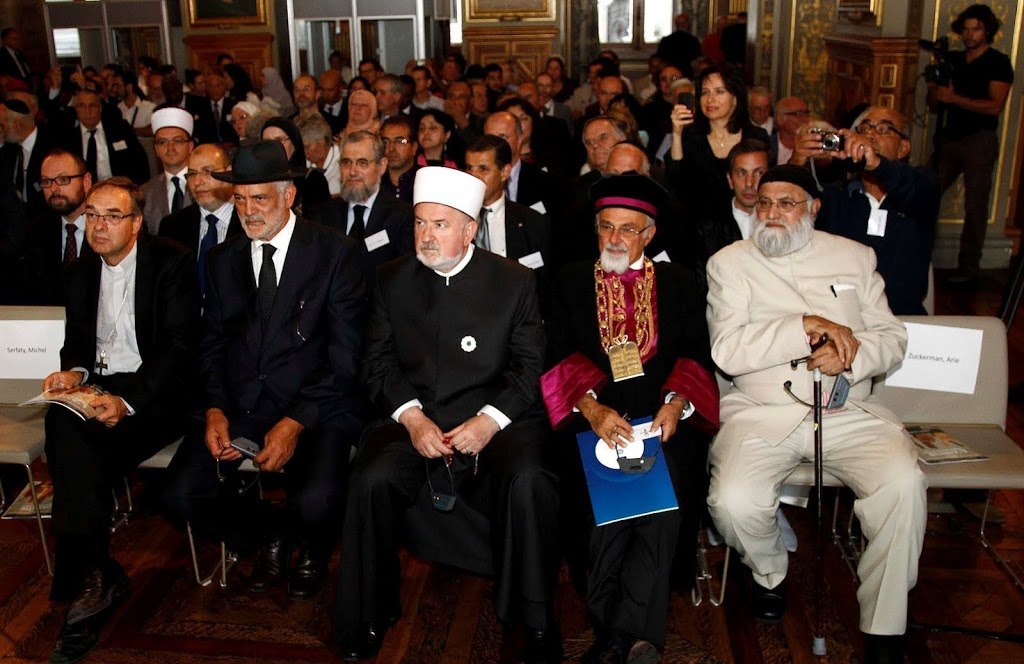
‘We’re all Muslims, we’re all Jews’, Israel Jewish Scene, Ynetnews, 6 Sep 2012 (my emphasis):

An initiative of the Foundation for Ethnic Understanding, the conference participants adopted a joint declaration calling for “‘zero tolerance’ against religious leaders of any faith who misuse their pulpits to incite religious bigotry.”

Conference co-sponsors include the European Jewish Congress and the Great Mosque of Paris.

The Gathering of European Jewish and Muslim Leaders attracted some of Europe’s most prominent Jewish and Muslim religious leaders who came out strongly against the recent increase in verbal and physical attacks on the two communities.

“There is no conflict between Judaism and Islam,” said Rabbi Marc Schneier, president and co-founder of The FFEU, “There is, however, a conflict between those who believe in tolerance and those who want to destroy life.”

Dalil Boubaker, rector of the Great Mosque of Paris, addressed the gathering’s opening event, emphasizing that “the holy Koran deeply respects all of the three Abrahamic faiths.”

The rector called on the religious leaders gathered in Paris’ famed city hall, Hotel de Ville, to “lead together to end racism and xenophobia in Europe.”

‘Assault on all people of faith’

Moshe Kantor, the president of the European Jewish Congress, added that “the recent attacks against our religious practices in Europe are an assault on all people of faith and they are indeed an attack on freedom of expression, the very basis for a free, democratic and tolerant European society.”

Rabbi Schneier then called on the participants to take the dialogue – which has been built up over the past four years through FFEU-driven initiatives of rabbis and imams – to the next level.

“We began in 2009 by hosting a delegation of European religious leaders to Washington and New York, with the hope of opening of a window of dialogue between the two communities,” recalled Rabbi Schneier.

“Through subsequent meetings in the US and Europe, a bond was forged and the leaders began to intensify their cooperation on areas of mutual concern like the governmental attacks on ritual slaughtering and circumcision in Europe.

“Today it is imperative for both sides to realize that a people who fights for their own right is only as honorable as when they fight for the rights of all people.

“The Jews of Europe stood up for their Muslim brethren when governments began to restrict the building of minarets, and American Jewry defended American Muslims from Islamaphobic incidents by stating ‘We are all Muslims.’

So much double-talk about “tolerance” and “rights” – straight out of the well-worn jewish playbook.

It’s unrealistic to imagine that outlawing their cultural practices would make them all leave, but it would make a good start. Their complaints and concerns for their own narrow identity and interests serve as a graphic reminder just how much they see common cause with each other, and yet how alien, alienated and alienating, they are to us.

The Foundation for Ethnic Understanding is based in New York and appears to be staffed mostly by jews dedicated to pursing the best interests of jews.
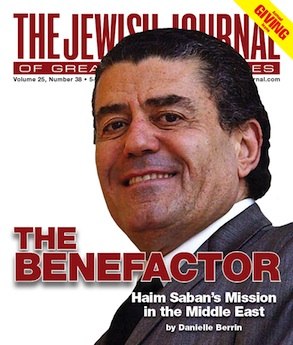
Saban: Obama is Best for Israel

The Truth About Obama and Israel, by Haim Saban, NYTimes.com:

AS an Israeli-American who cares deeply about the survival of Israel and the future of the Jewish people, I will be voting for President Obama in November. Here’s why.

Blah, blah, Israeli-firster rationale omitted.

When I enter the voting booth, I’m going to ask myself, what do I prefer for Israel and its relationship with the United States: meaningful action or empty rhetoric? To me the answer is clear: I’ll take another four years of Mr. Obama’s steadfast support over Mr. Romney’s sweet nothings.

Haim Saban is a private equity investor, the chairman of the Spanish-language media company Univision and a founder of the Saban Center for Middle East Policy at the Brookings Institution.

What’s best for America and Americans? “Israeli-American” Haim Saban and the New York Times don’t even pretend to care.

Dan Senor: Romney’s Jewish “Connector”

Romney’s Jewish Connector:

How Dan Senor became the GOP candidate’s key emissary to Israel’s intelligentsia and the Washington policy scene

Tablet Magazine is a jewish organ, and their article is a vetting of sorts, which in this context means a review of Senor’s history of working with other jews in pursuit of the best interests of jews. For the rest of us the article serves as a window into the workings of the jewish/judaized ruling class, both in Israel and the United States.

To some, Senor remains best known as the spokesman for the Coalition Provisional Authority, a role that made him a regular television fixture in the immediate aftermath of the 2003 Iraq invasion. In the years since, he’s reinvented himself as a cable news commentator and Israel advocate and has simultaneously amassed his own fortune working on Wall Street. He is, even among people who vehemently disagree with his politics, a popular guy who moves with equal ease in New York and Washington. He arrived in the governor’s camp with his own celebrity, and, in a sense, he offers the socially awkward candidate the thing his campaign most craves: an easy ability to make people like him. More importantly, Senor has been a vital emissary over the past six years for Romney not just to the Israelis and the American Jewish community, but to a Republican foreign-policy establishment that, even today, remains somewhat alien territory.

Senor arrived at his current role by way of an itinerant and mostly accidental career that has afforded him access to a wide range of very powerful, very famous, and very rich people. As an ambitious college intern on the Hill, he caught the attention of William Kristol, the editor-in-chief of the Weekly Standard, who gave him entree into the neoconservative circle surrounding George W. Bush. Senor eventually became the face of the Bush Administration’s efforts in Iraq, both during his time in Baghdad and later as a television pundit; while he was in Baghdad, he met his future wife, Campbell Brown, then a reporter for NBC. In between he went to Harvard Business School, worked for the Carlyle Group, and started a private-equity firm with his classmate and friend Chris Heinz, stepson of former Democratic presidential candidate Sen. John Kerry.

But his greatest success came in 2009, with the publication of Start-Up Nation, a slim blue-and-white volume he wrote with his brother-in-law, the Israeli newspaper columnist Saul Singer. Since its release in 2009, at the depths of the financial crisis, the book has become required reading for the entire Israeli government and for much of the American Jewish community. (The Palestinian Prime Minister Salam Fayyad also keeps a copy on his desk.) The title alone has become shorthand for the modern, techno-centric aspects of Israel, as distinct from the Israeli-Palestinian conflict. “It showed that every conversation about Israel doesn’t have to be about the settlements,” Senor told me when he and I met recently for dinner at Solo, a kosher restaurant in Manhattan.

In 2010, Senor was floated by Republicans, including Rudy Giuliani, as a possible Senate candidate in New York, but he decided not to enter the race, which would have pitted him against popular Democratic Sen. Kirsten Gillibrand. He now works for Paul Singer, the billionaire hedge-fund manager who is among Romney’s most prominent Wall Street backers. (Singer is no relation to Senor’s brother-in-law.) Senor is also a regular on Morning Joe, where he has become the show’s go-to conservative guest. To critics on both the left and the right, he represents the worst of the Bush era—the prioritization of loyalty and ideology over experience and expertise. “He was on MSNBC pushing for more robust intervention in Syria, and he was going up against a general,” said one longtime Republican operative, who asked not to be identified. “I was saying to myself, This is a guy where, if you look at him, no one’s ever going to confuse him with anyone who ever put on a uniform.”

But Senor’s varied background makes him a perfect interlocutor for Romney in clubby think-tank and fundraising circles. “There are a lot of smart guys in Washington who do some policy, some politics, some fundraising,” Kristol said. “But he certainly knows more than a lot of those guys, or knows better how it works.” In September 2009, after Romney’s first run for the Republican nomination, he joined Senor onstage at a conference hosted by the Foreign Policy Initiative, an organization Senor launched with Kristol and Robert Kagan. Romney made passing reference to an op-ed in the Wall Street Journal, prompting Senor to note it had been written by Bret Stephens, a columnist well known in conservative circles. “Brad Stephens’ piece?” Romney asked, blankly. “Bret Stephens,” Senor corrected. “Bret Stephens,” Romney repeated, and looked out at the audience. “Sorry, Bret.”

But, in a year when Israel has emerged as a central foreign-policy litmus test, Senor also brings an unusual advantage to the governor’s campaign: his close relationships with a small, influential group of American expats clustered in Jerusalem’s German Colony who operate at the highest levels of Israeli public life. Much has been made of Romney’s pre-political acquaintance with Netanyahu, dating to when they were both young men working for the Boston Consulting Group. But Senor, who travels to Israel several times a year, has ties to Jerusalem’s elite that are unusually personal and that are magnified by the uniquely Anglo-inflected nature of Netanyahu’s current government.

For Tablet’s jewish audience, the Republican foreign-policy establishment is “alien territory”, in contrast to Israel, which is more like home.