In the wake of the Loughner/Giffords shooting, amidst all the vitriolic rhetoric guilt-tripping Whites for participating in politics, a number of jews were speaking out about what they perceived the deeper meaning to be. From the beginning jews injected their own specifically jewish concerns into the political discourse and busily set about transforming the narrative from “congresswoman shot”, to “jewish congresswoman shot”, to “jewish congresswoman shot because she’s a jew”.
By the time Sarah Palin’s response came, days later, both the jewish and hypocritical nature of the most vitriolic rhetoric was increasingly obvious. Palin’s speech, America’s Enduring Strength, like most contemporary politcal speeches, consisted largely of non-partisan platitudes wrapped in pleasant sentiments, evoking images of an America which for the most part no longer exists. What set it apart was that in the middle Palin called out the scapegoaters in jewish terms:
If you don’t like a person’s vision for the country, you’re free to debate that vision. If you don’t like their ideas, you’re free to propose better ideas. But, especially within hours of a tragedy unfolding, journalists and pundits should not manufacture a blood libel that serves only to incite the very hatred and violence they purport to condemn. That is reprehensible.
And again, near the end, Palin made another pointed reference to the scapegoaters, their methods, and their purpose:
We need strength to not let the random acts of a criminal turn us against ourselves, or weaken our solid foundation, or provide a pretext to stifle debate.
America must be stronger than the evil we saw displayed last week. We are better than the mindless finger-pointing we endured in the wake of the tragedy.
As mild as this carefully worded reproach was, it hit very close to home. Hypocrisy is an accusation of serious substance to Whites, especially the kind who support Palin, but it isn’t at all effective on the “journalists and pundits”. The jews who responded weren’t upset about being called hypocrites. What they were upset about was an uppity, ignorant non-jew using their proprietary, jews-only victim card. Several jews were so incensed that they wrote two responses, or wrote something and also appeared on television.
General Reports: Jewish Blood Boiling
Jewish Group Slams Palin for ‘Blood Libel’ Remark, The Daily Beast, 12 Jan 2011.
Palin slammed for using ‘blood libel’ term, Jewish Journal, 12 Jan 2011. “Sarah Palin’s use of the term “blood libel” to decry blaming conservatives for the Arizona shooting has raised the ire of the Jewish community.”
U.S. Jewish leaders slam Sarah Palin’s blood libel accusation, Haaretz, 12 Jan 2011.
Blood libel: Jewish leaders object to Palin’s ‘blood libel’ charge, latimes.com, 12 Jan 2011. “Sarah Palin’s charge of ‘blood libel’ spurs outcry from Jewish leaders”.
Palin’s blood libel charge ignites firestorm, 12 Jan 2011.
Sarah Palin’s Blood Libel Controversial Reference Has Riled Emotions, 12 Jan 2011:
An aide close to Sarah Palin says death threats and security threats have increased to an unprecedented level since the shooting in Arizona, and the former Alaska governor’s team has been talking to security professionals.
Authoritative Statements from Professional Jewish Bigots
 J Street Responds to Palin’s “Blood Libel” Statement, J Street President Jeremy Ben-Ami, 12 Jan 2011:
We hope that Governor Palin will recognize, when it is brought to her attention, that the term “blood libel” brings back painful echoes of a very dark time in our communal history when Jews were falsely accused of committing heinous deeds. When Governor Palin learns that many Jews are pained by and take offense at the use of the term, we are sure that she will choose to retract her comment, apologize and make a less inflammatory choice of words.
 David A. Harris: Palin’s Incendiary “Blood Libel” Reference: Wrong Time, Wrong Place, Wrong Always:
WASHINGTON, D.C. Jan. 12, 2011 – The National Jewish Democratic Council (NJDC) today condemned Sarah Palin’s charged “blood libel” accusation, released early Wednesday by video. NJDC President and CEO David A. Harris said upon hearing Palin’s statement:
Following this weekend’s tragedy, we — and many others — simply did two things: we prayed for our friend Gabby while keeping all of the murdered and wounded in our thoughts and prayers, and we talked in broad terms about our increasingly charged level of political debate — asserting that now is as good a time as any to look inward and assess how all of us need to dial back the level of vitriol and anger in our public square. Nobody can disagree with the need for both.
Instead of dialing down the rhetoric at this difficult moment, Sarah Palin chose to accuse others trying to sort out the meaning of this tragedy of somehow engaging in a “blood libel” against her and others. This is of course a particularly heinous term for American Jews, given that the repeated fiction of blood libels are directly responsible for the murder of so many Jews across centuries — and given that blood libels are so directly intertwined with deeply ingrained anti-Semitism around the globe, even today.
Perhaps Sarah Palin honestly does not know what a blood libel is, or does not know of their horrific history; that is perhaps the most charitable explanation we can arrive at in explaining her rhetoric today.
All we had asked following this weekend’s tragedy was for prayers for the dead and wounded, and for all of us to take a step back and look inward to see how we can improve the tenor of our coarsening public debate. Sarah Palin’s invocation of a “blood libel” charge against her perceived enemies is hardly a step in the right direction.
The NJDC statement on the day of the shooting also expressed the desire to see their enemies “banished from our political discourse”.
 Palin: Stop Fanning Flames, Jewish Funds for Justice, 12 Jan 2011:
JFSJ to Sarah Palin: Stop Fanning the Flames of Division
NEW YORK – Simon Greer, president of Jewish Funds for Justice, released the following statement in response to Sarah Palin “blood libel” comment:
We are deeply disturbed by Fox News commentator Sarah Palin’s decision to characterize as a “blood libel” the criticism directed at her following the terrorist attack in Tucson. The term “blood libel” is not a synonym for “false accusation.” It refers to a specific falsehood perpetuated by Christians about Jews for centuries, a falsehood that motivated a good deal of anti-Jewish violence and discrimination. Unless someone has been accusing Ms. Palin of killing Christian babies and making matzoh from their blood, her use of the term is totally out-of-line.
In the past two months, Ms. Palin and Glenn Beck, the most well-known media personalities on Fox News, have abused two of the most tragic episode in the history of the Jewish people: the Holocaust and the blood libel. In addition, Roger Ailes, the head of the Fox News channel, referred to the executives at NPR as “Nazis.” Perhaps the popular news channel has such an ingrained victim mentality that it identifies with one of the most persecuted minorities in human history. But the Jewish community does not appreciate their identification, which only serves to denigrate the very real pain so many Jews have suffered because of anti-Semitic violence. It is clear that Fox News has a Jewish problem.
Sarah Palin did not shoot Rep. Gabrielle Giffords. Only the perpetrator can be found guilty for this act of terrorism. But it is worth pointing out that it was Rep. Giffords herself who first objected to Ms. Palin’s map showing her district in the crosshairs. “We’re on Sarah Palin’s targeted list, but the thing is, the way she has it depicted, it has the crosshairs of a gun sight over our district. When people do that they have to realize that there are consequences to that action.” According to Ms. Palin’s logic, Rep. Giffords statement was a blood libel against the Fox News host. The fact that Rep. Giffords is Jewish and Ms. Palin is Christian makes the accusation even more grotesque.
Ms. Palin clearly took some time to reflect before putting out her statement today. Despite that time, her primary conclusion was that she is the victim and Rep. Giffords is the perpetrator. As a powerful rhetorical advocate for personal responsibility, Ms. Palin has failed to live up to her own standards with this statement.
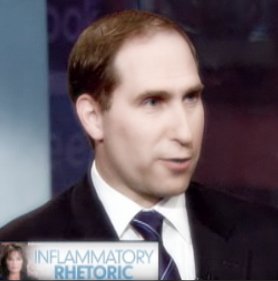
Simon Greer also appeared on MSNBC with Keith Olbermann, accompanied by a Sarah Palin avatar labeled “INFLAMMATORY RHETORIC”. Countdown: Palin angers Jewish community with speech, 12 Jan 2011:
Olbermann: Sarah Palin, knowingly or not, is comparing herself to the persecuted jews of the middle ages as a jewish congresswoman lies in critical condition in an Arizona hospital after being shot in the head.
Greer: Sarah Palin is trying to confuse us and make us think there is a victim in Alaska, which clearly there isn’t, and to do it adding insult to injury, she invokes a phrase that has cost countless lives of jews across the centuries and she uses it to launch a complaint about the media. On the face of it it’s a grotesque comparison.
Olbermann: Usually when somebody invokes it it’s related to actual persecution of another group. Is part of the problem here that the person who claims the blood libel is being used is also the person who claims it’s being used against them?
Greer: Yeah, you have a situation where a jewish congresswoman is fighting for her life and a Christian is claiming that she’s the one that’s the victim of a blood libel. It does make me think the leaders like Sarah Palin and other Tea Party leaders like Glenn Beck have a jewish problem. They continue to invoke holocaust, Hitler, nazi, blood libel – as if they’re trying to paint a picture of themselves as victims in an almost Orwellian turn of phrase. It’s a bit hard to fathom.
Greer: If she does offer an explanation I for one would love to hear what were the circle of jewish advisors around her, what were they thinking. Were they thinking, “we know what the blood libel is and we’re going to use it to great effect” or, “oops we didn’t really know what it meant, we deliberated for four days about what to say and then we slipped in the blood libel”. I would love to hear her explanation.
 Marvin Hier to Sarah Palin: You’re “Over the Top”, Jewish Journal, 13 Jan 2011:
That provoked Rabbi Marvin Hier, founder and dean of the Simon Wiesenthal Center, to call an out-of-bounds.
“It is simply inappropriate to compare current American politics with term that was used by Christians to persecute Jews,” said Hier. “She has every right to criticize journalists without going over the top.”
But as Palin may someday learn, and Hier and other Jewish leaders know wel, words really do matter. Equating even harsh criticism with “blood libel” is like going to the ER for a boo boo. It grossly demeans the historic reality of the blood libel and the victims who suffered brutally and needlessly because of it.
Other recent SWC trips to the ER: SWC Denounces ‘New Blood Libel’ at UC Campuses, 22 May 2007; Swedish Government’s Response “Inadequate” to New “Blood-Libel”, 19 Aug 2009.
Sarah Palin Charge of ‘Blood Libel’ Provokes Rhetorical Controversy, Andrea Stone, 12 Jan 2011:
To critics, Palin was reckless in her choice of words because “blood libel” is fraught with historic connotations.
“The term has a very specific meaning” connected to the charge that Jews used the blood of Christian boys in preparing matzah for the Passover Seder, said Deborah Lipstadt, a professor of modern Jewish history and Holocaust studies. “Governor Palin could have found a better term, especially given the fact that Representative Giffords is Jewish.”
Palin’s use of the term is “glaringly inappropriate and displays a profound lack of historical sensitivity,” said Jenna Weissman Joselit, a professor of history and Judaic studies at George Washington University.
“I would have advised against using it — the term is historically unique and refers specifically to false charges of ritual murder,” said Noam Neusner, a former speechwriter for President George W. Bush and the son of a famed Talmudic scholar. “While Ms. Palin has a legitimate gripe against her liberal critics, who were wrong to associate the Tucson shooter with her politics, she is using a term that simply does not apply. She could have simply used the word ‘libel’ and she would have been fine.”
Palin has been a strong supporter of Israel, and even her staunchest critics don’t suggest that anti-Semitism is behind the faux pas.
But Robert Lehrman, a former speechwriter for Vice President Al Gore, said Palin’s choice of words was likely not accidental.
“Only Jews know about” the visceral meaning of the term, he said. “And because the right and some tea party people — like Tony Katz — talk about the Jewish-dominated media, the unspoken implication is this: ‘Most people won’t get this, but you Jewish reporters know what I’m saying.'”
 Brad Hirschfield: Palin’s Charge of Blood Libel Plays the Jewish Card, Brad Hirschfield, self-described “Rabbi, Author and Expert on Religion and Public Life”, 12 Jan 2011:
First, let’s be clear about what a blood libel is. In the briefest terms, it is the charge that Jews use the blood of non-Jews, typically that of children, for ritual purposes, especially the making of Passover matzah.
The charge, which originated among medieval Catholics, has also been used by Protestants and more recently by Muslims too, to provoke rage at Jews — rage which on many occasions resulted in violence against Jews, and even their murders. That’s what makes Palin’s use of the term so interesting — for the analogy to work, she must be the Jew!
I have no particular problem with people, including gentiles, analogizing their own woes to that of Jews, but does Ms. Palin actually believe that her life is in danger because of the journalists and political talking heads who accuse her of complicity in the tragedy in Tucson?
If she does, then not only does she seem eager to play the Jew, she seems to agree with her detractors about the power of words to inspire violence. It’s amazing how the two sides, each so eager to cast blame upon the other, are so very much alike. Because her analogy, however unintentionally, drives home that point, I think it may be quite apt.
Ms. Palin’s choice of analogies is also a good one because it points to a situation in which people need to cast blame upon others to deflect from their own sins. In the case of the blood libel, it was used not only to create anti-Jewish sentiment, but to justify it.
Jews, it was charged, deserved to be tortured and killed because of their evil deeds. So Jew haters created a reason for the hate, one which not only inspired increased hate but justified, in their own minds, the hate they already had for Jews.
When Journalists and Pundits Attack
 Sarah Palin Says Media Guilty of ‘Blood Libel’: Why Her Speech Was Wrong, Howard Kurtz, 12 Jan 2011:
Blood libel, for those who are not familiar, describes a false accusation that minorities—usually Jews—murder children to use their blood in religious rituals, and has been a historical theme in the persecution of the Jewish people.
Had Palin scoured a thesaurus, she could not have come up with a more inflammatory phrase.
As someone who has argued that linking her rhetoric to the hateful violence of Jared Loughlin is unfair, I can imagine that the former governor was angry about how liberal detractors dragged her into this story. But after days of silence, she had a chance to speak to the country in a calmer, more inclusive way. She could have said that all of us, including her, needed to avoid excessively harsh or military-style language, without retreating one inch from her strongly held beliefs.
Instead she went the blood libel route.
The same day Howard Kurtz Tweeted:
There was some sympathy for Palin over being tied to shooting, + she chose to go inflammatory. Blood libel has special resonance for Jews.
 Hardball – Chris Matthews, Chuck Todd, Howard Fineman, 12 Jan 2011:
Matthews: Why would she use a phrase like that?
Todd: I don’t know. I think, ahh, I, uhh, it’s uhh, it, to me, she needs to answer that, I don’t understand…
Fineman: She has only one gear and that is forward and she only one mode and that is attack. I don’t think she fully understood the history because if she did understand the history she would realize that she was comparing herself, in this situation, to a jewish martyr during the middle ages, or the cossacks in russia or whatever, and all of her critics as people who engaged in that kind of behavior. That’s not just over the top, that’s the other side of the moon.
With ‘Blood Libel,’ The 2012 Campaign Has Begun, Howard Fineman, 12 Jan 2011:
After a litany of other Republicans, from Roger Ailes to Ari Fleischer, suggested that calmer rhetoric is warranted in the aftermath of Tucson, Palin — after remaining essentially silent for three days — amped up the rhetoric in a pointed counterattack, accusing “journalists and pundits” of manufacturing a “blood libel” against her by suggesting that she somehow is to blame for the toxic political atmosphere in Arizona.
There are few more freighted phrases in the history of hate than “blood libel,” which is the ancient and false accusation that Jews secretly murder Christian children as part of their religious rituals. This anti-Semitic attack has resulted in countless pogroms and massacres through the ages.
Saint Sarah, it seems, is now comparing herself to one of those martyrs.
Notably absent was any second-guessing of a single word or action of her own over the last two years. To do so, apparently, would mean to somehow accept the premise that the “lamestream media” is worthy of attention. As far as she is concerned, they don’t exist — except for the sake of being likened to pillaging Cossacks. (The comparison is not only over-the-top, it’s also insensitive, given that Rep. Gabrielle Giffords is Jewish.)
 Blood Libel, Adam Serwer, 12 Jan 2011:
Over at Greg’s place, I explain why Sarah Palin’s use of blood libel in the context of people accusing her of being responsible for the incident in Tucson is wrong, even if the accusations are unfair
This links The foolishness of the ‘blood libel’ charge:
Blood libel is a term that usually refers to an ancient falsehood that Jews use the blood of Christian children in religious rituals. For hundreds of years, particularly during the Middle Ages, it was used to justify the slaughter of Jews in the street and their expulsion from entire countries. “Blood libel” is not wrongfully assigning guilt to an individual for murder, but rather assigning guilt collectively to an entire group of people and then using it to justify violence against them.
This is a new low for Palin, but outsize comparisons of partisan political conflict to instances of terrible historical oppression is a fairly frequent rhetorical device among conservative media figures.
Now, mere days after the incident, with six people dead and Giffords still recovering, Palin is making herself the center of attention. It might please the audience for conservative talk radio or Fox News, but most people will be disgusted. As well they should be.
Sarah Palin charges critics with ‘blood libel’, Jennifer Epstein, 12 Jan 2011:
Palin’s use of the charged phrase “blood libel” — which refers to the anti-Semitic accusation from the Middle Ages that Jews killed Christian children to use their blood to make matzo for Passover — touched off an immediate backlash.
 “The blood libel is something anti-Semites have historically used in Europe as an excuse to murder Jews — the comparison is stupid. Jews and rational people will find it objectionable,” said Hank Sheinkopf, a New York-based Democratic political consultant and devout Jew. “This will forever link her to the events in Tucson. It deepens the hole she’s already dug for herself. … It’s absolutely inappropriate.”
But in her first extended response to the shooting – and just hours before President Barack Obama planned to speak at a memorial service in Tucson – Palin created a frenzy.
It was chiefly because of her use of “blood libel,” but also because she used the video largely to make an unapologetic case for her brand of confrontational politics.
 RealClearPolitics – Video – NBC’s Andrea Mitchell: Palin “Ignorant” For Using Term “Blood Libel”, 12 Jan 2011.
Yglesias » Blood Libel, Matt Yglesias, 12 Jan 2011:
Indeed, Jews throughout America can join me in remembering when our ancestors fled Eastern Europe in order to live in a land where nobody would ever criticize us on television.
 Analysis: Palin Plays the Victim Card, Dan Farber, 12 Jan 2011:
Palin appears to be appropriating the term to indicate that she is a victim, as a result of some groups and individuals claiming that her political rhetoric contributed to the actions of the deranged, lone gunman.
But the real victims are Rep. Giffords and the others who were wounded or killed, not Palin, who appears to be tone deaf to Giffords statement that there are consequences to actions. The consequences of Palin’s crosshairs may not be directly related to the shooting rampage in Tucson and assassination attempt, but they are related to the level of divisiveness in the country.
“Community leaders, not just political leaders, need to stand back when things get too fired up,” Giffords said during her MSNBC appearance in March 2010.
The likely presidential aspirant doesn’t seem to take any responsibility for ratcheting up the political dialog or believe that there is any need to moderate the tone of political discourse in America.
What ‘blood libel’ really means, Jonathan Zimmerman, 13 Jan 2011:
Palin should apologize, too. And not just to Jews, including Giffords.
No, Palin should apologize to all of us. In a speech condemning the irresponsibility of her critics, who have played fast and loose with the facts, Palin did something even worse: She trivialized one of the great crimes of human history.
 The Libel of “Blood Libel”, Noah Baron, 13 Jan 2011:
I cannot believe that Palin was ignorant of the history of the term “blood libel,” which was long used as an excuse by anti-Semites to persecute Jews. More likely, she chose it on purpose.
Palin’s statement is but one in a long line of manifestations of a paranoia and persecution complex that now characterizes the American conservative movement.
 Why Sarah Palin’s Use of ‘Blood Libel’ Is a Great Thing, Jeffrey Goldberg, 12 Jan 2011:
Sarah Palin has called the post-Tucson campaign of vilification against her and her fellow travelers a “blood libel.” On the one hand, this is unfortunate, as Jonah Goldberg points out, because it threatens to redefine the phrase, plus, what is happening to her is not precisely the byproduct of a blood libel.
On the other hand, Sarah Palin is such an important political and cultural figure that her use of the term “blood libel” should introduce this very important historical phenomenon to a wide audience, and the ensuing discussion — about how Fox News is not actually Mendel Beilis — will serve to enlighten and inform. It is a moral necessity, I think, for Christians to understand the blood libel (Muslims, too — see the Damascus Blood Libel of 1840), not only because it is part of their history, but because the blood libel still has modern ramifications — Israel, after all, was founded as a reaction to Christian hatred, of which the blood libel was an obvious and murderous manifestation.
I mean it sincerely when I say I hope Sarah Palin, who regularly expresses love for Jews and Israel, takes the time to learn about the history of the blood libel, and shares what she has learned with her many admirers.
Sarah Palin, Jewish Educator – The Atlantic, Jeffrey Goldberg, 12 Jan 2011:
My theory that Sarah Palin’s otherwise gross use of the term “blood libel” to describe criticism leveled against her has an upside — the potential to educate people about the actual meaning and history of the “blood libel” and its frightening relevance today — is being borne out in the in-box. Two such e-mails:
i had no idea ‘blood libel’ had a jewish origin, i doubt sarah palin does either, she picked up on it because it sounded sexy, and voila, more headlines.
I think it’s true that Sarah Palin had no idea of the meaning; I don’t actually believe she was Jew-baiting, or consciously trying to denigrate the experience of Jewish communities at the hands of their Christian neighbors.
And this:
What do you think the actual chances are that Sarah Palin will actually come out and apologize and learn something about the blood libel and try to raise consciousness about this? I don’t think it’s very high.
Keep hope alive, I say. This is a great moment for Sarah Palin to demonstrate some sensitivity, and to show that she’s capable of absorbing and assimilating new knowledge, and sharing that knowledge with others. I hope she doesn’t miss the chance.
Backstory
Intermittent respites from the unhinged jewish firestorm.
Ben Smith on Twitter, 12 Jan 2011:
A quick ‘blood libel’ thought. Palin’s aides, including @thegoldfarb [Michael Goldfarb], get the context — so this is a pot being stirred, not an accident…
Palin: ‘Blood libel’, Ben Smith, 12 Jan 2011:
The phrase “blood libel” was introduced into the debate this week by Instapundit’s Glenn Reynolds, and raised some eyebrows because it typically refers historically to the alleged murder of Christian babies by Jews, and has been used more recently by Israeli’s supporters to refer to accusations against the country. It’s a powerful metaphor, and one that carries the sense of an oppressed minority.
The Arizona Tragedy and the Politics of Blood Libel, Glenn Reynolds, 10 Jan 2011.
The Term ‘Blood Libel’: More Common Than You Might Think, Jim Geraghty, 12 Jan 2011.
Team Sarah Points to Even More Recent Uses of ‘Blood Libel’, Jim Geraghty, 13 Jan 2011.
With Friends Like These
 “Blood Libel” – By Jonah Goldberg – The Corner – National Review Online, 12 Jan 2011:
I should have said this a few days ago, when my friend Glenn Reynolds introduced the term to this debate. But I think that the use of this particular term in this context isn’t ideal.
Jewish Republicans muted on Palin’s ‘blood libel’ comment, Jordan Fabian, 12 Jan 2011:
Former Bush White House press secretary Ari Fleischer, a member of the Republican Jewish Coalition’s board of directors, did not address Palin’s use of the phrase “blood libel” but said she would have been better served by focusing on a more positive message.
 Exclusive: Alan Dershowitz Defends Sarah Palin’s Use of Term ‘Blood Libel’, 12 Jan 2011:
The term “blood libel” has taken on a broad metaphorical meaning in public discourse. Although its historical origins were in theologically based false accusations against the Jews and the Jewish People,its current usage is far broader. I myself have used it to describe false accusations against the State of Israel by the Goldstone Report. There is nothing improper and certainly nothing anti-Semitic in Sarah Palin using the term to characterize what she reasonably believes are false accusations that her words or images may have caused a mentally disturbed individual to kill and maim. The fact that two of the victims are Jewish is utterly irrelevant to the propriety of using this widely used term.
 Charles Krauthammer on debating Palin’s use of ‘blood libel’: ‘Have we completely lost our minds?’, 13 Jan 2011:
“[T]he fact is that even the ADL, the Anti-Defamation League in expressing a mild rebuke to Palin for using this admitted itself in its statement that the term ‘blood libel’ has become part of English parlance to refer to someone falsely accused,” Krauthammer said. “Let’s step back for a second. Here we have a brilliant, intelligent, articulate, beautiful, wife, mother and congresswoman fighting for her life, in a hospital in Tucson, and we’re having a national debate over whether the term ‘blood libel’ can be used appropriately in a non-Jewish context? Have we completely lost our minds?”
Jewish Pols Appalled, Condemn Palin, Others Feign Ignorance
 Palin Calls Criticism ‘Blood Libel’, Michael D. Shear, 12 Jan 2011:
Representative Debbie Wasserman Schultz, Democrat of Florida, who is a close friend of Ms. Giffords, issued a statement condemning her use of the phrase “blood libel.”
“Palin’s comments either show a complete ignorance of history, or blatant anti-Semitism,” said Jonathan Beeton, Ms. Wasserman Shultz’s spokesman. “Either way, it shows an appalling lack of sensitivity given Representative Giffords’s faith and the events of the past week.”
 Palin starts storm over media ‘blood libel’ – TheHill.com, Michael O’Brien and Jordan Fabian, 12 Jan 2011:
“When I heard it, I said, ‘What? This is ridiculous!’ ” Rep. Eliot Engel (D-N.Y.), who is Jewish, told The Hill. “It’s appalling. It’s an insensitive choice of words.”
Lawmakers on Wednesday indicated they were baffled by Palin’s “blood libel” characterization.
“Blood what?” Democratic Rep. Frank Pallone Jr. (N.J.) responded when asked for his response to the characterization.
Pallone’s confusion was shared by Reps. Ted Poe (R-Texas), James McGovern (D-Mass.), Joseph Crowley (D-N.Y.), Phil Gingrey (R-Ga.), Kevin Brady (R-Texas) and Louie Gohmert (R-Texas).
Gohmert said that he had not read or heard Palin’s self-defense, stating, “There are some words that you know incite people, just inflame their passions, and those are things that are helpful to stay away from.”
Other House Republicans simply shook their heads and opted not to comment on Palin’s message.
McGovern didn’t know what “blood libel” meant, saying he thought initially “it must be some sort of Alaska thing.”
Jewish Influence and Coded Language
Sarah Palin: Critics Blaming Political Right for Shootings Commit ‘Blood Libel’, Tom Diemer, 12 Jan 2011:
Palin, like many conservative Christians, is a strong supporter of Israel, and she has been particularly supportive of Israeli Prime Minister Benjamin Netanyahu’s hard-line stands versus the Palestinians. In an open letter to incoming Republican freshmen last November she implicitly rebuked President Obama when she wrote that “Jerusalem is the capital of Israel, not a settlement,” and in June she slammed Obama over what she said was his weak-kneed support of Israel following the Israeli commando attack on a Gaza-bound flotilla that left nine activists dead.
But Christian conservatives like Palin are also growing increasingly fond of Jewish religious traditions and motifs, sometimes celebrating Passover Seders and appropriating Old Testament references like the Israelites in exile to describe their own experience in modern America. Palin, for example, likes to compare herself to Queen Esther, the Jewish beauty from the Book of Esther who saves her people from destruction.
Such religious borrowing can be problematic for Jews, and Palin’s “blood libel” reference evoking such a devastating history at the hands of Christians could be especially explosive. The Anti-Defamation League said it was “inappropriate to blame Palin and others for causing this tragedy.” Still, the ADL said, “we wish Palin had not invoked the phrase ‘blood libel'” — words that have become part of English parlance, but ones “so fraught with pain in Jewish history.”
Palin Knew What She Was Saying, Matthew Cooper, 12 Jan 2011:
But, as is often the case, Palin is likely being underestimated and, perhaps, misunderstood. It’s highly unlikely that she threw an incendiary term out there without knowing what it means, and it’s even less likely she did so in an effort to promote anti-Semitism.
Here’ s another theory of the case: The former Alaska governor was likely trying to send a signal to her evangelical Christian supporters who are, in fact, deeply pro-Israel (although many Jews are wary of their support for the Zionist state, seeing them as more interested in the Rapture than a healthy Jewish nation).
Palin was likely aligning herself with pro-Israel evangelicals by identifying with Jews, not by insulting them, although that was surely the effect given the widespread bristling at her remarks.
After all, it’s not the first time Palin has aligned herself subtly with Jews. She has noted that after her election as governor in 2006, her childhood pastor suggested that she take the Bible’s Queen Esther as a role model. Esther was a beauty queen who became a fierce protector of the Jewish people. Palin is comfortable in the role of Esther, and many of her evangelical supporters see her in that guise, describing her as Esther-like. The multi-faith website Beliefnet called this phenomenon “Esther-mania.”
By adopting the blood libel language, Palin was most likely trying to pull another Esther — aligning herself with Jews, not denouncing them. It appears to have been a badly miscalculated effort, but it’s unlikely that it was her intention to offend.
“It was a dog whistle,” said one Jewish Republican who worked in the George H.W. Bush administration and declined to be named to avoid becoming enmeshed in the intraparty debate over Palin. The reference was to a device that’s silent to some ears but calls to others. “The media didn’t get it, but Christian activists did,” this source added.
Was Sarah Palin’s ‘Blood Libel’ Comment a ‘Dog Whistle’ — or Just Inadvertent?, Matt Lewis, 12 Jan 2011:
As Tom Diemer and David Gibson noted, the term ” ‘Blood libel’ is an extraordinarily loaded phrase because it recalls the false accusation by Christians against Jews that was used for centuries as an excuse for anti-Semitic persecution. The libel generally refers to the charge that Jews required human blood, and in particular the blood of Christian children, to bake matzoh bread.
While many believe this to be an example of “dog whistle” politics, I’m not so sure. A cipher works when the only people who hear the “dog whistle” are your complicit allies. That is clearly not the case in this instance. And so if others can immediately decode it, is it a dog whistle?
My guess is that this is simply a case of ignorance on the part of Palin and the speechwriter — and I don’t mean that in a derogatory way. Simply put, a lot of people don’t realize that these loaded terms have deeper and more sinister meanings.
Postscript, Business as Usual
 Democrat invokes Nazis to slam GOP on health care – On Politics: Covering the US Congress, Governors, and the 2012 Election, 19 Jan 2011. US Representative Steve Cohen, speaking on the record in the House of Representatives:
They say it’s a government takeover of health care. A big lie just like (Joseph) Goebbels. You say it enough and you repeat the lie, repeat the lie, repeat the lie and eventually people believe it. Like blood libel. That’s the same kind of thing. The Germans said enough about the jews, and the people believed it, and you had the holocaust. You tell a lie over and over again.
Over the Top and Beyond the Moon
Regardless of who chose the term blood libel or whether the intent was to provoke an overreaction from jews, that’s exactly what it produced. What happened is that an army of influential jewish journalists, pundits, and professional bigots instantly swarmed forth to self-righteously lecture the unwashed hoi polloi about jewish sensitivities and sensibilities, instructing Palin and the rest of us what we may or may not say.
That two words could produce such an enormous, immediate, angry jewish reaction is an indication of just how sensitive and defensive jews are about even an indirect reference to their influence. It also serves as a measure of that influence.
Jews focused on attacking Palin specifically because they didn’t want to address her point. As Fineman projected, jews have only one mode: attack. What agitated them so was being called out in jewish terms. They certainly were not put out about being called hyprocrites. Hypocrisy is something only Whites get upset about.
After seeing blood libel defined over and over and over again it’s impossible to believe that the term causes jews any pain whatsoever. What most obviously gets them exercised is seeing anyone but jews as victims. And my how cruel, merciless and paranoid they can be when they think someone is trying to use their own tricks against them.

 Chris Rock Quotes on Tea Party, Obama, Oscars Jude Law and More, interviewed by Scott Raab at Esquire, 16 Feb 2011: