Tag Archives: jewish influence

Jewish Politics in Post-White America


“Stick Together”

‘Mensch’ Dan Adler targets minorities with stereotype-laden ad, by Rachel Rose Hartman:

What’s the best way to reach out to Asian voters? Tell them you’re Jewish so you can relate. Right?

That’s the route Democratic candidate Dan Adler took in his most recent ad for California’s 36th District special election. In a heavily staged discussion among constituents at a set suggestive of a Korean-owned dry cleaner, the former Disney executive tells a woman behind the counter–who speaks with a heavy Asian accent–that he can relate to her concerns because “my wife is Korean.”

“You’re Jewish,” she replies.

“My family is Jewish.”

“We minorities should stick together,” she replies. Adler laughs as a young Asian couple looks on–the man’s shirt opens to reveal his Chinese script tattoos.

“Dan Adler. Send a mensch to Congress!” a multi-racial crowd shouts at the end, noting the Yiddish word for a person of high character. “What’s a mensch?” the woman from the dry cleaner asks the camera.

Adler’s faux pas here, according to Hartman, is the use of stereotypes in his explicitly pro-minority, implicitly anti-White campaign commercial. Something tells me this will not upset either Adler’s jew or Asian funders and voters, and if any Whites complain they can look forward to being branded and brushed off as “racists”.

Adler’s message assumes it is right and good that:

1) “minorities” see themselves as natural allies against non-“minorities”, ie. Whites.

2) jews identify as “minority”, not White.

Your deracinated White friends will not appreciate the use of this video as a teachable moment, but rub their noses in it anyway.

Who’s To Blame for Anti-White Governance

Last week a Hamburg judge filed a criminal complaint against German Chancellor Angela Merkel for “endorsing a crime” after she stated she was “glad” that Osama bin Laden was killed by US forces. Self-described jewish fifth columnist Lawrence Auster responded to this report by blaming Germans for all of Europe’s ills:

Just think, if the anti-Hitler plotters in 1944 had succeeded in killing him, and if some German leader had expressed his joy, this German judge, if translated back to 1944, would seek to punish him. I guess Germany hasn’t changed so much after all, hmm? Pure liberalism, which the Germans in their humorless fanatical thoroughness aspire to as the opposite of Nazi totalitarianism, is another form of totalitarianism. And in the same way, as I have often remarked, the German-championed transnational opposite of the Nazi nationalism which sought to destroy the nations of Europe, is also destroying the nations of Europe. One way or another, whether in their Nazi form or in their hyper-liberal form, the Germans pose a determined threat to the nations and peoples of the West. To paraphrase Churchill’s famous remark about the Germans, they need to be kept at our feet, or else they will go for our throat.

I am not being extreme or “anti-German” when I say that. The Germans agree with me. They see themselves as a threat to others. That’s why they say that the EU is necessary, to keep them, the ever-threatening Germans, in check. The problem is that the German-led EU which in the German mind is aimed at suppressing the German nation, must suppress all other European nations as well. This is why, just as German nationalism could not be allowed to rule Europe, German anti-nationalism also cannot be allowed to rule Europe. Germany must not rule, period.

Then in Debate on Germany Auster expressed regret that his sweeping condemnation of “the Germans” was not more comprehensive:

My strongly worded entry last week about German hyper-liberalism has set off something of a debate in the blogosphere. At Gates of Vienna, a German writer, Manfred Kleine-Hartlage, replies to me. I haven’t yet read his article. But for the moment I want to repeat once again the qualifications I made last week. My statements about Germany were not intended as a comprehensive criticism of Germany and Germans, and if I gave that impression I regret it. My argument related to one, narrowly framed, core issue: that just as the German hyper-nationalism of the past sought to crush the nations of Europe, German hyper-liberalism, which arose as an all-consuming reaction against German hyper-nationalism, also poses a danger to the nations of the West, and therefore it is not desirable for Germany, in its present, hyper-liberal state, to dominate Europe.

Auster’s “narrowly framed” problem isn’t just with nationalist or anti-nationalist Germans but with “the Germans” in general. He identifies Germans as a biological group having personality traits such as “humorless fanatical thoroughness” and “hyper-liberalism”. He sees them posing a danger not only to Europe but “the nations of the West”. Thus they must be “kept at our [sic] feet”.

In The Real Problem is “Global Governance” Manfred Kleine-Hartlage responds to Auster’s outrageous slander, specifically calling attention to Auster’s claim that “the Germans” agree with him:

Many Germans say this, because they were told to speak and think such things. They were taught to consider thousand years of German history just as a pre-history of Hitler. They were taught to regard their history as merely a history of crimes. They were taught that they are a danger to others. They were taught that patriotism and “nationalism” are the same thing, and that the latter is the root of all evils in the world. They were taught to hate themselves.

It started with the re-education after 1945, and this re-education is still going on. To poison an entire nation with self-hatred turned out to be a working concept, and this concept, once successfully applied, was generalized to the Western world as a whole, and as the concept of “white guilt” is now undermining our civilization. This is nothing you should blame the Germans for. They were just the guinea pigs.

The million-dollar-question is: Why is this done, and who does so?

Excellent question.

Having dealt with Auster, Kleine-Hartlage follows up by going where Auster never does. He points to the connection between the never-ending Global War on Terror and the never-ending drive for genocidal levels of immigration into all White countries – our hostile international elite:

Yes, Bin Laden was our enemy, but on the list of our enemies he was not number one, and not even number ten. Islam is marching forward in Europe not by terrorism, but by immigration and ethnic struggle, with strong support from the international political elites. It makes no sense to assert a difference between American and European elites, because they all belong to a transatlantic network centered in, but not confined to, America. Within this network, strategies are made compatible with each other, so that there is no such thing as a strictly national policy. There are disagreements on minor questions, but the general direction is towards establishing a global uniform civilization. The EU is part of this process, and an analyst blaming just Germany for that, as Mr. Auster does,

The problem is that the German-led EU which in the German mind is aimed at suppressing the German nation, must suppress all other European nations as well. This is why, just as German nationalism could not be allowed to rule Europe, German anti-nationalism also cannot be allowed to rule Europe. Germany must not rule, period.

proves that his hatred of a particular country is stronger than his analytical capabilities.

Why is the leading power in the “war on terror” at the same time urging France to open herself to Islamic infiltration and secretly fostering this infiltration, as we know by Wikileaks (and there is no reason to assume that the same strategy is not applied to other European countries)? Why is the European power most passionately joining this war — Great Britain — at the same time and with the same passion engaging in self-Islamization? Why are the Anglo-Saxon powers, while at war with more than one Islamic country, urging Europe to enlarge the European Union more and more, predictably with the result that Turkey and North Africa will join the club, thereby opening Europe to a flood of Muslim immigrants?

So instead of “the Germans” Kleine-Hartlage blames “the Anglo-Saxon powers” – the US and Britain. From his afterword:

Mr. Auster’s polemics have shown the gap between Anglo-Saxon and German conservatism. To bridge the gap a little bit, I have started a new blog, German Views, in order to make important articles from the conservative German blogosphere available in English.

The essay is reposted at his new blog, From a German Point of View: a Reply to Lawrence Auster, minus the afterword, but Kleine-Hartlage reiterates his point in a comment:

The problem – and the reason why I started this blog – is the dominance of the Anglo-Saxon narrative on Germany.

Kleine-Hartlage seems unaware that Lawrence Auster is no Anglo-Saxon, that his grandparents were all jewish immigrants to the US. Auster refers to Britain as “the Dead Island”, just as he refers to Germany as “that dead land”. His affections are for Israel. It may also surprise Kleine-Hartlage to know that the US Ambassador to France, Charles H. Rivkin, whose Wikileaked embassy report he linked, also has Russian jewish roots.

If we wish to talk honestly about who dominates not only the narrative on Germany but who dominates political, social, cultural and historical narratives in general, who is relentlessly encouraging Germans, Anglo-Saxons, and Whites in general to hate ourselves and feel guilty, then we must not neglect to mention the jewish elephant in the room. It is possible to honestly debate how significant jewish influence is. It is not honest to neglect to address that influence entirely.

I presume Kleine-Hartlage knows better than I do how German speech regarding jews is proscribed by law. Perhaps this is why he pins the blame on Anglo-Saxons.

Kleine-Hartlage might be interested to know that Auster’s recent ranting about the threat of German “hyper-liberalism” and German “anti-nationalism” is consistent with his usual schtick. He blames “the majority” (Whites) for “liberalism” (anti-Whiteness). He explicitly excuses “the jews”.

Just a few years ago Auster was discussing anti-nationalist sentiment in the US. Jews’ idiotic anti-nationalism:

Asked by the General Social Survey if immigration improves America, 52 percent of Protestants, 61 percent of Catholics, and 90 percent of Jews said yes. Matthew Yglesias, a Jew who works for The American Prospect, explains why Jews support immigration so much more than other groups, and Steve Sailer offers effective replies.

One of Yglesias’s points is: “Second, as a historical matter, nationalism has been Bad For The Jews.”

Yglesias is certainly correct that this is the Jewish view of the matter. But how truly idiotic and despicable a view it is. Jews have always lauded America for defeating Hitler. Would America have been able to defeat Hitler if it hadn’t existed as a nation and been a strong nation? Would it have been better for the Jews if Britain had had a weak sense of nationality and compromised with Hitler, instead of, as was the actual case under Churchill, a strong sense of nationality and stood up to him? Would Ann Frank’s family have had to hide in an attic for two years and then been arrested and sent to concentration camps where they died horrible deaths, if the Netherlands, instead of being a weak nation that was easily overrun by the Germans, had been a strong nation that was able to prevent the Germans from conquering the Netherlands and capturing all its Jews?

Also, most Jews are thankful for the fact that America, the strongest nation on earth, stands almost alone against the world-wide movement to destroy Israel. Will a weak and divided America be able to perform that function?

Don’t worry, Auster eventually excuses “the jews”. Note also that he doesn’t argue that jewish anti-nationalism is despicable because it’s bad for Whites (American, Briton, or Dutch). He thinks it’s despicable because it’s bad for “the jews”.

The usual judeo-liberal anti-nationalist hate/guilt narrative is that Whites must subordinate our interests to the interests of “minorities”, because if we worry about what’s best for us then we’re guilty of hate. Auster regularly calls attention to this narrative, at least as it pertains to blacks or muslims, but he wishes to preserve the special privileges of “minority” status for “the jews”. If we worry about what’s best for Whites, and that conflicts with what Auster thinks is best for “the jews”, then according to him we’re guilty of hate.

I’ll conclude here by quoting two jews who, though separated geographically and linguistically, sound remarkably alike. In fact if Lawrence Auster were transported back to 1944 it’s not unreasonable to imagine him expressing his thoughts in very similar terms.

Ilya Ehrenburg:

The Germans are not human beings. From now on the word German means to use the most terrible oath. From now on the word German strikes us to the quick. We shall not speak any more. We shall not get excited. We shall kill. If you have not killed at least one German a day, you have wasted that day … If you cannot kill your German with a bullet, kill him with your bayonet. If there is calm on your part of the front, or if you are waiting for the fighting, kill a German in the meantime. If you leave a German alive, the German will hang a Russian and rape a Russian woman. If you kill one German, kill another — there is nothing more amusing for us than a heap of German corpses. Do not count days, do not count kilometers. Count only the number of Germans killed by you. Kill the German — that is your grandmother’s request. Kill the German — that is your child’s prayer. Kill the German — that is your motherland’s loud request. Do not miss. Do not let through. Kill.

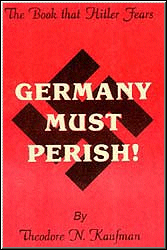
Theodore Kaufman (in his book, Germany Must Perish!):

Today’s war is not a war against Adolf Hitler.

Nor is it a war against the Nazis.

It is a war of peoples against peoples; of civilized peoples envisioning Light, against uncivilized barbarians who cherish Darkness.

Of the peoples of those nations who would surge forward hopefully into a new and better phase of life, pitted against the peoples of a nation who would travel backward enthusiastically into the dark ages. It is a struggle between the German nation and humanity.

Hitler is no more to be blamed for this German war than was the Kaiser for the last one. Nor Bismarck before the Kaiser. These men did not originate or wage Germany’s wars against the world. They were merely the mirrors reflecting centuries-old inbred lust of the German nation for conquest and mass murder.

This war is being waged by the German People. It is they who are responsible. It is they who must be made to pay for the war. otherwise, there will always be a German war against the world. And with such a sword forever hanging overhead the civilized nations of the world, no matter how great their hopes, how strenuous their efforts, will never succeed in creating that firm and solid foundation of permanent peace which they must first establish if ever they intend to start the building of a better world.

For not only must their be no more German wars in fact; there must not even remain the slightest possibility of one ever again occurring. A final halt to German aggression, not a temporary cessation, must be the goal of the present struggle.

This does not mean an armed mastery over Germany, or a peace with political or territorial adjustments, or a hope based on a defeated and repentant nation. Such settlements are not sufficiently conclusive guarantees of no more German aggressions.

This time Germany has forced a TOTAL WAR upon the world.

As a result, she must be prepared to pay a TOTAL PENALTY.

And there is one, and only one, such Total Penalty: Germany must perish forever!

In fact — not in fancy!

Germans are an execrable people! They think and dream of nothing but chicanery. Their great joy consists in fault-finding, shrieking and threats.

Though these men try to conflate their narrow concerns for jews with the interests of others, let us not pretend that what we see and hear are Whites spouting self-hatred.

Napoleon, the House of Rothschild, and Jewish Emancipation

The Rothschild story: A golden era ends for a secretive dynasty, by Paul Vallely, The Independent, 16 April 2004 (my emphasis):

More significant, however, was that in the process the Rothschilds created the world of banking as we know it today. Nathan operated principally as an underwriter and speculator in the early 19th-century bond market. He and his brothers invented, or at any rate popularised, the government bond, which allowed investors, big and small, to buy bits of the debts of sovereign states by purchasing fixed-interest bearer bonds.

Governments liked this because they could use them to raise colossal sums of money. Investors liked them because they could be traded – at prices that fluctuated in relation to the performance of the issuing government – and shrewd investors could make big sums. It brought investment in railways, the industrial revolution and ventures like the Suez Canal. The Rothschilds got a cut of everything.

It was a new kind of power. “I care not what puppet is placed upon the throne of England to rule the Empire on which the sun never sets. The man who controls Britain’s money supply controls the British Empire, and I control the British money supply,” Nathan said. The family developed a lack of awe for the powerful and important. A pompous aristocrat one day called on Nathan who was head down at his desk. Without looking up, the banker said: “Take a chair.” His caller, affronted, said: “You are speaking to the Prince of Thurn and Taxis.” To which Rothschild replied: “Take two chairs.” At one point he even rescued the Bank of England after a run on gold caused the collapse of 145 banks. In 1885 he was given the hereditary title of Baron Rothschild.

Many of the distinct characteristics of the family can be traced back to the will of the founder Mayer Rothschild. It stipulated that no public inventory should be made of his estate; that key positions in the House of Rothschild were to be held by family members; that the eldest son should inherit unless the rest agreed otherwise; that the family was to intermarry with first and second cousins to keep the fortune together; that anyone disputing these terms would be struck from the will. And that all this should apply in perpetuity.

In part this was about preserving not just their Jewish identity but a self-conscious position as role models for their poorer co-religionists. The Rothschilds expended much effort and money pressing for Jewish emancipation and equality across the continent.

Their Jewish solidarity was not heterogeneous. In 1938 Nathan’s great-great-grandson, Victor, shocked an audience by saying that in spite of “the slow murder of 600,000 people” on the continent “we probably all agree that there is something unsatisfactory in refugees encroaching on the privacy of our country, even for relatively short periods of time.” And the family split over the question of the dream of a Jewish homeland, with some members supporting the first Zionist settlement in Palestine and the Balfour declaration and others opposing it on the grounds that it would encourage anti-Semites to question the existing national identities of assimilated Jews around the rest of the world. None of which has allayed the wild fears of anti-Semites who throughout the 20th century branded the Rothschilds as part of a Jewish plot to take over the world.

The world has changed around the Rothschilds. At one point Nathan Rothschild was the richest man in Britain and probably in the world. In today’s terms he was wealthier than Bill Gates. But they never gained the foothold in America they needed. The world became corporate. Private banking got left behind.

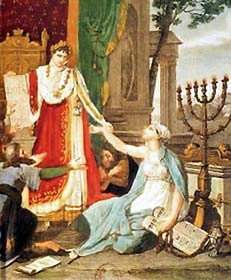
Napoleon and the Jews, Wikipedia:

Napoleon’s indirect influence on the fate of the Jews was even more powerful than any of the decrees recorded in his name. By breaking up the feudal trammels of mid-Europe and introducing the equality of the French Revolution he effected more for Jewish emancipation than had been accomplished during the three preceding centuries. The consistory of Westphalia became a model for other German provinces until after the fall of Napoleon, and the condition of the Jews in the Rhine provinces was permanently improved as a consequence of their subjection to Napoleon or his representatives. Heine and Börne both record their sense of obligation to the liberality of Napoleon’s principles of action, and the German Jews in particular have always regarded Napoleon as one of the chief forerunners of emancipation in Germany.

(Image from Jews and French Grand Opera.)

Criticism of The Culture of Critique

Below are some excerpts from a review by PLEASUREMAN, The Culture of Critique – My Posting Career (original emphasis):

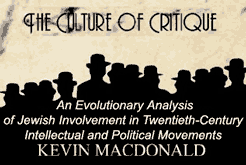
When I started reading Kevin MacDonald’s The Culture of Critique, I didn’t quite know what I was getting into. John Derbyshire was warned about people who get “the Jew thing”, and as I mentioned in Who’s Afraid of Kevin MacDonald? his own review of MacDonald’s work more or less pretends that the last 40 years of major Jewish influence on conservative politics never happened. It’s one thing to find this influence an overall positive thing, but to forget to mention that it happened strikes one as careless, especially when reviewing a work that discusses just this influence.

If conservatives are not introspective it follows that they are not closely focused on the permutations of conservatism that go beyond policy debate, including the permutations that lead to conservatism’s dark side. This dark side includes a tendency towards authoritarianism, close-mindedness, and paranoia. Liberalism has its extremism, conservatism has its dark side. It would be naive to fail to acknowledge this dark side when approaching controversial work like MacDonald’s. Unlike Herrnstein and Murray’s The Bell Curve, The Culture of Critique is not anchored in decades of irrefutable science, it is a more at a theory that attempts to explain Jewish dominance in Western academia, politics, and business. Moreover it is a theory tied to an already controversial idea, that ethnic groups can have an unconscious or subconscious group evolutionary strategy which benefits not merely the individual but the group itself. This goes beyond the normal attachment one feels for one’s nationality or ethnicity, and suggests that genetics and culture can interact in such a way that the result is justifiably called an evolutionary strategy.

But more than that, MacDonald’s scholarship is in what contemporary culture defines as forbidden territory. It must stand in the shadow of a malevolent lunatic fringe that has always followed conservative thought–a fringe that finds Jewish (and other) conspiracies everywhere, lives in fear of sinister forces, and rages impotently about everything it sees as a potential threat. There is no way to approach the question of Jewish influence without both conjuring this fringe and finding oneself accused of sympathy with it.

In my view, MacDonald’s incisive work is worth reading whether you are prepared to believe in a group evolutionary strategy or not, whether you believe Jewish influence has been pronounced or not. Even if MacDonald is completely wrong, his approach to groups deserves attention, particularly with regard to the ongoing transformation of American political life from a culture formed and guided by Northern Europeans to one that is approaching complete ethnic pluralism. I think it is likely that Jewish culture, as it has been shaped over the millenia, has worked to reinforce a set of behaviors, beliefs, and strategies with regard to other groups (and particularly with the universalist-minded West), and whether it is driven by evolutionary forces is beside the point–it nevertheless is, and has been strikingly influential upon the events of the 20th century. Indeed, it has changed the course of American history.

My initial goal here is to summarize MacDonald’s arguments and evidence, by chapter. This post is an introduction, and subsequent posts will take the chapters in sequence.

As Henry Ford remarked about Charles Lindbergh, “When Charles comes out here, we only talk about the Jews.” Get ready to talk about the Jews.

MacDonald next mentions Stephen Jay Gould, whose long record of intellectual prevarication on the subject of genetic differences (and human biodiversity in particular) speaks for itself. Gould has been an incredibly important figure in the demonization of psychometrics and his book The Mismeasure of Man is virtually a bible for what one might term the anti-intelligence clergy (intelligence doesn’t exist, cannot be measured, is not variable, etc). According to MacDonald, Gould’s views were influenced by his Jewish-Leftist identity and fear of anti-Semitism.

Gould made exaggerated and provably false claims about the congressional debates of the period. The immigration debate was largely about preserving America’s Nordic-derived identity and culture, and IQ testing did not play a significant role in any part of it. Gould’s response to such criticism was to ignore it, a response that has become a tradition among Gould’s worshipful and ill-informed followers. (Similarly, Gould ignored all modern IQ research on the ludicrous grounds that it was “ephemeral”.) A revised edition of The Mismeasure of Man essentially ignored all critical response to Gould’s book.

Gould further claimed that the 1924 immigration law was in some sense responsible for the deaths of Jews unable to emigrate from German-held territories before World War II, a hyperbolic and frankly hysterical conclusion that has become typical of Jewish anti-intellectualism. This rhetorical behavior is readily found in much Jewish political output, and MacDonald catalogues the varieties of it found in Gould’s work, including use of denigrating labels, oversimplified straw men, gilded writing, and perhaps the most popular technique, claiming moral superiority over one’s debate opponents. Nevertheless, Gould maintains a high level of posthumous prestige.

The Culture of Critique – My Posting Career – Page 2:

A response to The Culture of Critique

I was going to canvass some of the responses to MacDonald’s book, but why not just quote from the SLPC’s considered, measured review:

SPLC:

Kevin MacDonald is the neo-Nazi movement’s favorite academic. A psychology professor at California State University, Long Beach, MacDonald, who also is a board member of the white supremacist Charles Martel Society, published a trilogy that supposedly “proves” that Jews are genetically driven to destroy Western societies. MacDonald also argues that anti-Semitism, far from being an irrational hatred for Jews, is a logical reaction to Jewish success in societies controlled by other ethnic or racial groups. After the publication of a 2007 Intelligence Report exposé detailing MacDonald’s anti-Semitism, his teaching duties were reduced and many of his colleagues publicly condemned his racist research.

This is, as you have seen in my summary of MacDonald’s book, wholly malicious, tendentious, and dishonest. But we expect nothing less from the SPLC, a Jewish dominated organization that carefully manages its Wikipedia page to remove any hint of criticism. The SPLC is fixated on white supremacist groups but has of late broadened its scope to include any right-wing rhetoric that is more arousing than David Brooks after a bong hit. It doesn’t have any serious charter to pursue hatred as such, or else it would have to monitor itself for its flamboyant belligerance and crude bullying and coercion.

It may as well be said that this type of aggressive, moralistic posturing is a signature of Jewish rhetoric. It has such a long tradition that it must be recognized by everyone today as the sort of thing Jews often do–it is a hallmark, for example, of arguments in favor of Israel’s right to do everything, and was used extensively by neocons to justify the Iraq War.

This manner of argument is in keeping with Judaism’s aggressive competitive tendencies, high Jewish IQ, and legalistic morality. I add the last item because legalistic moral systems must of necessity be rigid. They are based on the idea that goodness is not arrived at by communal judgement (favored in altruistic societies), but by command of authority–and here the difference with Christianity could not be more striking. As I have noted in another context, much of the behavior we see today is premised on the notion that what is legally permissable is morally permissable–a statement very pregnant with meaning, and very much an inheritance from Jewish thinking, whether we realize it or not.

And what about The Culture of Critique? MacDonald chose his title well–Jewish culture is very tied up in the idea that argument, even tendentious argument, is good. I am not sure I follow him in his belief that Jewish behavior is an evolutionary adaptation–but let me qualify this. The idea of group evolutionary behavior remains controversial. There is some question as to how it operates through natural selection; I am not expert enough to present either side of this question. But then I suspect that the interaction between culture and natural selection is rather murky and difficult to quantify, much as most mixed nature-nurture traits are.

It is quite possible that characteristic Jewish culture was formed by happenstance–that is, it was shaped by the unique series of events and struggles it found itself in due to its place and time of origin and adjacent cultures. As a firm believer in the role that randomness plays in all life, I am not convinced that an explanation of cultural thinking must be any less arbitrary than this.

This remains an academic question because we can never develop a rigorous and falsifiable theory–we are left to believe what we will. But however it came to be, Jewish culture as it is today is a compelling force that has dramatically changed Western culture.

Perhaps a more interesting line of argument is that Jewish culture is a byproduct of high IQ. The pursuit of pluralism, for example, can be seen as Jewish defensiveness given its competitive nature–but it is also the mark of high IQ novelty seekers. Similarly, many of the ideological movements that MacDonald surveys had little trouble attracting gentiles of a certain type, however dominated their upper ranks may have been by Jews. And by “certain type” I am referring to the cognitive elite–the class of person who is readily won over to abstract theories and is disdainful of traditional practices. That Jews dominate may have less to do with Jewish culture and more to do with Jewish IQ. One omission MacDonald makes is in comparing Jewish achievement and wealth without controlling for IQ.

However this book is an impressive survey of Jewish involvement in the great changes of the 20th century. Wherever one comes down on this subject, it deserves better than the SPLC’s malicious and disingenuous treatment, or the cool oblviousness of most of the rest of Western society. It opens the door to many fascinating questions, not only to Jewish culture but to the whole nature of Western civlization and its potential downfall, to the study of group interaction, to the contrast between impermeable and assimilationist societies. It is a serious and manifestly well-intentioned academic work.

And for that reason, the reception of MacDonald’s work should be considered scandalous. We do not live in a freely thinking society if this careful and conscientious exploration of group behavior is beyond the pale. But then, looking around, one can readily see that we in fact live in a society governed by frivolity, snark, and clownishness–clownishness much like the SPLC’s ridiculous summary of MacDonald’s study of Jewish culture. Such is our intellectual world.

I do not agree with MacDonald that ethnic separatism offers European-derived culture anything more than devolution. I think ethnic separatism within a diverse nation will alter what we think of as Western culture and turn it into something no better than the self-interested ethnic enclaves that have exploited it. Universalism is simply a hallmark of the West; if it loses this trait, it loses itself.

The question of what to do is far too complicated to explore briefly, but a return to assimilationism and a renewal of Western values must be the only plausible course. All of our politics should be subordinate to this issue.

The Culture of Critique – My Posting Career – Page 3:

It’s sometimes used as an excuse that Jews even criticize themselves, without acknowledging that Jewish self-criticism is aimed at increasing cohesion by punishing deviation (such as intermarriage), while Jewish criticism of other cultures is aimed at undermining cohesion. It is silly to equate the two.

Kevin MacDonald:

I do think that the social tensions resulting from this assault on our people and culture will eventually get to the point that there will perforce be an audience for my work. It may seem odd to phrase it this way, but in a real sense all of us writing from a pro-White, pro-European perspective should be desperately trying to break through into the wider culture — to become famous and respected. If it doesn’t happen for any of us, then we have surely lost.

Referring to an interview with Kevin MacDonald by Alex Kurtagic:

http://www.wermodand…0220110000.html

The treatment of MacDonald shows the ugliest side of Jewish culture, particularly because the venue is academia. For me it is a reason I can never feel sympathetic toward Jewish concerns or Jewish claims of injustice; their culture is very hospitable to injustice and quite glibly so.

Jews Run Hollywood, Whites Get the Blame

New York Times critic Manohla Dargis, who is not Jewish, but to use her words, “I am married to a Jewish man, so I am sensitive to the representation of”how jewish Hollywood is. It doesn’t stop her from complaining that Hollywood’s movies are too “white”.

Steve Sailer quotes Dargis, reacts to her misdirected distaste like it’s a big joke, and tosses in his own sneer at “hillbilly” “white trash” for good measure. Sailer likes things like this. He calls attention to White/jew double standards without identifying them as such. Then instead of a sober lecture about “human biodiversity” he serves up a comedy schtick.

The search result in the first link in this post has been scrubbed of the blurb concerning Dargis’ jewish sensitivities, but the short synopsis that remains is relevant in its own right. Project MUSE – Shofar: An Interdisciplinary Journal of Jewish Studies – The Fockerized Jew?: Questioning Jewishness as Cool in American Popular Entertainment, by Samantha Baskind:

This essay examines the recent upsurge in overt Jewish identity in American popular culture, using the film Meet the Parents (2000) and its sequel Meet the Fockers (2004) as a case study to demonstrate how the Jewish Jew is no longer avoided and when portrayed does not fall victim to stereotyping. While looking at these two films together, I describe a broader evolution in media from the de-ethnicized Jew, and for that matter the de-ethnicized Jewish actor, to performers flaunting (and thereby celebrating) Jewishness in a Christian-centric society that has found acceptance of the Other. The paper also questions what about Jewishness is cool and describes how viewer subjectivities influence the perception of coolness.

The “upsurge in overt jewish identity” continued with Little Fockers (2010), which Dargis reviewed:

Part of what made the first movies work as well as they did — “Meet the Parents” hit in 2000, and its sequel, “Meet the Fockers,” followed four years later — was the cultural clash that dare not fully speak its name. Initially, the series only broadly winked at the reasons for Jack’s slow-burning tsuris. Was that a bagel in Greg’s pocket, or was he just glad to see his shiksa girlfriend and then wife, Pam (Teri Polo)? But when the second movie brought in Barbra Streisand and Dustin Hoffman to play Greg’s parents, any residual anxiety about the characters’ nominal cultural differences gave way to the spectacle of two legends playfully batting around the Jewish stereotypes that the stars themselves struggled against and transcended.

What Dargis calls “the cultural clash that dare not fully speak its name”, and then dances around in ewjay odecay, speaks its name quite clearly in jewish studies journals. Jews may fault everybody else for regarding them as the Other, but the truth is they freely discriminate themselves from “whites” whenever they like. When Whites distinguish ourselves from jews they act as if we’re morally or mentally defective.

Here are three more reviews of the Fockers series, with the common thread being an acute jewish awareness of the distinction between jews and Whites.

Meet the Parents: Little Fockers | SabDesi paints the Focker culture clash as one-sided “anti-semitism”:

There has always been some interesting cultural tension behind these films, an argument between race and power. Jack Byrnes (no relation, thank God) is a White Anglo-Saxon Protestant male force entering the domestic arena. That’s why his character worked for the CIA for 34 years, including 19 months in a Vietnamese prison camp; he is American power brought to bear on the enemy within – the schlemiel who is stealing his princess.

Greg Focker’s fool is a very old kind of Jewish comic character – a Jew who fears life among the Gentiles. Ben Stiller is its foremost practitioner in modern movies. It was clear in the first movie that a large part of Jack’s objection to Greg was anti-Semitism, along with his contempt for his caring profession. “Not a lot of men in your profession, are there Greg?” he asked in the first movie.

The second movie went further into this anti-Semitism, with Dustin Hoffman and Barbra Streisand as Greg’s parents, Bernie and Roz. They were hippies from Florida – a tad embarrassing but open-hearted. Roz was a flamboyant TV sex therapist; Bernie’s job was to smother everyone with kisses, especially Jack. The contrast was obvious but effective: cold eastern Protestant establishment versus warm kosher humanity. Puritans versus emigrants: no wonder Spielberg was interested.

Dannielle Blumenthal, self-described “Professional communicator fascinated by all things branding”, explains How the “Little Fockers” Brand Makes Sexism, Racism, and Anti-Semitism OK:

While the character of Roz Focker (Bernie’s wife) is supposed to represent liberated femininity, she is also portrayed as emasculating, pushy (recall the stereotype of the “pushy Jew”), and even a bit crazy. The message being that “women’s libbers” are all three of these things.

In contrast, Pam Focker (Greg’s wife) and Dina Byrnes (Jack’s wife) are portrayed as “normal and stable,” wives who know their place, don’t make “trouble” (e.g. emotional demands), and support their husbands endlessly no matter how crazy and possibly even unfaithful they act.

It is precisely Pam’s endless supportiveness, as well as her stereotypical Barbie-like beauty, that leads her to be portrayed as the “one true love” of Kevin, who pursues other women, but can never forget her. The most that Pam asks of Greg is to check on the facepainter for the kids’ upcoming birthday party, and when he doesn’t do it, she simply sighs and leaves the room.

In terms of racism, there were very few African-Americans in this movie at all, much less any in power. I saw one character playing a patient, one playing an incompetent nurse, and another on the subway train as an “extra.” Do the Fockers and the Byrnes not have any African-American friends, associates, customers, and so on? Why was the movie so “White?” I’m not saying that movies have to be advertisements for diversity but the Caucasian-ness of the movie seemed extreme.

There is another example of anti-Semitism besides the writers’ antipathy toward Roz (and Bernie) but I don’t want to give away that part of the plot.

Clearly though this is very much a movie poking fun at “WASP” culture and the difference between it and the movie’s Jewish characters. It seems like WASPiness is “idolized,” but also seen as dysfunctional, whereas Jewish culture is a kind of corrective. (Interestingly I was reading the book “Stuff White People Like” yesterday and it had a similar attitude toward WASPiness. It was also hilarious.)

Blumethal is hyper-sensitive to anti-jew slights, but like Sailer anti-White slights make her laugh.

The Fockers Trinity, by Joan Alpert:

Despite the silliness, the movies portray the shifting role of Jews in American culture. Jews have previously been portrayed as outside the majority culture; their masculinity is different than the norm; they are neurotic, weak and effeminate—a continuation of the anti-Semitic tradition that questioned Jewish maleness, says Daniel Itzkovitz, director of American Studies at Stonehill College in Easton, Massachusetts and contributor to the 2006 Jewish Identity in Postmodern American Culture. The movies give an “unwholesome perception of Jews,” claims one commentator, Rabbi Daniel Lapin, an Orthodox rabbi in California, by portraying them as “heinous caricatures.”

Fockers’ writer Joe Hamburg however, defends his films’ non-Jews. They “are not anti-Semitic,” he says; it’s just that Greg “feels out of place” in a WASP world in which bulletproof Kevlar surrounding the family van is the answer to paranoia, and lie detector tests and sodium pentathlon injections are the means to truth. Life is serious. Pam warns Greg, “Humor is entirely wasted on my parents.”

Basically, the WASP, Jack, is a jerk and the Jew, Greg, is a schlemiel, and the schlemiel wins. Actually, Greg is “a post modern schlemiel,” says Itzkovitz. Although he has the attributes of the stereotypical nerdy fumbler, “American society is now identifying with him.” He adds: “Non-Jews as well as Jews are feeling unsettled in the 21st century.” They realize they are not all-powerful, like Rambo, but anxious and insecure like Greg, whose warmth, decency and caring attract Pam.

There you have it. The professional jewish bigots say, “hey, your movies are anti-jew”. The writer answers, “nope, anti-WASP”.

“[T]he shifting role of Jews in American culture” has been to steadily displace and dispossess Whites. The jew schlemiels win. The White jerks lose. That’s how and why movies like the Fockers get made. That’s why Hollywood is the way it is.

UPDATE 15 Feb 2011: Danielle “Hollywood Jew” Berrin and friends lift the veil on an Oscar-nominated “white” film, Aaron Sorkin’s The Social Network, which they see as a jewish production with a central jewish theme.

Who does Aaron Sorkin really hate? | Jewish Journal:

While it is true that women in general do not shine in “The Social Network,” the critique is misguided, because Sorkin is quite specific as to which kind of women he is referencing, when he references them at all — and they come in two forms: Asian Americans and Jews. According to a surface reading, neither gets a pretty portrait; Asian women are depicted as attractive and easy, and Jewish women are brawling shrews.

Jewishness, in general, is a characteristic the fictional Zuckerberg and his friends are desperate to escape. At the Caribbean Night party at the Alpha Epsilon Pi house, one of Zuckerberg’s friends wryly remarks: “There’s an algorithm for the connection between Jewish guys and Asian girls: They’re hot, smart, not Jewish and can dance.” Sorkin would have us believe that, in the eyes of some Jewish men — or at least those run-of-the-mill Harvard scholars — one of the best things about an Asian woman is that she isn’t a Jewish woman. And in Sorkin’s story, Asians get bonus points for performing oral sex in public bathrooms.

“That’s not what you’re going to get from an Erica,” said Olivia Cohen-Cutler, referring to the film’s only female Jewish character. Cohen-Cutler, a senior executive at ABC, is the chair of Hadassah’s Morningstar Commission, which devotes attention to images of Jewish women in the media. While most are decrying the film’s treatment of women, Cohen-Cutler sees something different in the character Erica Albright.

In the film’s opening scene, the fictional Zuckerberg is on a date with Erica, who is pretty, sophisticated and exquisitely articulate. While trying to woo her, an arrogant and socially inept Zuckerberg winds up insulting her every which way, which prompts Erica to unequivocally reject him: “You’re going to be successful and rich. But you’re going to go through life thinking that girls don’t like you because you’re a tech geek. I want you to know, from the bottom of my heart, that won’t be true: It’ll be because you’re an asshole.”

But her assertiveness, while well-founded, is met with a withering take-down. Zuckerberg avenges himself on his blog, her rejection providing the impetus for the creation of “Facemash” — the beginning of Facebook.

In real life, he wrote, “[So and so] is a bitch. I need to think of something to take my mind off her. Easy enough. Now I just need an idea.”

In the movie, the fictional Zuckerberg also insults the size of her breasts — and her last name, with a subtle dig about how her family changed their name from “Albrecht” to “Albright” — the only hint that she is Jewish, though it’s never explicitly confirmed.

“In one way [the Zuckerberg character] was saying, ‘She’s a fraud because her family did this and I’m not because I’m still Zuckerberg,’ “ Cohen-Cutler said in an interview. “What you saw throughout the film was a combination of Zuckerberg’s arrogance and self-loathing related to his otherness, which played into the ‘Jewish men hate Jewish women’ continuum.”

If this were pure fiction, it might sting a little less, but unfortunately it isn’t: Zuckerberg, who might be the most eligible Jewish bachelor in the world, met his real-life girlfriend, the Chinese American medical student Priscilla Chan, on erev Shabbat at an AEPi party during his sophomore year. (According to The New Yorker, friends speculate that they will marry.)

Liel Leibovitz, a writer for the online Jewish magazine Tablet and an assistant professor of communications at New York University, believes this is just more evidence that Hollywood is undeniably and irretrievably hostile to Jewish women.

“Being ‘Jewish’ in Hollywood means adhering to the stereotype, namely the smart and shlubby person who overcomes insecurities and applies wit to get ahead,” Leibovitz wrote via e-mail. “That, of course, is a stereotype that’s great for guys, but not too great for women. While Jewish men can fit right into the ‘Jewish’ niche in Hollywood’s arsenal of preconceived notions and crumbling clichés, Jewish women cannot.”

Indeed, Erica is punished, not for being the object of the male gaze, but for subverting it by being the only character in the movie who is actually smarter than Zuckerberg. Even if her rejection is the proper comeuppance for his immaturity and arrogance, it is Zuckerberg who becomes the hero, while Erica remains the heartless wench who wounded him.

Where does this animosity toward Jewish women come from?

“I am convinced by the theory that pins the blame largely on Jewish men,” Leibovitz wrote in his e-mail. His much-read 2009 article “Gentlemen Prefer Blondes” postulates that both Hollywood’s executives and its leading men prefer shiksas. Period.

In that vein, Sorkin’s script and its obvious aversion to Jewish women can be seen as an indictment of Jewish women nobody likes: the entitled Jewish American Princess and the overbearing Jewish Mother. But Erica Albright-Albrecht doesn’t fit into either of those stereotypes, even if she derives, in some way, from an archetypal Jewish feminine strength.

“I long for the day when a Jewish actress would play a Jewish character that’s just the normal, uncomplicated, unremarkable love interest who also happens to be Jewish,” Leibovitz said.

An uncomplicated Jewish woman? No wonder Sorkin doesn’t deliver. He seems, instead, ambivalent about them. He can’t stand the stereotypical figures (either on screen or from his own life), but he is also trying to imagine something different. So while Erica is reproved for her boldness, it is Zuckerberg who ends up endlessly longing for her, and an ideal that doesn’t really exist.

I suppose it’s asking Hollywood too much for two smart, good-looking Jews to run off into the sunset together. Or at least, in this case, to Silicon Valley.

“It’s too bad that this movie, which is really a testament to the brilliance and single-mindedness of someone, had to flip the bird to being Jewish,” added Cohen-Cutler, who admitted she loved the movie regardless.

Too bad, indeed. The real world is full of Jewish women whose qualities run contrary to Hollywood stereotypes. Which leads me to believe that it isn’t Jewish women that are the problem; it’s that Jewish men like Mark Zuckerberg and Aaron Sorkin are hanging out with the wrong ones.

Jews like Berrin, Cohen-Cutler, and Leibovitz are obsessed with jewishness and jewish interests. They are free to observe and opine on those interests from authoritative, paid positions without being pathologized or demonized as “racists”. They are exquisitely attuned to the most subtle cues of jewishness and what they perceive to be anti-jewish slights. They personify the “stereotype” of jewish women (and neurotic, weak, effeminate jewish males) as brawling shrews.

In contrast non-jews are not similarly obsessed or attuned, or at least are strongly discouraged from being so by the pathologization and demonization they would be subjected to should they behave in such a fashion. If they see The Social Network in racial terms at all they see it as a “white” film. The subtle slights remain, but can instead be seen through White-centric eyes as evidence that Hollywood, and the jewish shrews, are undeniably and irretrievably hostile to Whites. (The word “shiksa”, for instance, is an epithet on par with “kikess”. Jews feel comfortable using such insults, confident that non-jews either don’t understand or that those who do can be dismissed as “anti-semites” for objecting to it.)

Liel Leibovitz’s Gentlemen Prefer Blondes provides more of the same hyper-aware jewish analysis:

Since the dawn of American entertainment, Jewish women were largely rendered invisible, absent everywhere from burlesque to Hollywood to prime-time television. Instead, they watched as their sons and brothers and husbands became successful producers, directors, and impresarios, powerful men who then chose to populate their works with a parade of sexy, sultry shiksas who looked nothing like their female kin.

Note that for Berrin and Leibovitz jewishness is about kinship, who a jew chooses to mate with. They do not pretend it is about religion. Their double-talk is that jewish men run Hollywood but have used their power to bash jewish women. This is an implausible rationalization offered as a substitute for the more plausible view that the jews who run Hollywood initially rendered jewish men and women alike invisible. Now that their hated competitors the WASPs have been routed jewish domination is increasingly secure, not only in Hollywood, but media in general, not to mention law, finance, education, and politics. What we are actually subjected to is “the recent upsurge in overt Jewish identity in American popular culture” that Baskind takes note of. The large number of recent films starring Ben Stiller, Adam Sandler, and Seth Rogen come to mind.

Of course through jewish eyes everything is about jews. Every situation is evaluated based on what’s good or bad for jews. Jewish dominance is never complete enough. Jewish “stereotypes” are like so many jewish Moby-Dicks, haunting jews even as they obsess over them, sniffing them out and impotently trying to slay them. Though jews are fanatically self-aware and hyper-critical the blame is inevitably transferred to someone else. They change names and get nose jobs but only because “anti-semitism” compels them to do so. They make movies portraying WASPs as buffoons, but what they actually see is cryptic “anti-semitism” glorifying “shiksas”.

No matter how self-consciously White I try to imagine being I can’t ever hope to hold a candle to such bigotry.