Yockey on Liberalism – Part 5

Imperium-cover

Deep in the weeds of Yockey’s critique of liberalism. Continuing with Imperium, The 20th Century Political Outlook, p212:

A moment’s reflection shows that Liberalism is entirely negative. It is not a formative force, but always and only a disintegrating force. It wishes to depose the twin authorities of Church and State, substituting for them economic freedom and social ethics. It happens that organic realities do not permit of more than the two alternatives: the organism can be true to itself, or it becomes sick and distorted, a prey for other organisms. Thus the natural polarity of leaders and led cannot be abolished without annihilating the organism. Liberalism was never entirely successful in its fight against the State, despite the fact that it engaged in political activity throughout the 19th century in alliance with every other type of State-disintegrating force. Thus there were National-Liberals, Social-Liberals, Free-Conservatives, Liberal-Catholics. They allied themselves with democracy, which is not Liberal, but irresistibly authoritarian in success. They sympathized with Anarchists when the forces of Authority sought to defend themselves against them. In the 20th century, Liberalism joined Bolshevism in Spain, and European and American Liberals sympathized with Russian Bolsheviks.

Liberalism can only be defined negatively. It is a mere critique, not a living idea. Its great word “freedom” is a negative–it means in fact, freedom from authority, i.e., disintegration of the organism. In its last stages it produces social

This is a reiteration of what we found earlier in Yockey’s description of political organisms, the friend-enemy disjunction, and the Laws of Totality and Sovereignty: liberalism is opposition to authority, a disintegrating force with dissolves political organisms and kills them dead.

Yockey’s view of democracy as “not Liberal, but irresistibly authoritarian in success” differs from the conventional view which conflates and even equates liberalism with democracy – e.g. “liberal democracy”. Yockey delves into democracy next, starting on page 224.

213

atomism, in which not only the authority of the State is combated, but even the authority of society and the family. Divorce takes equal rank with marriage, children with parents. This constant thinking in negatives caused political activists like Marx, Lorenz v. Stein and Ferdinand Lasalle to despair of it as a political vehicle. Its attitudes were always contradictory, it sought always a compromise. It sought always to “balance” democracy against monarchy, managers against hand-workers, State against Society, legislative against judicial. In a crisis, Liberalism as such was not to be found. Liberals found their way on to one or the other side of a revolutionary struggle, depending on the consistency of their Liberalism, and its degree of hostility to authority.

Even while Yockey was writing this, a seminal assault on the authority of White society and families was on its way. The Authoritarian Personality came not from atomistic “liberals” but from jews obsessed with the best interests of their own collective organism:

The Authoritarian Personality is a 1950 sociology book by Theodor W. Adorno, Else Frenkel-Brunswik, Daniel Levinson, and Nevitt Sanford, researchers working at the University of California, Berkeley, during and shortly after World War II.

The Authoritarian Personality “invented a set of criteria by which to define personality traits, ranked these traits and their intensity in any given person on what it called the ‘F scale’ (F for fascist).”

The impetus of The Authoritarian Personality was the Holocaust, the attempted genocidal extinction of European Jews by Adolf Hitler’s National Socialist party. Adorno had been a member of the “Frankfurt School”, a predominantly Jewish[7] group of philosophers and Marxist theorists who fled Germany when Hitler shut down their Institute for Social Research. Adorno et al. were thus motivated by a desire to identify and measure factors that were believed to contribute to antisemitic and fascist traits.

Here we see a contrast in personality traits of Whites and jews. Whites thought the war was over. Jews never stopped fighting. The jews find fault in White thinking. Whites, to the extent they even think about it, agree.

Back to Yockey:

Thus Liberalism in action was just as political as any State ever was. It obeyed organic necessity by its political alliances with non-Liberal groups and ideas. Despite its theory of individualism, which of course would preclude the possibility that one man or group could call upon another man or group for the sacrifice or risk of life, it supported “unfree” ideas like Democracy, Socialism, Bolshevism, Anarchism, all of which demand life-sacrifice.

II

From its anthropology of the basic goodness of human nature in general, Rationalism produced 18th century Encyclopedism, Freemasonry, Democracy, and Anarchism, as well as Liberalism, each with its offshoots and variations. Each played its part in the history of the 19th century, and, owing to the critical distortion of the whole Western Civilization entailed by the first two World Wars, even in the 20th century, where Rationalism is grotesquely out of place, and slowly transformed itself into

214

Irrationalism. The corpse of Liberalism was not even interred by the middle of the 20th century. Consequently it is necessary to diagnose even now the serious illness of the Western Civilization as Liberalism complicated with alien-poisoning.

Because Liberalism views most men as harmonious, or good, it follows that they should be allowed to do as they like. Since there is no higher unit to which all are tied, and whose superpersonal life dominates the lives of the individuals, each field of human activity serves only itself — as long as it does not wish to become authoritative, and stays within the framework of “society.” Thus Art becomes “Art for Art’s sake,” l’art pour l’art. All areas of thought and action become equally autonomous. Religion becomes mere social discipline, since to be more is to assume authority. Science, philosophy, education, all are equally worlds unto themselves. None are subject to anything higher. Literature and technics are entitled to the same autonomy. The function of the State is merely to protect them by patents and copyrights. But above all — economics and law are independent of organic authority, i.e., of politics.

Benjamin Constant, who in Yockey’s estimation was perhaps “the purest expression of the doctrine of Liberalism”, was an early popularizer of the expression art for art’s sake. Also:

A Latin version of this phrase, “Ars gratia artis”, is used as a motto by Metro-Goldwyn-Mayer and appears in the circle around the roaring head of Leo the Lion in its motion picture logo.

Thinking of and speaking to the future, Yockey describes the interplay of freedom, economics and law:

Twenty-first century readers will find it difficult to believe that once the idea prevailed that each person should be free to do as he pleased in economic matters, even if his personal activity involved the starvation of hundreds of thousands, the devastation of entire forest and mineral areas, and the stunting of the power of the organism; that it was quite permissible for such an individual to raise himself above the weakened public authority, and to dominate, by private means, the inmost thoughts of whole populations by his control of press, radio and mechanized drama.

They will find it more difficult yet to understand how such a person could go to the law to enforce his destructive will. Thus a usurer could, even in the middle of the 20th century,

215

invoke successfully the assistance of the law in dispossessing any numbers of peasants and farmers. It is hard to imagine how an individual could injure the political organism more than by thus mobilizing the soil into dust, in the phrase of the great Freiherr von Stein.

Heinrich Friedrich Karl vom und zum Stein:

Heinrich Friedrich Karl Reichsfreiherr[a] vom und zum Stein (25 October 1757 – 29 June 1831), commonly known as Baron vom Stein, was a Prussian statesman who introduced the Prussian reforms that paved the way for the unification of Germany. He promoted the abolition of serfdom, with indemnification to territorial lords; subjection of the nobles to manorial imposts; and the establishment of a modern municipal system.

Stein was from an old Franconian family.

The Prussian reforms were liberalism in action and included emancipation of the jews.

But — this followed inevitably from the idea of the independence of economics and law from political authority. There is nothing higher, no State; it is only individuals against one another. It is but natural that the economically more astute individuals accumulate most of the mobile wealth into their hands. They do not however, if they are true Liberals, want authority with this wealth, for authority has two aspects: power, and responsibility. Individualism, psychologically speaking, is egoism. “Happiness” = selfishness. Rousseau, the grandfather of Liberalism, was a true individualist, and sent his five children to the foundling hospital.

Law, as a field of human thought and endeavor, has as much independence, and as much dependence as every other field. Within the organic framework, it is free to think and organize its material. But like other forms of thought, it can be enrolled in the service of outside ideas. Thus law, originally the means of codifying and maintaining the inner peace of the organism by keeping order and preventing private disputes from growing, was transmuted by Liberal thought into a means of keeping inner disorder, and allowing economically strong individuals to liquidate the weaker ones. This was called the “rule of law,” the “law-State,” “independence of the judiciary.” The idea of bringing in the law to make a given state of affairs sacrosanct was not original with Liberalism. Back in Hobbes’s day, other groups were trying it, but the incorruptible mind of Hobbes said with the most precise clarity that the rule of law means the rule of those who determine and administer the law,

216

that the rule of a “higher order” is an empty phrase, and is only given content by the concrete rule of given men and groups over a lower order.

Who pays the piper calls the tune. He who administers the law rules.
Why Does Ricardo Duchesne Act Like He Can’t See the Jews?

suggestedlogoRev1

Via Mangan, Richardo Duchesne at Council of European Canadians asks, The Great Fear — Why do Whites Fear their own Ethnicity?

I encourage readers to watch “The Great Debate – Xenophobia: why do we fear others?” This debate, which took place at Arizona State University, March 31, 2012, was about the human instinct to form in-groups and out-groups particularly along ethnic lines. The members in this panel (primatologist Frans de Waal, economist Jeffrey Sachs, psychologist Steven Neuberg, neuroscientist Rebecca Saxe, and physicist and mathematician Freeman Dyson) all recognized in varying ways the powerful drive within all living beings, including bacteria, to organize themselves into in-groups and out-groups; and yet the tenor and objective of the conference, as evident from the title, was to view this as a problem that needs to be transcended.

Why a problem to be transcended? Because this evolutionary selected instinct is characterized by xenophobia, fear of those groups who are different, and preference for one’s ethnic group. But why is this a problem if it is a behavioral disposition selected by nature for its survival advantages? Because this is a panel of Western scientists committed to the idea that diversity is a strength and that Western societies must be open to mass immigration. Why? Because these scientists are members of a European-created culture that has come to believe that European ethnocentrism, and only this ethnocentrism, is harmful to humanity. Therefore, Europeans, and only Europeans, must work towards universal forms of community and human solidarity without outside-ness and without fear of the other.

Duchesne goes on to note that Sachs was “the most articulate in his explicit admission that we must follow the ideology of diversity regardless of what the scientific evidence says” and wonders, “How can a man of Sachs’s intellectual stature go for an argument that is devoid of merit?”

After searching in vain for some hint of jew-awareness, I left a comment. It seems to be stuck in moderation.

The answer is not complicated. It is not a mystery. The basic mechanics of group psychology are right there in Duchesne’s discussion. Yet he makes no mention of the jews or their anti-White animus. Instead he acts as if jews and Whites are inseparable partners in one big indistinguishable “us”.

In reality the jews are the archetypical Other. Deference to and worship of the Other is a jew-created culture. A plurality of the panel Duchesne discusses, including Sachs, are jews. Jews stereotypically psychopathologize Whites for not doing enough to “transcend” supposed problems like “xenophobia”. To put it in Duchesne’s own terms, this is a behavioral disposition which confers a survival advantage to jews at the expense of Whites.

Why do Whites, especially those who think deeply about group identity and psychology, fail to distinguish and acknowledge that jews see themselves as a group separate from Whites, and that jews as a group are in fact hostile and harmful to Whites? Why do Whites insist on pretending that jews are White and would rather think and say Whites are doing this to ourselves than note the clear differences between us and them? Why?

The word “self-delusion” came often to my mind as I heard these speakers. Self-delusion is defined as the act or state of deceiving or deluding oneself. A common example, the dictionary tell us, “is a person who believes himself to be much smarter than he actually is.” But these scientists are smart. Perhaps the definition by Voltaire would apply: “The human brain is a complex organ with the wonderful power of enabling man to find reasons for continuing to believe whatever it is that he wants to believe.” But the self-delusion here is even worse since these scientists have found reasons (based on their life-long research) not to believe whatever it is they want us to believe, but they still believe what they are ideologically expected to believe. And they are doing this openly in front of a large audience without anyone pondering over this self-imposed contradiction.

It only seems like a self-imposed contradiction when you don’t distinguish jews from Whites. The jews aren’t deluding themselves. As previously noted, jews behave as they do because they are hyper-conscious of their identity and interests, not because they are unconscious. They do what they think is good for jews, and a big part of that is guilt-tripping and scapegoating Whites. But rather than seeing jews being jews, Duchesne sees “liberals”. As I wrote in Liberalism as a Suicide Pact:

The litany of White sins – slavery, colonization, holocaust – is a jewish construct. It is jews driving the guilt-tripping that causes White guilt and negative associations with White group identity. “You aren’t liberal enough!” is the gist of it. Auster and Gottfried tack yet another item onto the list: “You’re so liberal you’re killing yourself!”

The idea that Whites are so stupid and crazy that we’re killing ourselves is just the most recent addition to the litany of White sins.

Duchesne is associated with The Occidental Observer, but his jew-blind defense of “Western civilization” smacks more of Lawrence Auster (or Takuan Seiyo, who comments on Duchesne’s article) than Kevin MacDonald.

Why does Duchesne blame Whites without mentioning the jews? Does he think it’s not important? Does he think everyone sees and understands the jews? Is he deluding himself? Why do intelligent Whites go for the arguments jews make? Because they refuse to recognize jews as the enemy. Which one is Duchesne?

Yockey on Liberalism – Part 4

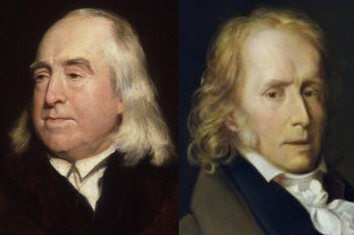
jeremy_bentham_benjamin_constant

Getting now to the meat of what Yockey had to say about liberalism.

Continuing with Imperium, Chapter 2, p209:

When it turned its gaze to History, Rationalism saw the whole tendency as one toward Reason. Man was “emerging” during all those millennia, he was “progressing” from barbarism and fanaticism to enlightenment, from “superstition” to “science,” from violence to “reason,” from dogma to criticism, from darkness to light. No more invisible things, no more spirit, no more soul, no more God, no more Church and State. The two poles of thought are “the individual” and “humanity.” Anything separating them is “irrational.”

210

This branding of things as irrational is in fact correct. Rationalism must mechanize everything, and whatever cannot be mechanized is of necessity irrational. Thus the entirety of History becomes irrational: its chronicles, its processes, its secret force, Destiny. Rationalism itself, as a by-product of a certain stage in the development of a High Culture, is also irrational. Why Rationalism follows one spiritual phase, why it exercises its brief sway, why it vanishes once more into religion — these questions are historical, thus irrational.

Liberalism is Rationalism in politics. It rejects the State as an organism, and can only see it as the result of a contract between individuals. The purpose of Life has nothing to do with States, for they have no independent existence. Thus the “happiness” of “the individual” becomes the purpose of Life. Bentham made this as coarse as it could be made in collectivizing it into “the greatest happiness of the greatest number.” If herding-animals could talk, they would use this slogan against the wolves. To most humans, who are the mere material of History, and not actors in it, “happiness” means economic wellbeing. Reason is quantitative, not qualitative, and thus makes the average man into “Man.” “Man” is a thing of food, clothing, shelter, social and family life, and leisure. Politics sometimes demands sacrifice of life for invisible things. This is against “happiness,” and must not be. Economics, however, is not against “happiness,” but is almost co-extensive with it. Religion and Church wish to interpret the whole of Life on the basis of invisible things, and so militate against “happiness.” Social ethics, on the other hand, secure economic order, thus promote “happiness. “

This calls to mind Thomas Jefferson’s invokation of “pursuit of happiness”.

From the Internet Encyclopedia of Philosophy page on Jeremy Bentham:

Jeremy Bentham was an English philosopher and political radical. He is primarily known today for his moral philosophy, especially his principle of utilitarianism, which evaluates actions based upon their consequences. The relevant consequences, in particular, are the overall happiness created for everyone affected by the action. Influenced by many enlightenment thinkers, especially empiricists such as John Locke and David Hume, Bentham developed an ethical theory grounded in a largely empiricist account of human nature. He famously held a hedonistic account of both motivation and value according to which what is fundamentally valuable and what ultimately motivates us is pleasure and pain. Happiness, according to Bentham, is thus a matter of experiencing pleasure and lack of pain.

Bentham saw happiness in terms of pleasure and pain, not “economic wellbeing”. Back to Yockey:

Here Liberalism found its two poles of thought: economics and ethics. They correspond to individual and humanity. The ethics of course is purely social, materialistic; if older ethics is

211

retained, its former metaphysical foundation is forgotten, and it is promulgated as a social, and not a religious, imperative. Ethics is necessary to maintain the order necessary as a framework for economic activity. Within that framework, however, “the individual” must be “free.” This is the great cry of Liberalism, “freedom.” Man is only himself, and is not tied to anything except by choice. Thus “society” is the “free” association of men and groups. The State, however, is un-freedom, compulsion, violence. The Church is spiritual un-freedom.

All things in the political domain were transvalued by Liberalism. War was transformed into either competition, seen from the economic pole, or ideological difference, seen from the ethical pole. Instead of the mystical rhythmical alternation of war and peace, it sees only the perpetual concurrence of competition or ideological contrast, which in no case becomes hostile or bloody. The State becomes society or humanity on the ethical side, a production and trade system on the economic side. The will to accomplish a political aim is transformed into the making of a program of “social ideals” on the ethical side, of calculation on the economic side. Power becomes propaganda, ethically speaking, and regulation, economically speaking.

Economics and ethics aren’t poles in the sense individuals and humanity are. In his view of rationalism/liberalism, economics and ethics aren’t opposed, the latter is based upon the former. The correspondence between indivduals and economics on the one hand, and between humanity and ethics on the other, also isn’t clear. Yockey’s point, I think, was that economics and ethics are connected to each other as well as to rationalism/liberalism. And even if we see economics and ethics as two somewhat independent axes, the two dimensional view they provide permits only a crimped and distorted perception of reality.

The more important polar opposites Yockey is trying to distinguish here are Liberalism and Authority.

The purest expression of the doctrine of Liberalism was probably that of Benjamin Constant. In 1814 he set forth his views on the “progress” of “man.” He looked upon the 18th century Enlightenment with its intellectualistic-humanitarian cast as merely preliminary to the true liberation, that of the 19th century. Economics, industrialism, and technics represented the means of “freedom.” Rationalism was the natural ally of this trend. Feudalism, Reaction, War, Violence, State, Politics, Authority — all were overcome by the new idea, supplanted by Reason, Economics, Freedom, Progress and Parliamentarism.

212

War, being violent and brutal, was unreasonable, and is replaced by Trade, which is intelligent and civilized. War is condemned from every standpoint: economically it is a loss even to the victor. The new war technics — artillery — made personal heroism senseless, and thus the charm and glory of war departed with its economic usefulness. In earlier times, war-peoples had subjugated trading-peoples, but no longer. Now trading-peoples step out as the masters of the earth.

Wikipedia’s page on Benjamin Constant gives us some idea why Yockey regarded him as the “purest expression” of liberalism:

One of the first thinkers to go by the name of Liberal, Constant looked to Britain rather than to ancient Rome for a practical model of freedom in a large, commercial society. He drew a distinction between the “Liberty of the Ancients” and the “Liberty of the Moderns”.[10] The Liberty of the Ancients was a participatory, republican liberty, which gave the citizens the right to directly influence politics through debates and votes in the public assembly.[10] In order to support this degree of participation, citizenship was a burdensome moral obligation requiring a considerable investment of time and energy. Generally, this required a sub-society of slaves to do much of the productive work, leaving the citizens free to deliberate on public affairs. Ancient Liberty was also limited to relatively small and homogenous societies, in which the people could be conveniently gathered together in one place to transact public affairs.[10]

The Liberty of the Moderns, in contrast, was based on the possession of civil liberties, the rule of law, and freedom from excessive state interference. Direct participation would be limited: a necessary consequence of the size of modern states, and also the inevitable result of having created a commercial society in which there are no slaves but almost everybody must earn a living through work. Instead, the voters would elect representatives, who would deliberate in Parliament on behalf of the people and would save citizens from the necessity of daily political involvement.[10]

Moreover, Constant believed that in the modern world, commerce was superior to war. He attacked Napoleon’s martial appetite on the grounds that it was illiberal and no longer suited to modern commercial social organization. Ancient Liberty tended to be warlike, whereas a state organized on the principles of Modern Liberty would be at peace with all peaceful nations.

Wikipedia also notes:

Henri-Benjamin Constant was born in Lausanne to descendants of Huguenot Protestants who had fled from Artois to Switzerland during the Huguenot Wars in the 16th century.

The Huguenot Connection, at Jewish Ideas Daily, notes how Huguenots hid jews during World War II, and refers to “a long history of Huguenot affinity with the Jews, traceable to the origins of French Protestantism and ultimately to the biblically rooted theology of John Calvin, the “father” of Reform Protestantism”, and “the lasting Huguenot sympathy for the Jewish people”. The sidebar contains a link to another article, The Huguenots, the Jews, and Me, subtitled “A tale of French philo-Semitism”:

Although my language and culture are French, I often feel more comfortable—morally and intellectually—in Israel than I do in my own country.

Yet I do not (as far as I know) have a single drop of Jewish blood in my veins. Neither did I, nor any member of my family, convert to Judaism. But philo-Semitism, which often includes an emotional identification with the Jewish people, is part of the heritage of the community I was raised in: The French Huguenots, or Protestants.

“We are not many. But we French Huguenots . . . who know our own history are linked with the Jewish people by too many bonds of culture, history, and religious beliefs to betray that old alliance.”

The Huguenots and the Jews Entwined in the pathways of History indicates that the roots of this affinity are, at least in part, biological, owing to a substantial number of “conversions” by jews.

Yockey on Liberalism – Part 3

imperium

Yockey viewed liberalism as rooted in and a product of Western philosophy.

Encyclopedia Britannica on rationalism:

rationalism, in Western philosophy, the view that regards reason as the chief source and test of knowledge. Holding that reality itself has an inherently logical structure

Rationalism has long been the rival of empiricism, the doctrine that all knowledge comes from, and must be tested by, sense experience.

In the debate between empiricism and rationalism, empiricists hold the simpler and more sweeping position, the Humean claim that all knowledge of fact stems from perception. Rationalists, on the contrary, urge that some, though not all, knowledge arises through direct apprehension by the intellect. What the intellectual faculty apprehends is objects that transcend sense experience—universals and their relations. A universal is an abstraction, a characteristic that may reappear in various instances: the number three, for example, or the triangularity that all triangles have in common. Though these cannot be seen, heard, or felt, rationalists point out that humans can plainly think about them and about their relations.

Continuing with Ulick Varange (Francis Parker Yockey) — Imperium, p 205, the section titled, The Two Political Anthropologies (those which posit a “naturally good” human nature, like liberalism, and those which see human nature as it is):

The leading 17th century political thinkers, like Hobbes and Pufendorff, looked upon the condition of “nature,” in which States existed, as one of continual danger and risk, in which those engaged in action were driven by all the instincts and impulses of the beasts — hunger, fear, jealousy, rivalries of all kinds, desire. Hobbes observed that true enmity is possible only between men, that the friend-enemy disjunction is as much deeper between men than between animals as the world of men is spiritually above the world of the beasts.

The key difference is that man has language, history and culture – and thus can coordinate and organize more comprehensively, across time as well as space. Consider, as an example of the depth of true enmity, the jews’ dictum: Never forgive, never forget.

The two political anthropologies are illustrated in the story, found in Carlyle, of the conversation between Frederick the Great and Sulzer, in which Sulzer was explaining the new discovery of Rationalism that human nature was essentially good. Ach, mein lieber Salzer, Ihr kennt nicht diese verdammte Rasse, said Friedrich — “You don’t know this damned race.”

The assumption of the goodness of human nature developed two main branches of theory. Anarchism is the result of radical acceptance of this assumption. Liberalism uses the assumption merely to weaken the State and make it subservient to “society.” Thomas Paine, an early Liberal, expressed the idea in a formula that remains valid for Liberalism today: Society is the result of

206

our reasonably regulated needs; the State is the result of our vices. Anarchism is the more radical in proportion to the completeness of its acceptance of the human goodness assumption.

The idea of “balance of power,” a technic [technology or science] of weakening the State, is Liberal throughout. By this means the State is to be rendered subject to economics. It cannot be called a State theory, for it is a mere negative. It does not deny the State completely, but wants it decentralized and weakened. It does not want the State to be the center of gravity of the political organism. It prefers to think of the organism as “society,” a loose grouping of free and independent groups and individuals, whose freedom finds its sole limitation with the customary criminal law. Thus Liberalism has no objection to individuals being more powerful than the State, being above the law. What Liberalism dislikes is authority. The State, as the grandest symbol of authority, is hated. The two noble orders, as the symbols of authority, are likewise hated.

Yockey’s description of liberalisms symptoms fit, but his anthropomorphization of it – assigning it human-like motives and emotions – doesn’t. Rather than seeing liberalism as a philosophy about the meaning of humanity and society, he saw them both as integrally connected to liberalism, in contradistinction to politcal organisms and the friend-enemy disjunction, Law of Totality and Law of Sovereignty which define them.

Anarchism, the radical denial of the State, and of all organization whatever, is an idea of genuine political force. It is anti-political in its theory, but by its intensity it is political in the only way that politics can manifest itself, i.e., it can bring men into its service and range them against others as enemies. During the 19th century, anarchism was a force to be reckoned with, although it was nearly always allied with some other movement. Particularly in 19th and early 20th century Russia was anarchism a powerful political reality. It was known there as Nihilism. The local strength of anarchism in Russia was owing to its coincidental attractiveness for the tremendous anti-Western feeling under the thin Petrine crust. To be anti-Western was to be against everything, therefore anti-Western Asiatic negativism adopted the Western theory of Anarchism as its vehicle of expression.

“Petrine crust” refers to the influence of Peter the Great, emperor of Russia between 1682 and 1725.

207

Liberalism, however, with its compromising, vague attitude, incapable of precise formulation, incapable also of rousing precise feelings, either affirmative or negative, is not an idea of political force. Its numerous devotees, in the 18th, 19th and 20th centuries have taken part in practical politics only as the ally of other groups. It could not create an issue; it could not line up men as friends or enemies; therefore it was not a political idea, but only an idea about politics. Its followers had to be for or against other ideas as a means of expressing their Liberalism.

Anarchism was able to rouse men to sacrifice of life, not so Liberalism. It is one thing to die to wipe out all order, all State; it is quite another to die in order to bring about a decentralization of State power. Liberalism is in essence nonpolitical; it is outside of politics. It would like to have politics serve as the handmaid of economics and society.

208

Liberalism

Liberalism is a most important by-product of Rationalism, and its origins and ideology must be clearly shown.

The “Enlightenment” period of Western history which set in after the Counter-Reformation laid more and more stress on intellect, reason and logic as it developed. By the middle of the 18th century this tendency produced Rationalism. Rationalism regarded all spiritual values as its objects and proceeded to revalue them from the standpoint of “reason.” Inorganic logic is the faculty men have always used for solving problems of mathematics, engineering, transportation, physics and in other non-valuing situations. Its insistence on identity and rejection of contradiction are practicable in material activity. They afford intellectual satisfaction also in matters of purely abstract thought, like mathematics and logic, but if pursued far enough they turn into mere techniques, simple assumptions whose only justification is empirical. The end of Rationalism is Pragmatism, the suicide of Reason.

To unpack that last sentence requires some understanding of the history of philosophy.

Encyclopedia Britannica on pragmatism:

pragmatism, school of philosophy, dominant in the United States in the first quarter of the 20th century, based on the principle that the usefulness, workability, and practicality of ideas, policies, and proposals are the criteria of their merit.

More on pragmatism can be found at the Internet Encyclopedia of Philosophy page on John Dewey:

John Dewey was a leading proponent of the American school of thought known as pragmatism, a view that rejected the dualistic epistemology and metaphysics of modern philosophy in favor of a naturalistic approach that viewed knowledge as arising from an active adaptation of the human organism to its environment.

Back to Yockey:

This adaptation of reason to material problems causes all problems whatever to become mechanical when surveyed in

209

“the light of reason,” without any mystical admixture of thought or tendency whatever. Descartes reasoned the animals into automata, and a generation or so later, man himself was rationalized into an automaton — or equally, an animal. Organisms became problems in chemistry and physics, and superpersonal organism simply no longer existed, for they are not amenable to reason, not being visible or measurable. Newton provided the universe of stars with a non-spiritual self-regulating force; the next century removed the spirit from man, his history and his affairs.

Reason detests the inexplicable, the mysterious, the half-light. In a practical problem in machinery or ship-building one must feel that all the factors are under his knowledge and control. There must be nothing unpredictable or out of control. Rationalism, which is the feeling that everything is subject to and completely explicable by Reason, consequently rejects everything not visible and calculable. If a thing actually cannot be calculated, Reason merely says that the factors are so numerous and complicated that in a purely practical way they render the calculation unfeasible, but do not make it theoretically impossible. Thus Reason also has its Will-to-Power: whatever does not submit is pronounced recalcitrant, or is simply denied existence.

When it turned its gaze to History, Rationalism saw the whole tendency as one toward Reason. Man was “emerging” during all those millennia, he was “progressing” from barbarism and fanaticism to enlightenment, from “superstition” to “science,” from violence to “reason,” from dogma to criticism, from darkness to light. No more invisible things, no more spirit, no more soul, no more God, no more Church and State. The two poles of thought are “the individual” and “humanity.” Anything separating them is “irrational.”

Interesting. Here Yockey attributes the suppression of nationalism and racialism (which separate the poles of individualism and humanism) to rationalism/liberalism, rather than jewish influence. In this I think he was wrong.

The Jewish Reaction to Eric Cantor’s Loss

eric_cantor

Left pivots from ‘Tea Party is dead’ to ‘Tea Party hates Jews’ after Cantor loses, Twitchy.

Lefties Drag Cantor’s Jewish Faith Into Shocking Loss, When They May Have Contributed to His Demise, Tom Blumer, NewsBusters:

Perhaps Cantor’s agreement to meet with a group which brazenly announced its intent “to play the Jewish card” to push “immigration reform” (read: illegal-immigrant amnesty), and who apparently have no problem with “wiggle-waggling the legal system” to get it done, sufficiently cemented a perception in GOP voters’ minds that he would inevitably sell out loyal constituents who had previously sent him to the House seven times.

If so, whose fault is that? Answer: Liberal Jews “playing the Jewish card” who thought that Eric Cantor was untouchable — and were emphatically proven wrong.

For Jewish Republicans: Oy vey, Alexander Burns, Politico:

His defeat has left Jewish organizations in both parties reeling, especially the GOP’s long-suffering Jewish coalition groups.

Cantor was – and for now, remains – the No. 2 Republican in a conference of 233 lawmakers. But for Jewish Republicans, Cantor is a singular figure, the only Jewish member of the House majority and the lone Jewish leader in a party that has strenuously courted the community in recent presidential elections, to little avail.

Now, with Cantor’s defeat, there’s no longer a point man to help organize trips to Israel for junior GOP lawmakers, as Cantor routinely did. Jewish nonprofits and advocacy groups have no other natural person in leadership to look to for a sympathetic ear. No other Republican lawmaker can claim to have precisely the same relationship with gaming billionaire Sheldon Adelson, a primary benefactor of both the Republican Party and the Republican Jewish Coalition.

And no other member can play quite the same role in promoting Jewish Republican congressional candidates, as Cantor did in one election after another.

As Democrats seek to cement a public perception of the GOP as an intolerant and homogenous party, the defeat of the nation’s leading Jewish Republican over his support for more relaxed immigration laws can only help.

Rabbi Jack Moline, executive director of the National Jewish Democratic Committee, called it an especially bitter pill that Cantor went down to a challenger running to his right on immigration – as Moline put it, that Cantor “has been undone by an issue that they didn’t make much progress on, but that is reflective of Jewish values.”

“From the point of view of a Democrat, I’m not disappointed to see him go,” Moline said, acknowledging: “There is always a pride in the Jewish community when one of our own makes good, as I think there is in every community.

Former NJDC president David Harris, calling Cantor’s loss a “concern to nonpartisan Jewish organizations,” argued that the political takeaway for Jewish voters should be clear.

“Jews are so well represented on the Supreme Court. They’re so well represented in Congress. But as a professional political class, Jewish Republicans are just not part of that party,” he said.

If Cantor played a critically important symbolic role for Republican Jews, it’s unclear whether his defeat will bring immediate consequences for policy. The GOP is a staunchly pro-Israel party, even if many of its members may have never set foot in a synagogue.

Former White House press secretary Ari Fleischer, who serves on the RJC board, said that from a historical perspective Cantor’s defeat was “very sad – but my politics don’t revolve around my identity as much as they do my ideology.”

“It was a real point of pride to have Eric as a Jewish Republican. There are some other Jewish Republicans running in 2014,” Fleischer said. “Let’s wait and see.”

David Brat’s Writings: Hitler’s Rise ‘Could All Happen Again’, Reid J. Epstein, Wall Street Journal:

But it is the reference to Hitler’s Germany that is likely to turn heads during Mr. Brat’s first full day as a tea party star.

Cantor’s Loss a Bad Omen for Moderates, Jonathan Weisman and Jennifer Steinhauer, New York Times:

And in a year when the Republican establishment was supposed to finally conquer its Tea Party wing, the upstarts wound up with perhaps the biggest victory of any primary season.

David Wasserman, a House political analyst at the nonpartisan Cook Political Report, said another, more local factor has to be acknowledged: Mr. Cantor, who dreamed of becoming the first Jewish speaker of the House, was culturally out of step with a redrawn district that was more rural, more gun-oriented and more conservative.

“Part of this plays into his religion,” Mr. Wasserman said. “You can’t ignore the elephant in the room.”

Cantor’s loss leaves Jewish Republicans bereft, Ron Kampeas, Jewish Telegraphic Agency:

“We’re all processing it,” said Matt Brooks, the president of the Republican Jewish Coalition. “He was an invaluable leader, he was so integral to the promotion of, to congressional support of the pro-Israel agenda. It is a colossal defeat not just for Republicans but for the entire Jewish community.”

Cantor’s Jewish involvement deepened as his days grew busier. Raised in a Conservative Jewish home, he started to keep kosher and take private classes with Orthodox rabbis. His three children with wife Diana, whom he met at Columbia University, were active in Jewish youth movements.

Confidants say his commitment to Israel intensified after a cousin, Daniel Cantor Wulz, was killed in a 2006 suicide bombing in Tel Aviv.

For Jewish leaders, Cantor was a critical address within the Republican Party for the Jewish community’s domestic agenda, said William Daroff, the Washington director of the Jewish Federations of North America.

“When there was a need for a heavy lift for much of our Jewish federation agenda, we could count on being able to call Eric and have him help us get to the finish line,” Daroff said.

Steve Rabinowitz, a publicist who represents Jewish groups as well as liberal and Democratic causes, said he was conflicted about Cantor’s departure. On the one hand, he couldn’t help but be amused that Cantor’s flirtation with the Tea Party came back to haunt him. On the other, Rabinowitz suggested that Cantor’s defeat was a minus for the Jewish community.

“Wearing my mainstream Jewish skullcap, it’s clear the community needs people like Eric Cantor,” Rabinowitz said. “This is a loss for the Jewish community. I have my disagreements with him, but he’s been there for the community.”

Did Eric Cantor Lose the GOP Primary Because He’s Jewish?, Jason Zengerle, New Republic:

Over the course of his 14 years in Washington, Cantor never ignored that elephant—and often tried to exploit it. This was most evident when it came to fundraising, which was the foundation of the Cantor political operation.

Beyond fundraising, Cantor’s religion gave him that thing his fellow Republicans so often lack and desperately covet: a diversity chit. He’s the only Jewish Republican in Congress—“I make the Jewish Caucus in the House bipartisan every time I go in,” he likes to joke—and his quest to become speaker of the House was made to seem a little less grubby and sweaty by the fact that he was seeking to make history by becoming the first Jewish speaker.

None of this is to say that Cantor’s religion hasn’t caused him difficulties over the years. There was always something uncomfortable about hearing Cantor’s Republicans colleagues attribute his fundraising success to his Judaism. And their portrayals of Cantor as an awkward grind—as someone who was no fun to be around—carried a whiff of cultural stereotyping. I remember wincing when one of them told me a story of being nonplussed at encountering an anxious Cantor not long after he joined the House GOP leadership: “I was like, ‘Dude, you just got appointed chief deputy whip and made it onto the Ways and Means Committee. It’s Hanukkah every day for you!’”

A number of his allies and aides had told me that one of the reasons they believed Cantor was so despised on the left was because of his religion—and the expectation that, as a Jew, he should be a Democrat. When I asked Cantor during one of our interviews in his Capitol office if he agreed with that theory, there was a long, painful pause. “I don’t, I can’t imagine that,” he finally said, “but it could be.” He went on to recall the criticism he received from some Jewish groups for meeting privately with Benjamin Netanyahu after the 2010 midterms—“I remember they laid into me, in a way, accusing me of things as a Jew, which I couldn’t even imagine”—and how any time there was a sign about Hitler or the Holocaust at a Tea Party rally, he was asked about it by the press.

Why Eric Cantor chose Bobby Van’s, Byron Tau, Politico:

“I think the party is definitely going to be losing one of its top two fundraisers in the House,” said Jeff Burton, a consultant and lobbyist who previously led the National Republican Congressional Committee’s Young Guns program founded by Cantor.

Aside from Boehner, Burton said, no other member of Congress in the Republican Party comes to close to Cantor in terms of being a cash magnet and a fundraising draw.

Federal Election Commission records show the Cantor campaign paid for event catering in cities like Boca Raton, Los Angeles, Richmond, Manhattan, Las Vegas, Palm Beach, Fla. Atlanta, Denver, Beverly Hills, Calif., and elsewhere. His campaign finance reports show hotel stays in Georgia, California, Florida, Nevada, New York and other fundraising hotspots in the weeks leading up to his election.

But critics of money in politics said that the window into Cantor’s extensive fundraising world shows the problems with the current system of money in politics.

“You’re entertaining donors that expect to be treated like royalty,” said Nick Nyhart, president of the group Public Campaign — a watchdog organization that advocates for publicly financed campaigns. “It’s another symbol that the big money fundraising system creates an out of touch Congress.”

Opponent Resonated With Christian Conservatives in a Way Cantor Could Not, Sheryl Gay Stolberg, New York Times:

“He’s a public official in an overtly non-Jewish world,” said Rabbi Gary S. Creditor of Temple Beth El in Richmond, which Mr. Cantor attended as a boy. “He didn’t flaunt being a Jew, and he did not highlight it, but he did not deny it, either.”

Now Mr. Cantor’s stunning primary loss on Tuesday — to a little-known economics professor, David Brat, who called his election “a miracle from God” — has raised questions about whether anti-Semitism was at work.

There were hints of anti-Semitism when Mr. Cantor first ran for the House in 2000 — a “whisper campaign,” Ms. Hoffman reported, portraying his opponent as “the only Christian” in the race. But there was nothing of that sort this time, said Richard Grossman, a Jewish lobbyist in Richmond and a Cantor supporter. “If there was an undertone or a hidden message somewhere, the Jewish community would have reacted,” he said, “and I would say our history has been that we may overreact.”

Nancy Belleman, who is active in Jewish affairs in Richmond, said she viewed Mr. Cantor with a mix of “pride and disappointment.” She said she and some other Jewish Democrats had long wished that Mr. Cantor would be voted out of office. Of Mr. Brat’s victory, she said, “It goes under the banner of, ‘Be careful what you wish for.’ ”

Eric Cantor’s extreme voters: The House Majority Leader’s 7th District primary voters were white, old, and conservative, William Saletan, Slate.

Overwhelmingly liberal, many U.S. Jews still took pride in Eric Cantor, Michelle Boorstein, The Washington Post:

Whenever Eric Cantor is in a room with fellow Jews, the Republican often is the odd political-man out. But the shocking defeat of the highest-ranking Jewish member of the House had Jews across the political spectrum nursing some tribal pride on Wednesday.

Much of Cantor’s conservative domestic politics are anathema to Jews, 7o percent of whom say they are Democrats or lean that way. But he played a unique role by advocating in the areas where many Jews are more conservative, particularly around the security of Israel and in public support for Jewish institutions.

“The partisan in me can’t help but be amused,” said Steve Rabinowitz, a Democratic media strategist who worked in Bill Clinton’s White House and now serves many Jewish organizations. “But the Jewish communal professional in me thinks it’s not a good thing for the community.”

To many liberal, secular Jews, Cantor’s support for things like expanded public funding to religious institutions “is problematic,” Diament said.

“But from our perspective, we’re losing a real partner and real champion.”

Did Eric Cantor Lose Because He’s Jewish? You Betcha, J.J. Goldberg, The Jewish Daily Forward.

The jew cries out in pain as he strikes you.

The reverberations triggered by Cantor’s unprecedented ouster reflect the thoroughly judaized nature of the current regime. The proverbial elephant in the room is the unrivalled power and influence of the jews – a group who, left or right, religious or secular, see themselves first and foremost as jews.

The standard left-vs-right partisan paradigm fails miserably to explain what’s happening here. Left and right against the tea party gets closer to the truth. Both lobes of the jew-led plutocratic media-financial-political complex are waging a genocidal war by mass immigration on a White population which is hopelessly divided, demoralized, in denial and in disarray.

Politics + Technology = Nonsense at the Speed of Light