Secure America, For Israel

secure_america_for_israel

The twits at Secure America Now are pumping out judeo-con double-talk: America must support Israel defending itself!

Institute for Policy Studies provides some “left-wing” jewish insight into SAN:

Secure America Now (SAN) is a hawkish advocacy group founded in 2011 by pollsters John McLaughlin and Pat Caddell. The group produces political ads and policy analyses in an effort to “inject national security issues into the public dialogue.”[1] A high-profile “member” of the group is Devon Cross, a longstanding neoconservative activist who has supported a number of militarist advocacy initiatives, including the Project for the New American Century.[2]

Secure America Now has been criticized for attempting to mask a right-wing, “pro-Israel” agenda with misleading claims about bipartisanship. For instance, in a report about a poll it released in July 2011 that purported to demonstrate that Jewish Americans were abandoning the Democratic Party, the Washington Post’s Plum Line reported, “Republicans are touting yet another poll that purports to predict the end of the Jewish allegiance to the Democratic Party. Citing a new poll by Republican John McLaughlin and Pat Caddell, the GOP’s favorite ‘Democrat,’ they have convinced themselves that this time, Obama really is in trouble among Jewish voters.”

The pro-Israel agenda is bipartisan. “Left-wing” organizations ordinarily mask it. What makes SAN “right-wing” is that it doesn’t. SAN also makes no attempt to explain how “standing with Israel” helps “Secure America Now”. To do so would mean acknowledging that 1) the jews run America, 2) they care far more about Israel than America, and 3) SAN exhortations to “stand with Israel” and “stop Iran” are about signaling a willingness to serve the jews, not Americans.

Predictably, such obsequiousness amuses the jews.

Four Jews, One Opinion on Israel

weinstein_silver_harman_maher

Bill Maher, Jane Harman, Jamie Weinstein and Charles Krauthammer agree. Somebody has to be at fault, and it can’t possibly be the Israelis.

“Liberal” Maher faults “the rest of the world” and even the “Palestinian civilians who are dying”. He describes the Israelis as “the victim of the soft bigotry of high expectations”. Their enemies, in contrast, he expects to just get over being expelled.

“Conservative” Krauthammer understands how these sneaky Palestinians think, playing up their weakness and exaggerating their suffering, counting on the “near-total historical ignorance and reflexive sympathy” of others. Krauthammer, after all, is one of the foremost experts in such matters.

“Liberal” Harman is a dimmer Maher. She agrees with Krauthammer. She advocates secure borders for Israelis, because she wishes them to have peace. She advocates exactly the opposite for Americans, no doubt because she doesn’t wish for us to have peace.

“Conservative” Weinstein is a dimmer Krauthammer. He too knows how these Palestinians think. All he thinks anyone needs to know is that they’re anti-jew. Never mind why.

Yockey on Culture and Race – Part 1

union_movement_european_liberation_front

Having reviewed Yockey’s understanding of European philosophy and liberalism we move now to his understanding of European culture and race.

An article by Anthony Gannon, who knew and worked with Yockey, appeared at Counter-Currents recently. Francis Parker Yockey, 1917–1960:

This pen-name was symbolic of the extremities of Europe as seen by Yockey; Ulick was an Irish name indicating the western boundary, whilst the Varange were nomadic tribesmen operating on the eastern fringes of Europe.

I will say no more on the disjunction between Yockey and Sir Oswald, as there is nothing constructive to be gained from raking over old ashes. Indeed, it is true that Yockey was disappointed that neither he, nor Imperium, found favor with the remnants of pre-War British fascism in general. He attracted the bitter and stupid hostility of Arnold Leese, the leader of the former Imperial Fascist League, along with his latter-day disciples such as A. F. X. Barron and company, The Britons, and sundry others of like mind. Of course, all of these groupings were equally opposed to Sir Oswald Mosley and his ideas — so there was no organized common front, per se, against Yockey; he was just someone else to hate. His sin in their eyes was to reject vertical race, rooted in 19th-century materialistic thinking, and to put in its place the 20th-century system of horizontal race — spiritual race. However, it is true beyond doubt that the main reason why so many of those who could have been expected to support Yockey’s ideas, did not do so for another reason — jealousy; jealousy of his intellect and ability. In every intellectual exchange between Yockey and others which I ever witnessed, Yockey always emerged the winner, and almost all of the losers never forgave him for this.

In almost every case, such people were visibly impressed by his intellect and power of expression and, certainly, they had never met anyone like him before. He was a talented pianist who could play the works of Chopin and Liszt in concert hall style, and with a fire and expression that was remarkable. Ladies liked Yockey, and he liked the ladies; they felt his magnetism and intensity and responded readily to both. Some of the people we met were German born, and with them Yockey would converse in German, without difficulty, most of them congratulating him on his grasp of the language and on his accent.

In spite of first impressions, if Yockey met some people frequently and for long periods, there was always the chance of a quarrel. He did not suffer fools gladly, and could become quite insulting and contemptuous to those he believed were being unduly obstinate or slow in conceding a point in dispute.

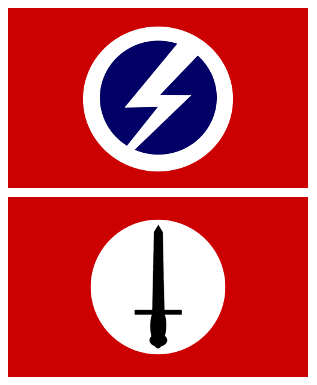
Oswald Mosley was the subject of a special program at the White network in July 2013. After WWII Mosley’s main theme was “Europe A Nation”. In 1948 he formed the Union Movement, whose political position is classified by Metapedia as National Europeanism and European Socialism:

the Union Movement attempted to redefine the concept by stressing the importance of European unity rather than narrower country-based nationalisms

In 1949 Yockey, Gannon and others who had split from Union Movement formed European Liberation Front, whose political position is classified by Metapedia as Social nationalism, European nationalism, Third Positionism.

The pan-European visions of Mosley, Yockey and others were holistic, rooted in a desire to promote the vitality and common interests of Europeans and European culture. In contrast, the European Economic Community (established in 1958) and European Union (established in 1993) effectively hijacked what Yockey called the Idea and delivered a distorted version, a purely economic and legal union whose effects on the unique biology and culture of Europe have been increasingly obviously disastrous. Contemporary nationalists rightly see the EU as a fraud – far from an expression of common interests the EU presents a shared existential threat to all Europeans.

For more information on Arnold Leese listen to Voice of Albion w/ Paul Hickman 4-23-14 at Renegade Broadcasting. Paul reads from and comments on Leese’s autobiography Out of Step – Events in the lives of an Anti-Jewish Camel-Doctor.

We consider Yockey’s views on culture and race starting at page 245 of Imperium, in the section he titled “CULTURAL VITALISM” and subtitled “(A) Culture Health”:

‘I recognize only two nations, the Occident, and the Orient.”

— Napoleon

“It is want of race, and nothing else, that makes intellectuals — philosophers, doctrinaires, Utopists — incapable of understanding the depth of this metaphysical hatred, which is the beat-difference of two currents of being manifested as an unbearable dissonance, a hatred that may become tragic for both.”

— Spengler

“I wanted to prepare the fusion of the great interests of Europe, as I had accomplished that of the parties. I concerned myself little with the passing rancor of the peoples, for I was sure that the results would lead them irresistibly back to me. Europe would in this way have become in truth a united nation, and every one would have been, no matter where he traveled, in the same Fatherland. This fusion will accomplish itself sooner or later through the pressure of the facts; the impulse has been given which, since my downfall and the disappearance of my system, will make the restoration of balance possible in Europe only by merger and fusion of the great nations.”

— Napoleon

Napoleon’s west/east “national” dichotomy is a geographic/administrative subdivision which traces back to Rome. The nationalities of Europe can be similarly but more aptly characterized and subdivided ethno-linguistically into Germanic, Italic and Slavic, which all trace back to the Aryans.

Race scientists of the 19th and early 20th centuries understood Europeans as a subset of the Caucasian race, which they subdivided according to physical and mental characteristics into Nordic, Mediterranean and Alpine races which roughly overlap and correspond to the aforementioned linguistic subdivisions.

Such coarse groupings fit somewhere in the continuum between the relatively tighter notion of nation and looser notion of continental-scale race.

Yockey regarded spirit and soul as paramount and preeminent over biology/materialism. Thus his emphasis on “the Western Culture” and “the Western civilization” rather than the European people, which he subdivided into two parts according to spirit: the masses and a much less numerous culture-bearing stratum.

The Revolution Devours its Zizeks

zizek_waving_his_hands

A sample of the judaized mainstream media reaction to Slavoj Zizek’s plagiarized review of Kevin MacDonald provides a glimpse of right and wrong as proscribed by the anti-White/pro-jew regime:

Did Marxist Philosophy Superstar Slavoj Žižek Plagiarize a White Nationalist Journal?, by Taylor Wofford, Newsweek.

Slavoj Zizek plagiarized white supremacist magazine American Renaissance. Why?, by By Rebecca Schuman, Slate.

Famed Philosopher Accused Of Plagiarizing White Separatist Journal, by Annalisa Quinn, NPR.

Slavoj Žižek Sorta Kinda Admits Plagiarizing White Supremacist Journal, by Michelle Dean, Gawker.

The “marxist”/”leftist” commissariat is virtually stoning one of their own superstars, and it clearly is less about his plagiarism, a mere intellectual crime, than it is about their perception that he kinda sorta violated their anti-White/pro-jew moral imperative.

The commissars are morally outraged. Plagiarism, schmagiarism. Though shalt not discuss anti-jew or pro-White thoughts without unambiguous and unreserved condemnation. It’s a secular, racially particularist morality which holds jews, as a group, exempt from any criticism, placing them over above and in utter contradistinction to Whites, who may only be criticized, at least when our very existence isn’t flatly denied.

Whereas the anti-White attitude is right up front in the headlines above, you have to dig a bit to find the pro-jew attitude driving it. Matthew Walther lays both halves out most explicitly in his brief condemnation of Zizek at The American Spectator. Walther asks, Did the Marxist Philosopher Slavoj Zizek Plagiarize a White Nationalist Magazine?

It certainly looks that way. The other night I was reading my galley copy of Adam Kirsch’s forthcoming essay collection, Rocket and Lightship. It’s full of good stuff, but the best piece in it is about the Slovenian Marxist gadfly Slavoj Zizek. Zizek is a strange character: a social democratic dissident turned unapolegtic Leninist; a pop-culture loving obscurantist; a millionaire philosopher. He is also, Kirsch intimates, without quite saying as much, an anti-Semite.

Now I read at Ron Unz’s new website that Zizek appears to have plagiarized a book review that appeared nearly two decades ago in Jared Taylor’s soi-dissant “white nationalist” (a stupid, meaningless phrase: there is no such country as “white”) magazine, American Renaissance.

Zizek has apparently been playing along the edge of the pro-jew line for a while, and some jews, ever sensitive and vigilant, have noticed.

Kirsch’s relatively lengthy indictment of Zizek The Deadly Jester, published by New Republic in 2008, strikes a similar tone to the brief and more recent scolds noted above. But lacking the “White nationalist” foil Kirsch had to perform a much more elaborate dance around “the Žižek phenomenon” before finally getting to his point.

“Our ‘freedoms,'” Žižek writes in Welcome to the Desert of the Real, “themselves serve to mask and sustain our deeper unfreedom.” This is the central instance in Žižek’s work of the kind of dialectical reversal, the clever anti-liberal inversion, that is the basic movement of his mind. It could hardly be otherwise, considering that his intellectual gods are Hegel and Lacan—masters of the dialectic, for whom reality never appears except in the form of the illusion or the symptom. In both their systems, the interpreter—the philosopher for Hegel, the analyst for Lacan—is granted absolute, unchallengeable authority. Most people are necessarily in thrall to appearances, and thereby to the deceptions of power; but the interpreter is somehow immune to them, and can singlehandedly recognize and expose the hidden meanings, the true processes at work in History or in the Unconscious.

This sacerdotal notion of intellectual authority makes both thinkers essentially hostile to democracy, which holds that the truth is available in principle to everyone, and that every individual must be allowed to speak for himself. Žižek, too, sees the similarity—or, as he says, “the profound solidarity”—between his favorite philosophical traditions. “Their structure,” he acknowledges, “is inherently ‘authoritarian’: since Marx and Freud opened up a new theoretical field which sets the very criteria of veracity, their words cannot be put to the test the same way one is allowed to question the statements of their followers.” Note that the term “authoritarian” is not used here pejoratively. For Žižek, it is precisely this authoritarianism that makes these perspectives appealing. Their “engaged notion of truth” makes for “struggling theories, not only theories about struggle.”

But to know what is worth struggling for, you need theories about struggle. Only if you have already accepted the terms of the struggle—in Žižek’s case, the class struggle—can you move on to the struggling theory that teaches you how to fight. In this sense, Žižek the dialectician is at bottom entirely undialectical. That liberalism is evil and that communism is good is not his conclusion, it is his premise; and the contortions of his thought, especially in his most political books, result from the need to reconcile that premise with a reality that seems abundantly to indicate the opposite.

Hence the necessity of the Matrix, or something like it, for Žižek’s worldview. And hence his approval of anything that unplugs us from the Matrix and returns us to the desert of the real—for instance, the horrors of September 11.

See where Zizek is going? Kirsch does.

There is a name for the politics that glorifies risk, decision, and will; that yearns for the hero, the master, and the leader; that prefers death and the infinite to democracy and the pragmatic; that finds the only true freedom in the terror of violence. Its name is not communism. Its name is fascism, and in his most recent work Žižek has inarguably revealed himself as some sort of fascist. He admits as much in Violence, where he quotes the German philosopher Peter Sloterdijk on the “re-emerging Left-Fascist whispering at the borders of academia”—”where, I guess, I belong.” There is no need to guess.

Žižek endorses one after another of the practices and the values of fascism, but he obstinately denies the label. Is “mass choreography displaying disciplined movements of thousands of bodies,” of the kind Leni Riefenstahl loved to photograph, fascist? No, Žižek insists, “it was Nazism that stole” such displays “from the workers’ movement, their original creator.” (He is willfully blind to the old and obvious conclusion that totalitarian form accepts content from the left and the right.) Is there something fascist about what Adorno long ago called the jargon of authenticity—”the notions of decision, repetition, assuming one’s destiny … mass discipline, sacrifice of the individual for the collective, and so forth”? No, again: “there is nothing ‘inherently fascist'” in all that. Is the cult of martyrdom that surrounds Che Guevara a holdover from the death worship of reactionary Latin American Catholicism, as Paul Berman has argued? Perhaps, Žižek grants, “but—so what?” “To be clear and brutal to the end,” he sums up, “there is a lesson to be learned from Hermann Goering’s reply, in the early 1940s, to a fanatical Nazi who asked him why he protected a well-known Jew from deportation: ‘In this city, I decide who is a Jew!’… In this city, it is we who decide what is left, so we should simply ignore liberal accusations of inconsistency.”

Here, near the end, Kirsch finally drops his mask. The last fifteen paragraphs are all about jews, judaism, Israel and “anti-semitism” – laying bare Kirsch’s entirely jewish concerns. In classic jewish form he begins by psychopathologizing Zizek for “obsessing” about the jews:

To produce this quotation [about Goering] in this context is a sign, I think, of something darker. It is a dare to himself to see how far he can go in the direction of indecency, of an obsession that has nothing progressive or revolutionary about it.

It is not surprising that it is the subject of the Jews that calls forth this impulse in Žižek, because the treatment of Jews and Judaism in his work has long been unsettling—and in a different way from his treatment of, say, the United States, which he simply denounces. Žižek’s books are loosely structured and full of digressions, more like monologues than treatises, but for that very reason, his perpetual return to the subject of the Jews functions in his writing the way a similar fixation might function in an analysand’s recital: as a hint of something hidden that requires critical examination.

Typically, the form that Žižek’s remarks on Jews take is that of an exposition of the mentality of the anti-Semite. This is an unimpeachable and rather common forensic device, but somehow it does not quite account for the passionate detail of Žižek’s explorations.

The power and influence of jews is pervasive in, say, the United States. Other than jew-obsessed jews and the occasional slip-up by one of their useful idiots, only “anti-semites” take any notice. What is remarkable is that, whether they perceive jewish influence or not, most everyone else keeps their mouths shut about it, even while they freely criticize “Americans” and “Europeans” collectively.

Which brings us to the crux of Kirsch’s beef. It’s about policing perceptions and assigning blame:

Why this need to keep open, as if for the sake of argument, the possibility that the Jews really were guilty of all the things of which the Nazis accused them? Why, when Žižek returns to this same line of reasoning in Violence—”even if rich Jews in the Germany of the 1930s ‘really’ exploited German workers, seduced their daughters,” and so on—are there quotation marks around “really,” as though the truth or the falsehood of Jewish villainy were a question to be postponed until it can be given fuller consideration?

These moments, unpleasant as they are, are not quite expressions of anti-Semitism. But in In Defense of Lost Causes, Žižek does make plain what he might call the “fantasmatic screen” through which he sees Jews.

As far back as World War II, he remarks, rehearsing one of the oldest and most pointless “ironies” of modern history, “the Nazis and the radical Zionists shared a common interest…. In both cases, the purpose was a kind of ‘ethnic cleansing.'”

This method of alleviating European guilt by casting “the exemplary victims” of the Holocaust as in some sense the agents of holocaust is far from unknown on the European left. But what is less common, even there, is Žižek’s resurrection of some of the oldest tropes of theological and philosophical anti-Semitism.

It makes sense, then, that Žižek should finally cast his anti-Judaism in explicitly theological terms. Why is it that so many of the chief foes of totalitarianism in the second half of the twentieth century were Jews—Arendt, Berlin, Levinas? One might think it is because the Jews were the greatest victims of Nazi totalitarianism, and so had the greatest stake in ensuring that its evil was recognized.

Kirsch concludes:

Under the cover of comedy and hyperbole, in between allusions to movies and video games, he is engaged in the rehabilitation of many of the most evil ideas of the last century. He is trying to undo the achievement of all the postwar thinkers who taught us to regard totalitarianism, revolutionary terror, utopian violence, and anti-Semitism as inadmissible in serious political discourse.

Kirsch can’t quite call what Zizek does “anti-semitism” because Zizek makes it difficult to understand what he’s doing. In trying to decipher Zizek, however, Kirsch shows us his own “fantasmatic screen”, and it has nothing to do with Zizek. Kirsch sees the jews as purely innocent victims, and unsurprisingly it has everything to do with seeing Whites purely as their victimizers.

The Zizek affair isn’t about the revolutionary left devouring its own heroes. It’s about maintaining a regime under which painting Whites as guilty and evil is the norm, and any criticism of jews is inadmissible.

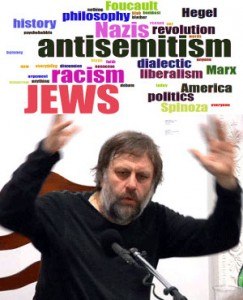
Picture source: Slavoj Zizek with Josefina Ayerza; “It doesn’t have to be a jew…” It doesn’t have to be an Eskimo either. But of course it is the jews – if not for them nobody would make such a ridiculous fuss insisting that it isn’t. That’s how a bullshit artist like Zizek can become rich and famous by regurgitating typically jewish psychobabble about “racists” and “Americans”, but stands to forfeit it all by kinda sorta offending the sensibilities of the jews.


Yockey on Liberalism – Part 7

hegel_machiavelli

Concluding this short series concerning Yockey’s Imperium, The 20th Century Political Outlook:

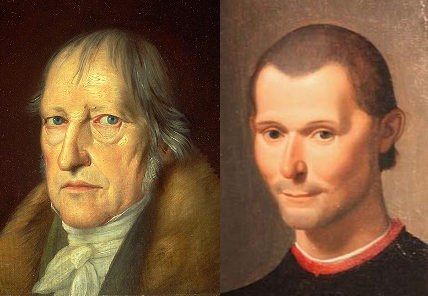
Hegel posited a three-stage development of mankind from the natural community through the bourgeois community to the State. His State-theory is thoroughly organic, and his definition of the bourgeois is quite appropriate for the 20th century. To him the bourgeois is the man who does not wish to leave the sphere of internal political security, who sets himself up, with his sanctified private property, as an individual against the whole, who finds a substitute for his political nullity in the fruits of peace and possessions and perfect security in his enjoyment of them, who therefore wishes to dispense with courage and remain secure from the possibility of violent death. He described the true Liberal with these words.

The political thinkers mentioned do not enjoy popularity with the great masses of human beings. As long as things are going well, most people do not wish to hear talk of power-struggles, violence, wars, or theories relating to them. Thus in the 18th and 19th centuries was developed the attitude that political thinkers — and Macchiavelli was the prime victim — were wicked men, atavistic, bloodthirsty. The simple statement that wars would always continue was sufficient to put the speaker down as a person who wanted wars to continue. To draw attention to the vast, impersonal rhythm of war and peace

221

showed a sick mind with moral deficiency and emotional taint. To describe facts was held to be wishing them and creating them. As late as the 20th century, anyone pointing out the political nullity of the “leagues of nations” was a prophet of despair. Rationalism is anti-historical; political thinking is applied history. In peace it is unpopular to mention war, in war it is unpopular to mention peace. The theory which becomes most quickly popular is one which praises existing things and the tendency they supposedly illustrate as obviously the best order, and as preordained by all foregoing history. Thus Hegel was anathema to the intellectuals because of his State-orientation, which made him a “reactionary,” and also because he refused to join the revolutionary crowd.

Since most people wish to hear only soporific talk about politics, and not demanding calls to action, and since in democratic conditions it matters to political technics what most people wish to hear, democratic politicians evolved in the 19th century a whole dialectic of party-politics. The idea was to examine the held of action from a “disinterested” standpoint, moral, scientific, or economic, and to kind that the opponent was immoral, unscientific, uneconomic — in fact — he was political. This was devilishness that must be combated. One’s own standpoint was entirely “non-political.” Politics was a word of reproach in the Economic Age. Curiously however, in certain situations, usually those involving foreign relations, “unpolitical” could also be a term of abuse, meaning the man so described lacked skill in negotiating. The party-politician also had to feign unwillingness to accept office. Finally a demonstration of carefully arranged “popular will” broke down his reluctance, and he consented to “serve.” This was described as Macchiavellism, but obviously Macchiavelli was a political thinker, and not a camouflageur. A book by a party-politician

222

does not read like The Prince, but praises the entire human race, except certain perverse people, the author’s opponents.

Yockey counterposed the liberal, i.e. someone who won’t take his own side, against the “political”, i.e. those who will. Today’s White politicians have “progressed” to the point where they are increasingly anti-White and openly take the side of the non-White Other.

Actually Machiavelli’s book is defensive in tone, justifying politically the conduct of certain statesmen by giving examples drawn from foreign invasions of Italy. During Macchiavelli’s century, Italy was invaded at different times by Frenchmen, Germans, Spaniards and Turks. When the French Revolutionary Armies occupied Prussia, and coupled humanitarian sentiments of the Rights of Man with brutality and large-scale looting, Hegel and Fichte restored Macchiavelli once again to respect as a thinker. He represented a means of defense against a foe armed with a humanitarian ideology. Macchiavelli showed the actual role played by verbal sentiments in politics.

One can say that there are three possible attitudes toward human conduct, from the point of evaluating its motives: the sentimental, the realistic, and the cynical. The sentimental imputes a good motive to everybody, the cynical a bad motive, and the realistic simply seeks the facts. When a sentimentalist, e.g., a Liberal, enters politics, he becomes perforce a hypocrite. The ultimate exposure of this hypocrisy creates cynicism. Part of the spiritual sickness following the First World War was a wave of cynicism which arose from the transparent, revolting, and incredible hypocrisy of the little men who were presiding over affairs at that time. Macchiavelli had however an incorruptible intellect and did not write in a cynical spirit. He sought to portray the anatomy of politics with its peculiar problems and tensions, inner and outer. To the fantastic mental illness of Rationalism, hard facts are regrettable things, and to talk about them is to create them. A tiny politician of the Liberal type even sought to prevent talk about the Third World War, after the Second. Liberalism is, in one word, weakness. It wants every day to be a birthday, Life to be a long party.

223

The inexorable movement of Time, Destiny, History, the cruelty of accomplishment, sternness, heroism, sacrifice, superpersonal ideas — these are the enemy. Liberalism is an escape from hardness into softness, from masculinity into femininity, from History to herd-grazing, from reality into herbivorous dreams, from Destiny into Happiness. Nietzsche, in his last and greatest work, designated the 18th century as the century of feminism, and immediately mentioned Rousseau, the leader of the mass-escape from Reality. Feminism itself — what is it but a means of feminizing man? If it makes women man-like, it does so only by transforming man first into a creature whose only concern is with his personal economics and his relation to “society,” i.e., a woman. “Society” is the element of woman, it is static and formal, its contests are purely personal, and are free from the possibility of heroism and violence. Conversation, not action; formality, not deeds. How different is the idea of rank used in connection with a social affair, from when it is applied on a battlefield! In the field, it is fate-laden; in the salon it is vain and pompous. A war is fought for control, social contests are inspired by feminine vanity and jealousy to show that one is “better” than someone else.

And yet what does Liberalism do ultimately to woman: it puts a uniform on her and calls her a “soldier.” This ridiculous performance but illustrates the eternal fact that History is masculine, that its stern demands cannot be evaded, that the fundamental realities cannot be renounced, even, by the most elaborate make-believe. Liberalistic tampering with sexual polarity only wreaks havoc on the souls of individuals, confusing and distorting them, but the man-woman and the woman-man it creates are both subject to the higher Destiny of History.

Yockey saw liberalism as springing from the White mind, Western philosophy and specifically Rationalism, originating with John Locke and Jean-Jacques Rousseau in the mid-18th century. More than once Yockey asserted that Rationalism, and thus liberalism, are based on the false premise that man is “good” by nature. He described liberalism as “Rationalism in politics”, a “mere negative” which weakens the State and makes it subservient to “society”, a loose grouping of free independent groups and individuals, a thoroughly liberal construct.

Yockey saw liberalism as “thinking about politics” rather than “political thinking”, opposed to Authority in any form, but most especially the State and the Church. He saw liberalism as outside and in violation of his Laws of Totality and Sovereignty, thus corrosive to political organisms and the friend-enemy disjunction which defines them. “[A]lways and only a disintegrating force”.

Yockey saw liberalism as individualistic, humanistic and materialistic. He noted Jeremy Bentham’s guiding principle, “the greatest happiness of the greatest number”. “The two poles of [Rationalism] are ‘the individual’ and ‘humanity.’ Anything separating them is ‘irrational.'” He deplored that liberalism enables wealthy individuals to become more important than political organisms, and to twist the “rule of law” to serve their own selfish interests. “In earlier times, war-peoples had subjugated trading-peoples, but no longer. Now trading-peoples step out as the masters of the earth.”

New (jewish) masters aside, Yockey saw a deluded sentimentalism in the liberal hope that elevating commerce and economics would end war, the harsh reality being that under this delusion wars had only become more devastating.

“The purest expression of the doctrine of Liberalism was probably that of Benjamin Constant.” Wikipedia contains some hints why Yockey saw Constant this way:

Constant’s repeated denunciation of despotism pervaded his critique of French political philosophers Jean-Jacques Rousseau and Abbé de Mably. These writers, influential to the French Revolution, according to Constant, mistook authority for liberty and approved any means of extending the action of authority.

Moreover, Constant believed that in the modern world, commerce was superior to war. He attacked Napoleon’s martial appetite on the grounds that it was illiberal and no longer suited to modern commercial social organization. Ancient Liberty tended to be warlike, whereas a state organized on the principles of Modern Liberty would be at peace with all peaceful nations.

Regarding the principle of freedom in liberalism Yockey wrote:

It is a mere critique, not a living idea. Its great word “freedom” is a negative it means in fact, freedom from authority, i.e., disintegration of the organism. In its last stages it produces social atomism, in which not only the authority of the State is combated, but even the authority of society and the family.

At the same time a team of jews were hard at work attacking the White family and producing social atomism with The Authoritarian Personality.

However, Yockey saw the influence of jews as distinct from liberalism:

it is necessary to diagnose even now the serious illness of the Western Civilization as Liberalism complicated with alien-poisoning

In contrast to liberalism Yockey recommended Ethical Socialism, which Oswald Spengler called Prussianism. Spengler described the Prussian spirit as, “aristocratic virtue, of which few are possessed” and “a proud and exclusive Socialism for men of race, for the elect of life”. In other words the Aryan spirit, or the spirit of National Socialism.

Yockey described “true liberalism” as Hegel’s view of bourgeois – the individual against the whole, who values personal security over courage and a potentially violent death. Liberalism, in one word, is weakness. At the very end he connects liberalism to feminism, “an escape from hardness into softness, from masculinity into femininity”.

Yockey dedicated only 15 pages of his 619-page magnum opus to liberalism. In this series we have only barely probed his thoughts. Yockey’s words and style are deceptively simple. His ideas are rooted in and intertwined with historical and philosophical references which make true understanding difficult, even for those prepared to dig deeper. The effort is worth it, especially for thinkers looking for mental exercise and an excuse to trace through some of the vast history of European political thought. After having done so I can say that those less willing to embark on such excursions should feel no guilt or shame. There are more accessible works – e.g. by Kevin MacDonald or Revilo Oliver – from which one can learn more with less effort.

Politics + Technology = Nonsense at the Speed of Light