The Revolution Devours its Zizeks

zizek_waving_his_hands

A sample of the judaized mainstream media reaction to Slavoj Zizek’s plagiarized review of Kevin MacDonald provides a glimpse of right and wrong as proscribed by the anti-White/pro-jew regime:

Did Marxist Philosophy Superstar Slavoj Žižek Plagiarize a White Nationalist Journal?, by Taylor Wofford, Newsweek.

Slavoj Zizek plagiarized white supremacist magazine American Renaissance. Why?, by By Rebecca Schuman, Slate.

Famed Philosopher Accused Of Plagiarizing White Separatist Journal, by Annalisa Quinn, NPR.

Slavoj Žižek Sorta Kinda Admits Plagiarizing White Supremacist Journal, by Michelle Dean, Gawker.

The “marxist”/”leftist” commissariat is virtually stoning one of their own superstars, and it clearly is less about his plagiarism, a mere intellectual crime, than it is about their perception that he kinda sorta violated their anti-White/pro-jew moral imperative.

The commissars are morally outraged. Plagiarism, schmagiarism. Though shalt not discuss anti-jew or pro-White thoughts without unambiguous and unreserved condemnation. It’s a secular, racially particularist morality which holds jews, as a group, exempt from any criticism, placing them over above and in utter contradistinction to Whites, who may only be criticized, at least when our very existence isn’t flatly denied.

Whereas the anti-White attitude is right up front in the headlines above, you have to dig a bit to find the pro-jew attitude driving it. Matthew Walther lays both halves out most explicitly in his brief condemnation of Zizek at The American Spectator. Walther asks, Did the Marxist Philosopher Slavoj Zizek Plagiarize a White Nationalist Magazine?

It certainly looks that way. The other night I was reading my galley copy of Adam Kirsch’s forthcoming essay collection, Rocket and Lightship. It’s full of good stuff, but the best piece in it is about the Slovenian Marxist gadfly Slavoj Zizek. Zizek is a strange character: a social democratic dissident turned unapolegtic Leninist; a pop-culture loving obscurantist; a millionaire philosopher. He is also, Kirsch intimates, without quite saying as much, an anti-Semite.

Now I read at Ron Unz’s new website that Zizek appears to have plagiarized a book review that appeared nearly two decades ago in Jared Taylor’s soi-dissant “white nationalist” (a stupid, meaningless phrase: there is no such country as “white”) magazine, American Renaissance.

Zizek has apparently been playing along the edge of the pro-jew line for a while, and some jews, ever sensitive and vigilant, have noticed.

Kirsch’s relatively lengthy indictment of Zizek The Deadly Jester, published by New Republic in 2008, strikes a similar tone to the brief and more recent scolds noted above. But lacking the “White nationalist” foil Kirsch had to perform a much more elaborate dance around “the Žižek phenomenon” before finally getting to his point.

“Our ‘freedoms,'” Žižek writes in Welcome to the Desert of the Real, “themselves serve to mask and sustain our deeper unfreedom.” This is the central instance in Žižek’s work of the kind of dialectical reversal, the clever anti-liberal inversion, that is the basic movement of his mind. It could hardly be otherwise, considering that his intellectual gods are Hegel and Lacan—masters of the dialectic, for whom reality never appears except in the form of the illusion or the symptom. In both their systems, the interpreter—the philosopher for Hegel, the analyst for Lacan—is granted absolute, unchallengeable authority. Most people are necessarily in thrall to appearances, and thereby to the deceptions of power; but the interpreter is somehow immune to them, and can singlehandedly recognize and expose the hidden meanings, the true processes at work in History or in the Unconscious.

This sacerdotal notion of intellectual authority makes both thinkers essentially hostile to democracy, which holds that the truth is available in principle to everyone, and that every individual must be allowed to speak for himself. Žižek, too, sees the similarity—or, as he says, “the profound solidarity”—between his favorite philosophical traditions. “Their structure,” he acknowledges, “is inherently ‘authoritarian’: since Marx and Freud opened up a new theoretical field which sets the very criteria of veracity, their words cannot be put to the test the same way one is allowed to question the statements of their followers.” Note that the term “authoritarian” is not used here pejoratively. For Žižek, it is precisely this authoritarianism that makes these perspectives appealing. Their “engaged notion of truth” makes for “struggling theories, not only theories about struggle.”

But to know what is worth struggling for, you need theories about struggle. Only if you have already accepted the terms of the struggle—in Žižek’s case, the class struggle—can you move on to the struggling theory that teaches you how to fight. In this sense, Žižek the dialectician is at bottom entirely undialectical. That liberalism is evil and that communism is good is not his conclusion, it is his premise; and the contortions of his thought, especially in his most political books, result from the need to reconcile that premise with a reality that seems abundantly to indicate the opposite.

Hence the necessity of the Matrix, or something like it, for Žižek’s worldview. And hence his approval of anything that unplugs us from the Matrix and returns us to the desert of the real—for instance, the horrors of September 11.

See where Zizek is going? Kirsch does.

There is a name for the politics that glorifies risk, decision, and will; that yearns for the hero, the master, and the leader; that prefers death and the infinite to democracy and the pragmatic; that finds the only true freedom in the terror of violence. Its name is not communism. Its name is fascism, and in his most recent work Žižek has inarguably revealed himself as some sort of fascist. He admits as much in Violence, where he quotes the German philosopher Peter Sloterdijk on the “re-emerging Left-Fascist whispering at the borders of academia”—”where, I guess, I belong.” There is no need to guess.

Žižek endorses one after another of the practices and the values of fascism, but he obstinately denies the label. Is “mass choreography displaying disciplined movements of thousands of bodies,” of the kind Leni Riefenstahl loved to photograph, fascist? No, Žižek insists, “it was Nazism that stole” such displays “from the workers’ movement, their original creator.” (He is willfully blind to the old and obvious conclusion that totalitarian form accepts content from the left and the right.) Is there something fascist about what Adorno long ago called the jargon of authenticity—”the notions of decision, repetition, assuming one’s destiny … mass discipline, sacrifice of the individual for the collective, and so forth”? No, again: “there is nothing ‘inherently fascist'” in all that. Is the cult of martyrdom that surrounds Che Guevara a holdover from the death worship of reactionary Latin American Catholicism, as Paul Berman has argued? Perhaps, Žižek grants, “but—so what?” “To be clear and brutal to the end,” he sums up, “there is a lesson to be learned from Hermann Goering’s reply, in the early 1940s, to a fanatical Nazi who asked him why he protected a well-known Jew from deportation: ‘In this city, I decide who is a Jew!’… In this city, it is we who decide what is left, so we should simply ignore liberal accusations of inconsistency.”

Here, near the end, Kirsch finally drops his mask. The last fifteen paragraphs are all about jews, judaism, Israel and “anti-semitism” – laying bare Kirsch’s entirely jewish concerns. In classic jewish form he begins by psychopathologizing Zizek for “obsessing” about the jews:

To produce this quotation [about Goering] in this context is a sign, I think, of something darker. It is a dare to himself to see how far he can go in the direction of indecency, of an obsession that has nothing progressive or revolutionary about it.

It is not surprising that it is the subject of the Jews that calls forth this impulse in Žižek, because the treatment of Jews and Judaism in his work has long been unsettling—and in a different way from his treatment of, say, the United States, which he simply denounces. Žižek’s books are loosely structured and full of digressions, more like monologues than treatises, but for that very reason, his perpetual return to the subject of the Jews functions in his writing the way a similar fixation might function in an analysand’s recital: as a hint of something hidden that requires critical examination.

Typically, the form that Žižek’s remarks on Jews take is that of an exposition of the mentality of the anti-Semite. This is an unimpeachable and rather common forensic device, but somehow it does not quite account for the passionate detail of Žižek’s explorations.

The power and influence of jews is pervasive in, say, the United States. Other than jew-obsessed jews and the occasional slip-up by one of their useful idiots, only “anti-semites” take any notice. What is remarkable is that, whether they perceive jewish influence or not, most everyone else keeps their mouths shut about it, even while they freely criticize “Americans” and “Europeans” collectively.

Which brings us to the crux of Kirsch’s beef. It’s about policing perceptions and assigning blame:

Why this need to keep open, as if for the sake of argument, the possibility that the Jews really were guilty of all the things of which the Nazis accused them? Why, when Žižek returns to this same line of reasoning in Violence—”even if rich Jews in the Germany of the 1930s ‘really’ exploited German workers, seduced their daughters,” and so on—are there quotation marks around “really,” as though the truth or the falsehood of Jewish villainy were a question to be postponed until it can be given fuller consideration?

These moments, unpleasant as they are, are not quite expressions of anti-Semitism. But in In Defense of Lost Causes, Žižek does make plain what he might call the “fantasmatic screen” through which he sees Jews.

As far back as World War II, he remarks, rehearsing one of the oldest and most pointless “ironies” of modern history, “the Nazis and the radical Zionists shared a common interest…. In both cases, the purpose was a kind of ‘ethnic cleansing.'”

This method of alleviating European guilt by casting “the exemplary victims” of the Holocaust as in some sense the agents of holocaust is far from unknown on the European left. But what is less common, even there, is Žižek’s resurrection of some of the oldest tropes of theological and philosophical anti-Semitism.

It makes sense, then, that Žižek should finally cast his anti-Judaism in explicitly theological terms. Why is it that so many of the chief foes of totalitarianism in the second half of the twentieth century were Jews—Arendt, Berlin, Levinas? One might think it is because the Jews were the greatest victims of Nazi totalitarianism, and so had the greatest stake in ensuring that its evil was recognized.

Kirsch concludes:

Under the cover of comedy and hyperbole, in between allusions to movies and video games, he is engaged in the rehabilitation of many of the most evil ideas of the last century. He is trying to undo the achievement of all the postwar thinkers who taught us to regard totalitarianism, revolutionary terror, utopian violence, and anti-Semitism as inadmissible in serious political discourse.

Kirsch can’t quite call what Zizek does “anti-semitism” because Zizek makes it difficult to understand what he’s doing. In trying to decipher Zizek, however, Kirsch shows us his own “fantasmatic screen”, and it has nothing to do with Zizek. Kirsch sees the jews as purely innocent victims, and unsurprisingly it has everything to do with seeing Whites purely as their victimizers.

The Zizek affair isn’t about the revolutionary left devouring its own heroes. It’s about maintaining a regime under which painting Whites as guilty and evil is the norm, and any criticism of jews is inadmissible.

Picture source: Slavoj Zizek with Josefina Ayerza; “It doesn’t have to be a jew…” It doesn’t have to be an Eskimo either. But of course it is the jews – if not for them nobody would make such a ridiculous fuss insisting that it isn’t. That’s how a bullshit artist like Zizek can become rich and famous by regurgitating typically jewish psychobabble about “racists” and “Americans”, but stands to forfeit it all by kinda sorta offending the sensibilities of the jews.
Yockey on Liberalism – Part 7

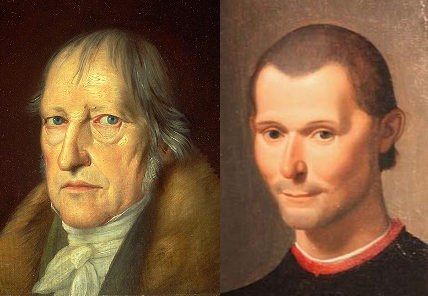
hegel_machiavelli

Concluding this short series concerning Yockey’s Imperium, The 20th Century Political Outlook:

Hegel posited a three-stage development of mankind from the natural community through the bourgeois community to the State. His State-theory is thoroughly organic, and his definition of the bourgeois is quite appropriate for the 20th century. To him the bourgeois is the man who does not wish to leave the sphere of internal political security, who sets himself up, with his sanctified private property, as an individual against the whole, who finds a substitute for his political nullity in the fruits of peace and possessions and perfect security in his enjoyment of them, who therefore wishes to dispense with courage and remain secure from the possibility of violent death. He described the true Liberal with these words.

The political thinkers mentioned do not enjoy popularity with the great masses of human beings. As long as things are going well, most people do not wish to hear talk of power-struggles, violence, wars, or theories relating to them. Thus in the 18th and 19th centuries was developed the attitude that political thinkers — and Macchiavelli was the prime victim — were wicked men, atavistic, bloodthirsty. The simple statement that wars would always continue was sufficient to put the speaker down as a person who wanted wars to continue. To draw attention to the vast, impersonal rhythm of war and peace

221

showed a sick mind with moral deficiency and emotional taint. To describe facts was held to be wishing them and creating them. As late as the 20th century, anyone pointing out the political nullity of the “leagues of nations” was a prophet of despair. Rationalism is anti-historical; political thinking is applied history. In peace it is unpopular to mention war, in war it is unpopular to mention peace. The theory which becomes most quickly popular is one which praises existing things and the tendency they supposedly illustrate as obviously the best order, and as preordained by all foregoing history. Thus Hegel was anathema to the intellectuals because of his State-orientation, which made him a “reactionary,” and also because he refused to join the revolutionary crowd.

Since most people wish to hear only soporific talk about politics, and not demanding calls to action, and since in democratic conditions it matters to political technics what most people wish to hear, democratic politicians evolved in the 19th century a whole dialectic of party-politics. The idea was to examine the held of action from a “disinterested” standpoint, moral, scientific, or economic, and to kind that the opponent was immoral, unscientific, uneconomic — in fact — he was political. This was devilishness that must be combated. One’s own standpoint was entirely “non-political.” Politics was a word of reproach in the Economic Age. Curiously however, in certain situations, usually those involving foreign relations, “unpolitical” could also be a term of abuse, meaning the man so described lacked skill in negotiating. The party-politician also had to feign unwillingness to accept office. Finally a demonstration of carefully arranged “popular will” broke down his reluctance, and he consented to “serve.” This was described as Macchiavellism, but obviously Macchiavelli was a political thinker, and not a camouflageur. A book by a party-politician

222

does not read like The Prince, but praises the entire human race, except certain perverse people, the author’s opponents.

Yockey counterposed the liberal, i.e. someone who won’t take his own side, against the “political”, i.e. those who will. Today’s White politicians have “progressed” to the point where they are increasingly anti-White and openly take the side of the non-White Other.

Actually Machiavelli’s book is defensive in tone, justifying politically the conduct of certain statesmen by giving examples drawn from foreign invasions of Italy. During Macchiavelli’s century, Italy was invaded at different times by Frenchmen, Germans, Spaniards and Turks. When the French Revolutionary Armies occupied Prussia, and coupled humanitarian sentiments of the Rights of Man with brutality and large-scale looting, Hegel and Fichte restored Macchiavelli once again to respect as a thinker. He represented a means of defense against a foe armed with a humanitarian ideology. Macchiavelli showed the actual role played by verbal sentiments in politics.

One can say that there are three possible attitudes toward human conduct, from the point of evaluating its motives: the sentimental, the realistic, and the cynical. The sentimental imputes a good motive to everybody, the cynical a bad motive, and the realistic simply seeks the facts. When a sentimentalist, e.g., a Liberal, enters politics, he becomes perforce a hypocrite. The ultimate exposure of this hypocrisy creates cynicism. Part of the spiritual sickness following the First World War was a wave of cynicism which arose from the transparent, revolting, and incredible hypocrisy of the little men who were presiding over affairs at that time. Macchiavelli had however an incorruptible intellect and did not write in a cynical spirit. He sought to portray the anatomy of politics with its peculiar problems and tensions, inner and outer. To the fantastic mental illness of Rationalism, hard facts are regrettable things, and to talk about them is to create them. A tiny politician of the Liberal type even sought to prevent talk about the Third World War, after the Second. Liberalism is, in one word, weakness. It wants every day to be a birthday, Life to be a long party.

223

The inexorable movement of Time, Destiny, History, the cruelty of accomplishment, sternness, heroism, sacrifice, superpersonal ideas — these are the enemy. Liberalism is an escape from hardness into softness, from masculinity into femininity, from History to herd-grazing, from reality into herbivorous dreams, from Destiny into Happiness. Nietzsche, in his last and greatest work, designated the 18th century as the century of feminism, and immediately mentioned Rousseau, the leader of the mass-escape from Reality. Feminism itself — what is it but a means of feminizing man? If it makes women man-like, it does so only by transforming man first into a creature whose only concern is with his personal economics and his relation to “society,” i.e., a woman. “Society” is the element of woman, it is static and formal, its contests are purely personal, and are free from the possibility of heroism and violence. Conversation, not action; formality, not deeds. How different is the idea of rank used in connection with a social affair, from when it is applied on a battlefield! In the field, it is fate-laden; in the salon it is vain and pompous. A war is fought for control, social contests are inspired by feminine vanity and jealousy to show that one is “better” than someone else.

And yet what does Liberalism do ultimately to woman: it puts a uniform on her and calls her a “soldier.” This ridiculous performance but illustrates the eternal fact that History is masculine, that its stern demands cannot be evaded, that the fundamental realities cannot be renounced, even, by the most elaborate make-believe. Liberalistic tampering with sexual polarity only wreaks havoc on the souls of individuals, confusing and distorting them, but the man-woman and the woman-man it creates are both subject to the higher Destiny of History.

Yockey saw liberalism as springing from the White mind, Western philosophy and specifically Rationalism, originating with John Locke and Jean-Jacques Rousseau in the mid-18th century. More than once Yockey asserted that Rationalism, and thus liberalism, are based on the false premise that man is “good” by nature. He described liberalism as “Rationalism in politics”, a “mere negative” which weakens the State and makes it subservient to “society”, a loose grouping of free independent groups and individuals, a thoroughly liberal construct.

Yockey saw liberalism as “thinking about politics” rather than “political thinking”, opposed to Authority in any form, but most especially the State and the Church. He saw liberalism as outside and in violation of his Laws of Totality and Sovereignty, thus corrosive to political organisms and the friend-enemy disjunction which defines them. “[A]lways and only a disintegrating force”.

Yockey saw liberalism as individualistic, humanistic and materialistic. He noted Jeremy Bentham’s guiding principle, “the greatest happiness of the greatest number”. “The two poles of [Rationalism] are ‘the individual’ and ‘humanity.’ Anything separating them is ‘irrational.'” He deplored that liberalism enables wealthy individuals to become more important than political organisms, and to twist the “rule of law” to serve their own selfish interests. “In earlier times, war-peoples had subjugated trading-peoples, but no longer. Now trading-peoples step out as the masters of the earth.”

New (jewish) masters aside, Yockey saw a deluded sentimentalism in the liberal hope that elevating commerce and economics would end war, the harsh reality being that under this delusion wars had only become more devastating.

“The purest expression of the doctrine of Liberalism was probably that of Benjamin Constant.” Wikipedia contains some hints why Yockey saw Constant this way:

Constant’s repeated denunciation of despotism pervaded his critique of French political philosophers Jean-Jacques Rousseau and Abbé de Mably. These writers, influential to the French Revolution, according to Constant, mistook authority for liberty and approved any means of extending the action of authority.

Moreover, Constant believed that in the modern world, commerce was superior to war. He attacked Napoleon’s martial appetite on the grounds that it was illiberal and no longer suited to modern commercial social organization. Ancient Liberty tended to be warlike, whereas a state organized on the principles of Modern Liberty would be at peace with all peaceful nations.

Regarding the principle of freedom in liberalism Yockey wrote:

It is a mere critique, not a living idea. Its great word “freedom” is a negative it means in fact, freedom from authority, i.e., disintegration of the organism. In its last stages it produces social atomism, in which not only the authority of the State is combated, but even the authority of society and the family.

At the same time a team of jews were hard at work attacking the White family and producing social atomism with The Authoritarian Personality.

However, Yockey saw the influence of jews as distinct from liberalism:

it is necessary to diagnose even now the serious illness of the Western Civilization as Liberalism complicated with alien-poisoning

In contrast to liberalism Yockey recommended Ethical Socialism, which Oswald Spengler called Prussianism. Spengler described the Prussian spirit as, “aristocratic virtue, of which few are possessed” and “a proud and exclusive Socialism for men of race, for the elect of life”. In other words the Aryan spirit, or the spirit of National Socialism.

Yockey described “true liberalism” as Hegel’s view of bourgeois – the individual against the whole, who values personal security over courage and a potentially violent death. Liberalism, in one word, is weakness. At the very end he connects liberalism to feminism, “an escape from hardness into softness, from masculinity into femininity”.

Yockey dedicated only 15 pages of his 619-page magnum opus to liberalism. In this series we have only barely probed his thoughts. Yockey’s words and style are deceptively simple. His ideas are rooted in and intertwined with historical and philosophical references which make true understanding difficult, even for those prepared to dig deeper. The effort is worth it, especially for thinkers looking for mental exercise and an excuse to trace through some of the vast history of European political thought. After having done so I can say that those less willing to embark on such excursions should feel no guilt or shame. There are more accessible works – e.g. by Kevin MacDonald or Revilo Oliver – from which one can learn more with less effort.

Yockey on Liberalism – Part 6

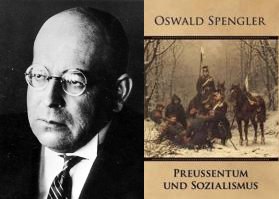
oswald_spengler_prussianism_and_socialism

Continuing with Imperium, The 20th Century Political Outlook, p215:

The idea of bringing in the law to make a given state of affairs sacrosanct was not original with Liberalism. Back in Hobbes’s day, other groups were trying it, but the incorruptible mind of Hobbes said with the most precise clarity that the rule of law means the rule of those who determine and administer the law,

216

that the rule of a “higher order” is an empty phrase, and is only given content by the concrete rule of given men and groups over a lower order.

This was political thinking, which is directed to the distribution and movement of power. It is also politics to expose the hypocrisy, immorality and cynicism of the usurer who loudly demands the rule of law, which means riches to him and poverty to millions of others, and all in the name of something higher, something with supra-human validity. When Authority resurges once more against the forces of Rationalism and Economics, it proceeds at once to show that the complex of transcendental ideals with which Liberalism equipped itself is as valid as the Legitimism of the era of Absolute Monarchy, and no more. The Monarchs were the strongest protagonists of Legitimism, the financiers of Liberalism. But the monarch was tied to the organism with his whole existence, he was responsible organically even where he was not responsible in fact. Thus Louis XVI and Charles I. Countless other monarchs and absolute rulers have had to flee because of their symbolic responsibility. But the financier has only power, no responsibility, not even symbolic, for, as often as not, his name is not generally known. History, Destiny, organic continuity, Fame, all exert their powerful influence on an absolute political ruler, and in addition his position places him entirely outside the sphere of base corruptibility. The financier, however, is private, anonymous, purely economic, irresponsible. In nothing can he be altruistic; his very existence is the apotheosis of egoism. He does not think of History, of Fame, of the furtherance of the life of the organism, of Destiny, and furthermore he is eminently corruptible by base means, as his ruling desire is for money and ever more money.

“The usurer” and “the financier” is best understood as jews, who do in fact care about the life of the jewish organism. George Soros is a contemporary example which comes immediately to mind. Names less generally known include Haim Saban and Sheldon Adelson.

The Execution of Louis XVI, 1793, king of France 1774-1793. Charles I of England, monarch of the three kingdoms of England, Scotland, and Ireland from 1625 until his execution in 1649.

In his contest against Authority the finance-Liberal evolved

217

a theory that power corrupts men. It is, however, vast anonymous wealth which corrupts, since there are no superpersonal restraints on it, such as bring the true statesman completely into the service of the political organism, and place him above corruption.

It was precisely in the fields of economics and law that the Liberal doctrine had the most destructive effects on the health of the Western Civilization. It did not matter much that esthetics became independent, for the only art-form in the West which still had a future, Western Music, paid no attention to theories and continued on its grand creative course to its end in Wagner and his epigones. Baudelaire is the great symbol of l’art pour l’art: sickness as beauty. Baudelaire is thus Liberalism in literature, disease as a principle of Life, crisis as health, morbidity as soul-life, disintegration as purpose. Man as individualist, an atom without connections, the Liberal ideal of personality. It was in fields of action rather than of thought that the injury was greatest.

Richard Wagner, German composer. Charles Baudelaire, French poet, member of the Decadent movement.

Allowing the initiative in economic and technical matters to rest with individuals, subject to little political control, resulted in the creation of a group of individuals whose personal wills were more important than the collective destiny of the organism and the millions of the population. The law which served this state of affairs was completely divorced from morality and honor. To disintegrate the organism from the spiritual side, what morality was recognized was divorced from metaphysics and religion, and related only to “society.” The criminal law reflected finance-Liberalism by punishing crimes of violence and passion, but not classifying such things as destroying national resources, throwing millions into want, or usury on a national scale.

The independence of the economic sphere was a tenet of

218

faith with Liberalism. This was not subject to discussion. There was even evolved an abstraction named “economic man,” whose actions could be predicted as though economics were a vacuum. Economic gain was his sole motive, greed alone spurred him on. The technic of success was to concentrate on one’s own gain and ignore everything else. This “economic man” was however man in general to the Liberals. He was the unit of their world-picture. “Humanity” was the sum total of these economic grains of sand.

III

The type of mind which believes in the essential “goodness” of human nature attained to Liberalism. But there is another political anthropology, one which recognizes that man is disharmonious, problematical, dual, dangerous. This is the general wisdom of mankind, and is reflected by the number of guards, fences, safes, locks, jails and policemen. Every catastrophe, fire, earthquake, volcanic eruption, flood, evokes looting. Even a police strike in an American city was the signal for looting of the shops by the respectable and good human beings.

Thus this type of thought starts from facts. This is political thinking in general, as opposed to mere thinking about politics, rationalizing. Even the wave of Rationalism did not submerge this kind of thinking. Political thinkers differ greatly in creativeness and depth, but they agree that facts are normative. The very word theory has been brought into disrepute by intellectuals and Liberals who use it to describe their pet view of how they would like things to be. Originally theory was explanation of facts. To an intellectual who is adrift in politics, a theory is an aim; to a true politician his theory is a boundary.

A political theory seeks to find from history the limits of the

219

politically possible. These limits cannot be found in the domain of Reason. The Age of Reason was born in bloodshed, and will pass out of vogue in more bloodshed. With its doctrine against war, politics, and violence, it presided over the greatest wars and revolutions in 5,000 years, and it ushered in the Age of Absolute Politics. With its gospel of the Brotherhood of Man, it carried on the largest-scale starvation, humiliation, torture and extermination in history against populations within the Western Civilization after the first two World Wars. By outlawing political thinking, and turning war into a moral-struggle instead of a power-struggle it flung the chivalry and honor of a millennium into the dust. The conclusion is compelling that Reason also became political when it entered politics, even though it used its own vocabulary. When Reason stripped territory from a conquered foe after a war, it called it “disannexation.” The document consolidating the new position was called a “Treaty,” even though it was dictated in the middle of a starvation-blockade. The defeated political enemy had to admit in the “Treaty” that he was “guilty” of the war, that he is morally unfit to have colonies, that his soldiers alone committed “war crimes.” But no matter how heavy the moral disguise, how consistent the ideological vocabulary, it is only politics, and the Age of Absolute Politics reverts once again to the type of political thinking which starts from facts, recognizes power and the will-to-power of men and higher organisms as facts, and finds any attempt to describe politics in terms of morals as grotesque as it would be to describe chemistry in terms of theology.

Yockey describes what he means by Absolute Politics earlier in Imperium: “We stand at the beginning of the Age of Absolute Politics, and one of its demands is naturally for powerful weapons. Therefore, technics is ordered to strain after absolute weapons.”

“The Brotherhood of Man” was part of the (jewish) zeitgeist by the late 1940s. the White network – Race and Fraud: The Races of Mankind – Part 4 discusses an anti-“racist” cartoon by that title, which was based on the fraudulent pseudoscientific war-era propaganda produced by Franz Boas’ disciples Ruth Benedict and Gene Weltfish.

There is a whole tradition of political thinking in the Western Culture, of which some of the leading representatives are Montaigne, Macchiavelli, Hobbes, Leibnitz, Bossuet, Fichte, de Maistre, Donoso Cortes, Hippolyte Taine, Hegel, Carlyle.

220

While Herbert Spencer was describing history as the “progress” from military-feudal to commercial-industrial organization, Carlyle was showing to England the Prussian spirit of Ethical Socialism, whose inner superiority would exert on the whole Western Civilization in the coming Political Age an equally fundamental transformation as had Capitalism in the Economic Age. This was creative political thinking, but was unfortunately not understood, and the resulting ignorance allowed distorting influences to fling England into two senseless World Wars from which it emerged with almost everything lost.

The contemporary view of Ethical socialism, as described by Wikipedia:

Ethical socialism is a political philosophy that appeals to socialism on ethical and moral grounds as opposed to economic, rationalist and materialist grounds.[1] It emphasizes the need for a morally conscious economy based upon the principles of service, cooperation, and social justice while opposing possessive individualism.[2] Therefore, in contrast to socialism inspired by rationalism, historical materialism, neoclassical economics and Marxist theory which base their appeals for socialism on grounds of economic efficiency, rationality or historical inevitability; ethical socialism focuses on the moral and ethical reasons for advocating socialism.

Ethical socialism is a form of liberal socialism closely related to Christian socialism, and had a profound impact on the social democratic movement and reformism during the later half of the 20th century, particularly in Great Britain.

Ethical socialism was advocated and promoted by former British Prime Minister Tony Blair

This cannot be the “Ethical Socialism” Yockey, the proud disciple of Spengler, had in mind. He referred instead to a distinction made by The Philosopher himself, in his essay “The Hour of Decision”, in 1933, which the synopsis at Amazon describes as:

An essay by the author of The Decline of the West, Oswald Spengler, on the need for “Prussianism” in order to save civilization from the “Coloured Peril,” based on Spengler’s view, just after the Naxi rise to power in 1933, that the white (European) tribes were under attack by colored races through a “war” by various political forces – enemies of the white race.

Oswald Spengler – Prussian Socialism, via The Traditionalist, is an excerpt in which Spengler contrasts the nationalist/moral form of socialism with the economic/internationalist/jewish form:

Throughout the world they think of Socialism not as a moral attitude of life but as economic Socialism, Labour Socialism, as a mass ideology with material aims. Program Socialism of every sort is thinking from below, building on base instincts, canonizing the herd-feeling which everywhere today lurks behind the slogan of “overcoming individualism”; it is the contrary of Prussian feeling, which has livingly experienced through exemplary leaders the necessity of disciplined devotion and possesses accordingly the inward freedom that comes with the fulfilment of duty, the ordering of oneself, command of oneself, for the sake of a great aim.

Labour-Socialism in every form, on the other hand, is, as I have already shown, definitely English in origin. It arose, about 1840, simultaneously with the victory of the joint-stock company and the rootless “financial” form of capital. Both were the expression of Free Trade Manchesterism: this “white” Bolshevism is capitalism from below, wage-capitalism, just as speculative finance-capital in respect of its method is Socialism from above, from the stock exchange.

Prussian is, lastly, a character which disciplines itself, such as that of Frederick the Great, which he himself paraphrased as consisting in being the First Servant of the State. … To be a servant of the State is an aristocratic virtue, of which few are possessed. If this is “Socialistic,” it is a proud and exclusive Socialism for men of race, for the elect of life. Prussianism is a very superior thing which sets itself against every sort of majority- and mob-rule; above all, against the dominance of the mass character. Moltke, the great educator of the German officer, the finest example of true Prussianism in the nineteenth century, was thus constituted. Count Schlieffen summed up his personality in the motto: “Talk little, do much, be, rather than seem.”

This idea of a “Prussian” existence will be the starting-point for the ultimate overthrowing of the World Revolution. There is no other possibility. I said, as far back as 1919: Not everyone is a Prussian who is born in Prussia; the type is possible anywhere in the white world and actually occurs, though rarely. […] The Prussian idea is opposed to finance-Liberalism as well as to Labour-Socialism. Every description of mass and majority, everything that is “Left,” it regards as suspect. […] All really great leaders in history go “Right,” however low the depths from which they have climbed. It is the mark of the born master and ruler.

What Spengler saw as Prussian – “aristocratic virtue, of which few are possessed” and “a proud and exclusive Socialism for men of race, for the elect of life” – are traits Ricardo Duchesne attributes to Aryans.

Cameron: Too White = Bad, Too Jew = Good

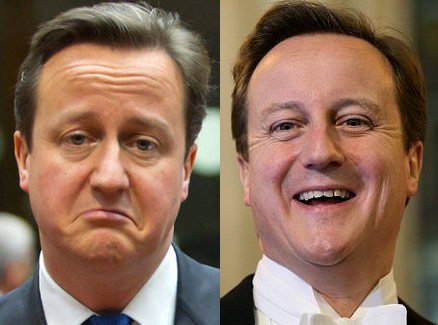
david_cameron_too_white_vs_too_jew

The anti-White/pro-jew regime in action in Britain.

MPs are too white, says David Cameron, Telegraph, 29 June 2014:

MPs do not represent the people of Britain properly because they are too white, David Cameron has said.

The Prime Minister said there is “much more to be done” to encourage more people from ethnic minority backgrounds to enter Parliament.

Mr Cameron made the comments in a preface to a book, “Rainbow over Westminster”, which charts the increasing number of MPs who are black or from ethnic minority backgrounds.

In the preface, Mr Cameron said that the book “serves as a reminder – that there is much more to be done.

“Our Parliament is still nowhere near representative enough of the country we live in today.

“We should not presume that this will simply correct itself over time. History isn’t written for us: it is written by us.”

Surprise new UK trade minister is committed Jew, thinks Israel’s ‘amazing’, The Times of Israel, June 2013:

There are so many Jews at the top of Britain’s Conservative party, Prime Minister David Cameron once quipped, that it should be known as the Torah party rather than the Tory party.

With the announcement last Wednesday that Ian Livingston was selected as trade and investment minister and elevated to the House of Lords, Cameron has appointed to the government possibly its most committed Jew yet, and certainly its most outspoken supporter of Israel — which Livingston has called “the most amazing state in the world.”

Livingston leads an active Jewish life, regularly attending an Orthodox shul, Borehamwood and Elstree United Synagogue just outside London. He is a well-known supporter of Israel and of Jewish charities, in recent years hosting or speaking at events for high school Yavneh College, the United Jewish Israel Appeal, human rights NGO Rene Cassin, and Jewish business incubator TraidE, among other causes.

Cameron’s ‘Torah’ government, My Catbird Seat, June 2013:

Three years ago The Jewish Chronicle published a list of Jewish MPs in Britain’s parliament, naming 24. The Jewish population in the UK at that time was – and probably still is – around 280,000 or just under 0.5%. There are 650 seats in the House of Commons so, on a proportional basis, Jews could expect 3 seats. But with 24 they were 8 times over-represented. Which meant, of course, that other groups were under-represented.

The UK’s Muslim population is about 2.4 million or nearly 4%. Similarly, their quota would be 25 seats but they had only 8 – a serious shortfall. If Muslims were over-represented to the same extent as Jews (i.e. 8 times) they’d have 200 seats. Imagine the hullabaloo.

Over-representation in the House of Commons is only part of the picture. Many more Jews have been inserted into the House of Lords and other non-elected and unaccountable positions. An even bigger worry is the huge number of non-Jewish Zionists that have infiltrated every level of political and institutional life. They swell the pro-Israel lobby to such an extent that it is believed to account for 80% of the Parliamentary Conservative Party, which now rules with the Liberal Democrats as their junior coalition partner.

The Jewish Chronicle, in its 2006 special report ‘Team Cameron’s big Jewish backers’, revealed the support that enabled Cameron to suddenly burst into the political limelight, almost unknown, to take the Conservative leadership. With no significant achievement under his belt he was then able to manoeuvre, with the help of his backers, into Britain’s PM slot.

Sailer Forgets

Last year Sailer was writing about jewish influence on immigration. See here and here. He may have written more, and more recently. I don’t know, I’ve lost interest in keeping up with him since he moved in with Ron Unz.

Now Sailer has amnesia. He wonders, Why did we do this to ourselves?

The best excuse is that American elites did this to America in a fit of absentmindedness.

But, there is also — and in this case perhaps more significant — the massive dereliction of duty by elites. The more the evidence piles up that they ought to apologize to us, the more they will make it dogma, punishing expressions of skepticism with social, career, and legal penalties, that this was a Great Idea.

He realizes there’s an us and a them. He doesn’t want to think about that. Instead he’s thinking about excuses. I think the more evidence piles up that all the jews’ “Great Ideas” are poison, the more the jew-excusers insist that we’re poisoning ourselves.

Politics + Technology = Nonsense at the Speed of Light