Yockey on Liberalism – Part 2

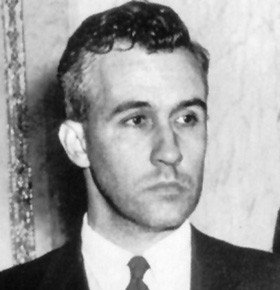
francis_parker_yockey_1960

Rusty’s comment provides another view of liberalism, as rebellion against natural law:

The more degenerate our society becomes, the more it seems to me that liberalism and sin are practically the same thing. The fountain of both are the same: the belief that one can break the rules of the universe and of God(s) and not have to face any consequences. All other errors (sins) follow from this basic rebellious notion.

Ted Sallis on Yockey’s liberalish-sounding concern about European inequality, intolerance:

Yockey was likely troubled by the idea of disjunctive subracial (e.g., Nordic/Alpine/Mediterranean) European subdivisions that considered these putative subraces as almost different species (with implications of superiority/inferiority). As a promoter of European unity, Yockey eagerly latched on to absurd Boasian counter-theories to invalidate what he saw as invidious and divisive distinctions among Europeans.

Yockey’s thoughts on both points can be found in Imperium, p.152. Here Yockey sets the stage for his assessment of liberalism by describing the definitive role of the “friend-enemy disjunction” for political organisms:

The Laws of Totality and Sovereignty

The organic Laws of Sovereignty and Totality refer to all political units whatever. They describe any unit, whatever its provenance, that reaches the degree of intensity of expression at which it participates in a friend-enemy disjunction. Totality refers both to issues within the organism and to persons within the organism. Any issue within the organism is subject to political determination, because every issue is potentially political. Any person in the organism is existentially embraced in the organism. Sovereignty places the decision in every important juncture with the organism. Both of these laws are existential, like all organic conditions: either the organism is true to them, or it is faced with sickness and death. Both laws will be explained.

First the Law of Totality: Any contrast, opposition, or hostility whatever existing within groups among the organism may become political in its nature, if it reaches the point where a group or a unit feels another group, class or stratum to be a real enemy. For such a unit to arise within an organism is for

153

the possibility of civil war to be present, or a severe crisis in the organism, which renders the organism liable to damage or extinction from without. Therefore, every organism, by its very existence, has the characteristic that it assumes power over the determination of all issues. This does not mean that it plans the total life of the population — economic, social, religious, educational, legal, technical, recreational. It means merely that all of these things are subject to political determination. Many of these things are neutral to some States, but objects of interest to others. But all organisms will intervene when an inner grouping may possibly become a focus of a friend-enemy disjunction. This describes all political units whatever, entirely independently of how they formulate their written constitutions, if they have any.

The Law of Totality affects individuals by embracing them existentially in the life of the organism. Politics places the life of every man within the political unit in the balance. It demands, by its very existence, the readiness of all individuals in the service of its fulfillment to risk their lives. Other groups may demand dues, periodical attendance at meetings, investment of time in group projects. If they demand however — so fundamental is this organic law of totality — that the member plight his life to the group, they become therewith political. The French public law professor Haurion designated it as the hall-mark of a political unit that it embraced the individual entirely, whereas non-political groups embrace him only partially.

This is the Law of Totality in other words. It is thus a touchstone of a group for this purpose whether it demands an existential oath.

If a group extracts such an oath from members, the group is political. This Law of Totality, it is hardly necessary to add, is

154

not at all derived from conscription for military service. Conscription exists only for a few centuries within a High Culture, whereas the Law of Totality describes the Culture itself when it is itself constituted as a political organism, and, during the period of concentration of politics in Culture-States, it describes every individual State. Like all organic laws it is existential: if any inner force can challenge it, the organism is sick; if the challenge is attended with success, the organism is in severe crisis and may be annihilated. In any case, its unity will be temporarily in abeyance, with the possibility of partitioning by outer powers.

The Law of Sovereignty is the inner necessity of organic existence which places the decision in every important juncture with the organism, as opposed to allowing any group within to make the decision. An important juncture is any one which affects the organism as a whole, its steering in the world, its choice of allies and enemies, the decision of war and peace, its inner peace, its unchallenged inner right to decide controversies. If any of these can be called into question, it is a sign that the organism is sick. In the healthy organism, this sovereignty is absolutely undisputed, and may continue so for centuries. But a new age with new interests may raise contrasts which the rulers do not grasp; they may blunder, and find themselves on the defensive in a civil war. The challenge of the sovereignty of the organism was the first symptom of crisis. If the organism survives the crisis, the new rulers of the same organism will be the focus of the same sovereignty.

An important fact has been touched upon with this: it is not the rulers who are sovereign within the meaning of this law. Their powers in fact are derived from their symbolic-representative position. If a stratum represents and acts in the Spirit of the Age, revolution against it is impossible. An organism true to itself cannot be sick or in crisis.

155

The Law of Sovereignty does not mean that every aspect of group life within the organism is dominated at all times by the political, nor that everything is organized, or that a centralized system of government necessarily reaches out always and destroys every organization of whatever kind. The outlook developed here is purely factual, and the Law of Sovereignty describes all political organisms; it is a formulation in words of a quintessential characteristic of a political organism.

Yockey’s laws are existential. Political organisms which violate The Law of Totality, through division, die. Those which violate the Law of Sovereignty, by loss of self-consciousness and self-rule, also die.

Yockey’s view, almost seventy years on, remains relevant. Though the Spirit of the Age, the zeitgeist, the “philosophy of society”, continues to mutate, it is still called “liberalism”. The rule of an implacably hostile, judaized elite and their multicultural/multiracial divide-and-conquer ideals flout both of Yockey’s laws. The prognosis for the political organisms which embrace such “liberalism” is increasingly obvious – sickness and death.

With this groundwork laid, we move now to Yockey’s analysis of the origins and traits of what he called liberalism. Skipping ahead to p.204, he identifies the key false premise as a misunderstanding of human nature:

The Two Political Anthropologies

The touchstone of any political theory whatever is its attitude to the fundamental ethical quality of human nature. From this standpoint there are only two kinds: those which posit a “naturally good” human nature, and those which see human nature as it is on the other hand. Good has meant reasonable, perfectible, peaceful, educable, desiring to improve, and various other things.

Every Rationalistic political or State theory regards man as “good” by nature. The Encyclopedists, the Illuminati and the devotees of Baron Holbach’s philosophy were all symptomatic of the advent of Rationalism in the 18th century. All talked of “the essential goodness of human nature.” Rousseau was the most forceful and radical of 18th century writers in this respect. Voltaire set himself apart by denying totally this essential goodness of human nature.

It is curious that a theory of politics could ever possibly ground itself on such an assumption, since politics actualizes itself only in the form of the friend-enemy disjunction. Thus a

205

theory of hostility assumes that human nature is essentially peaceable and non-hostile.

The middle of the 18th century is the beginning of the word liberalism, and of the idea-complex liberalism. Since human nature is basically good, there is no need to be strict with it, one can be “liberal.” This idea was derived from the English Sensualist philosophers. The Social Contract theory of Rousseau originated with the Englishman Locke in the previous century. All Liberalism predicates a sensualistic, materialistic philosophy. Such philosophies are rationalistic in tendency, and Liberalism is simply one variety of politically applied rationalism.

The delusion that human nature is basically good fuels the “liberal” drive for freedom and equality. Taken to its usual universalist extreme, it also fits the view of “liberalism” as the delusion that everybody is “us”. “Liberals” don’t need to take their own side because they see only one side, the side they imagine everyone (except White “racists”) is already on.

The Fifty Worst Jews of 2014

jp_top50_worst_jews

‘The Jerusalem Post’s’ top 50 most influential Jews of 2014, 3 June 2014:

The point of putting together such a list is to recognize the achievements of our tribe across the world, people who in one way or another have worked tirelessly for the improvement of humanity and, in doing so, have made their mark on history.

Included in the overview article are links to separate pages with detailed descriptions for each jew in the list. The word power occurs almost as frequently as influence, especially for those at the top. These are jews who have definitely worked tirelessly and made their mark on history. However, the suggestion that they have used their power and influence “for the improvement of humanity” is ridiculous, unless you understand “humanity” to mean “jewry”.

Most of the jews in the list are Israelis, and most of them are government officials. Many of the rest head organizations in the Anglosphere which are dedicated to promoting jewish and Israeli interests. More than anything else this is a list of jew-first and Israel-first chauvinists. From the point of view of anyone whose interests are harmed by jewish power and influence this can therefore be regarded as a list of some of the worst jews.

‘The Jerusalem Post’s’ top 50 most influential Jews of: 1-10
‘The Jerusalem Post’s’ top 50 most influential Jews of: 11-20
‘The Jerusalem Post’s’ top 50 most influential Jews of: 21-30
‘The Jerusalem Post’s’ top 50 most influential Jews of: 31-40
‘The Jerusalem Post’s’ top 50 most influential Jews of: 41-50

Before the creation of the Jewish state, in the throes of rampant anti-Semitism and horrors of the Holocaust, it would have been unthinkable to put together such a list. But today, thanks in great part to the strength and stature of Israel and the unprecedented freedom that Jews enjoy in the United States and elsewhere, there has been a Jewish renaissance.

Rising anti-Semitism in Europe is a worrying trend, and it is especially important that prominent Jews with influence in Europe are supported in their struggle against this phenomenon.

Jewish power and influence now runs rampant over the rest of humanity. Denial and shifting blame is becoming less and less tenable. Beside serving as an expression of naked triumphalism, or as an Orwellian attempt to turn jewish rule into something their subjects should celebrate, lists like this represent in effect a burning of the boats, prodding the most prominent jews who aren’t already fully committed to use their power and influence to squash any pushback.

Have we left important people off the list? Of course.

Here are the names on the list:

1. Jack Lew
2. Janet Yellen
3. Binyamin Netanyahu
4. Shimon Peres
5. Sheldon Adelson
6 Malcolm Hoenlein
7. Avigdor Liberman
8. Adina Bar-Shalom
9. Yair Lapid
10. Naftali Bennett
11. Elie Wiesel
12. Ronald Lauder
13. Steven Spielberg
14. Stanley Fischer
15. Shari Arison
16. Rabbi Yechiel Z. Eckstein
17. Tzipi Livni
18. Scarlett Johansson
19. Isaac Herzog
20. Ed Miliband
21. Yosef Abramowitz
22. Lynn Schusterman
23. Matthew Bronfman
24. Karnit Flug
25. Joseph Gitler
26. Nir Barkat
27. Natalie Portman
28. Nitsana Darshan-Leitner
29. Irwin Cotler
30. Jeremy Ben-Ami
31. Moshe Kantor
32. Hershey Friedman
33. Ephrat Levy-Lahad
34. Ephraim Mirvis
35. Jonathan Sacks
36. Abe Foxman
37. Idan Raichel
38. Lena Dunham
39. George Soros
40. Vladimir Sloutsker
41. Benny Gantz
42. Daniel Gordis
43. Ester Rada
44. Raphael Mechoulam
45. Dalia Dorner
46. Ofra Strauss
47. Chaim Chesler
48. David Golinkin
49. Marcie Natan
50. Mark Leibler

Yockey on Liberalism – Part 1

yockey

Revilo Oliver wrote The Shadow of Empire: Francis Parker Yockey After Twenty Years in June of 1966. Oliver regarded “the great problem of history” to be whether “cataclysmic changes [e.g. the British conquest of India and subsequent withdrawal] are wrought by the weakness and folly of men or by blind and ineluctable forces of nature”. Oliver noted:

The great modern philosopher of history is, of course, Oswald Spengler, whose Decline of the West formulated the problem in terms so clear and universal that everything written on the subject since 1918 has perforce had to be a commentary on Spengler — an attempt to extend, modify, or refute his magisterial synthesis.

Oliver described the connection between Spengler’s work and Yockey’s:

Francis Parker Yockey proudly proclaimed himself the disciple of the man to whom he often refers as simply The Philosopher

Oliver on Yockey’s Imperium:

This is not a book for “liberal intellectuals” or other children. No man can study history until he has learned that he must study it objectively and dispassionately, without reference to his emotions or predilections.. Whether you view Caesar with admiration or horror, whether you love or hate him, has nothing whatever to do with the fact that he was victorious at Pharsalus.

No man should consider problems in historionomy if he does not realize that the only question before him will be the accuracy of the diagnosis or prognosis. The validity of the analysis does not in the least depend on the reader’s emotional reaction to the future that it portends. When a physician diagnoses diabetes or arteriosclerosis or cancer, the only question is whether he has observed the symptoms accurately and reasoned from them correctly. Our wish that the patient did not have the disease is utterly irrelevant.

Infantile minds, accustomed to living almost entirely in the vaporous realm of their own imagination, are incapable of distinguishing between reality and their own fancies. That is why I counsel “liberal intellectuals” not to read Imperium. If they are able to understand it, the book will certainly send them into a tantrum and may induce a paroxysmic fit. They had better stay in their academic lecture-halls or other play-pens, where they can be happy making mud-pies, which they can call “world peace” and about which they can dance in a circle, chanting

Higgledy-piggledy, my fat hen,
Now we’ve got a big U.N.

I also hope that Imperium will not fall into the hands of tenderhearted Conservatives who want to Love Everybody. Those dear ladies have noble souls, but they are much too good for this world.

Oliver also expressed some concerns about Spengler, Yockey and Imperium:

Spengler assumed such plasticity of human nature that he greatly underestimated and almost ignored the biological differences between human beings. Spengler was deceived by the pseudo-scientific data forged or distorted by the school of Franz Boas

Spengler cites Boas with unjustified respect, and Yockey follows Spengler, though with some prudent reservations. Both try to refute genetics by citing examples of apparently total cultural assimilation; they do not see that these could be explained by phenomena they recognize elsewhere: the cultural passivity of the majority in all nations and cultures, and the tendency of isolated individuals to adapt themselves to the society in which they find themselves. It is true that Orientals in the West have conformed, with apparent eagerness and sincerity, to Occidental culture; it is also true that white men have “gone native” among the American Indians and Polynesians. The one example proves no more than the other.

Race Ignored

Spengler virtually ignores race as a biological reality and even uses the word “race” in a non-biological sense to designate full participation in a culture.

See my previous work on race and anthropology and race and fraud for more information about Franz Boas and how the jewish intellectual movement known as Boasian anthropology derailed race science.

For Yockey, the question is less critical than for Spengler. Yockey is concerned primarily with showing that “race-differences between White men, which means Western men, is vanishingiy small” in comparison with the gulfs that separate Western men from Negroes and Orientals. That, no one can deny.

Imperium contains a number of historical oversights and lapses, such as are inevitable when a man tries to generalize from a vast mass of complex details — inevitable even when the author writes in a well-stocked library after decades of intensive study and meditation. Yockey, it must be remembered, was a young man of thirty-one, by profession a lawyer, who wrote in a room of an isolated inn on the lonely shore of the Irish Sea north of St. George’s Channel — wrote from memory in a fire of inspiration and while still feeling the moral revulsion caused, by his participation in the early stages of the obscene farce that was enacted at Nuremberg to provide a hypocritical pretext for the lynchings that the United States carried out as a pawn of the International Communist Conspiracy. I shall merely list the three most conspicuous historical errors.

In Oliver’s estimation Yockey did not fully grasp the long-term, biological nature of the jewish problem:

The Jewish Race

(3) When Yockey concluded that the Jewish “race” (in his non-biological sense of the word) was formed by the ghettoes of Mediaeval Europe, he probably did not know that the historical record extends over twenty-five centuries. There is no reason to suppose that the Jews who migrated to the Mediaeval cities and established their ghettoes aroused more resentment among the Christian populations than the Jews who settled on an island in the Nile near the First Cataract aroused among the native Egyptian population in the fifth century B.C. Yockey’s mistake, by the way, vitiates the parallel that he draws between the Jews in Europe and the Parsees in India.

Such errors of detail do not invalidate the general thesis of Imperium. Yockey’s analysis of the forces that are eroding our civilization is significantly supported by the fact that Lawrence R. Brown, who wrote when Imperium was almost unprocurable and seems never to have heard of it, reached substantially the same conclusions by an entirely different method in his learned and lucid work, The Might of the West (New York, Obolensky, 1963). And in several distinct areas, the future that Yockey forecast in 1947 seems to be taking shape before our eyes today. Imperium is not a revelation of an ineluctable future, but it is a work that we must study and ponder, if we would act intelligently in our time.

Even so, Oliver still saw value in Yockey’s work:

The great value of Imperium is that it forces us to reconsider our position realistically.

The liberalism Yockey critiques seems quite distinct from what I have so far discussed in What is Liberalism?, Liberalism as a Death Wish and Liberalism as a Suicide Pact. Yockey’s view of liberalism seems similar to Guessedworker’s view, in that both regard liberalism as an irrepressible expression of European man. Next time we’ll compare Yockey’s points with the broader philosophy-of-society liberalism we have previously explored.

My attempt to understand liberalism is an attempt to understand the cataclysmic changes wrought in its name. The answer, it seems, is not in either man or nature, but in both, in man’s nature. As difficult as it may be to overcome our nature, those of us who struggle to understand this nature, and to communicate our understanding to others, do so only because we do wish to overcome it.

Ted Sallis noted Kerry Bolton’s New Yockey Biography Project at The Occidental Observer. Sallis echoed Oliver’s concerns:

Many of Yockey’s ideas on biological race specifically, and on science and scientific topics generally, are not only ludicrous but just plain wrong. Objectively wrong. With respect to race, I suspect that the views of Yockey (and Evola as well) were negatively influenced by some of the racial theories popular before WWII, and still extant today, particularly in the American “movement.” In other words, I don’t think Yockey had any problem with the major racial (e.g., European/African/Asian) distinctions; instead, Yockey was likely troubled by the idea of disjunctive subracial (e.g., Nordic/Alpine/Mediterranean) European subdivisions that considered these putative subraces as almost different species (with implications of superiority/inferiority). As a promoter of European unity, Yockey eagerly latched on to absurd Boasian counter-theories to invalidate what he saw as invidious and divisive distinctions among Europeans.

You can find more information about Francis Parker Yockey and Imperium at Metapedia.

Majority Rights Radio: Guessedworker speaks with Tanstaafl

twomenandmoon

Earlier today I had the pleasure of speaking with Guessedworker from Majority Rights. Over the course of about one and three quarter hours GW and I discussed jewish influence, race, liberalism, Christianity, Lawrence Auster, Paul Weston, White nationalism, European and American relations, and the White network.

Liberalism as a Suicide Pact

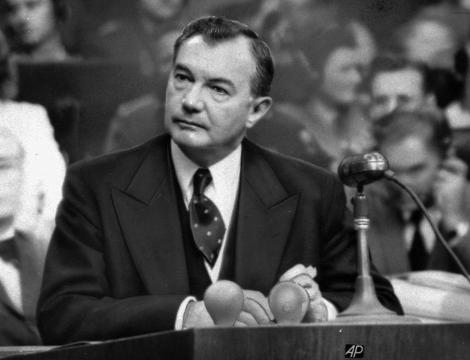
jackson_at_nuremberg

For jews like Lawrence Auster and Paul Gottfried, blaming “liberalism” is a way of shifting blame away from the jews. Here is Auster’s description of their mutual understanding:

Jewish liberals see white Christians as guilty. The Jews feel ok about themselves, they think the white gentile majority is the problem.

By contrast, white Protestant liberals feel guilty about themselves. This leaves them without a confident group selfhood. They believe only in equality, only in their own guilt for somehow standing in the way of equality. It is this lack of collective and even individual selfhood, this inner nothingness, this willingness to be destroyed, that makes the white Protestants the true liberals. The Jews, whose collective and individual psyche is not guilty under liberalism (since in the liberal world view Jews are victims and the champions of victims), have psychological power and self-confidence and thus are not true liberals.

A true liberal is a person who is willing to accept his group’s extinction. Protestants are willing to accept their group’s extinction. Jews are not. Therefore Protestants are closer to the true liberal essence than the Jews are.

The dissembling here is two-fold. First, they describe racial group differences as religious. Second, and far more important, they ignore jewish anti-White animus.

So how does this White “liberalism” they describe work? They see that the broad-minded White “liberal” individualist don’t-take-your-own-side attitude is not just a poor long-term strategy for the individual, but leads directly to extinction for the group. So how is it that such passive, insecure nothings ever came to run the show?

The answer is that Whites don’t run “liberalism”, the jews do. It is specifically because jews define what contemporary “liberalism” is that White “liberals”, as effete as they are, have gotten and will continue to get the blame for it.

The litany of White sins – slavery, colonization, holocaust – is a jewish construct. It is jews driving the guilt-tripping that causes White guilt and negative associations with White group identity. “You aren’t liberal enough!” is the gist of it. Auster and Gottfried tack yet another item onto the list: “You’re so liberal you’re killing yourself!”

The shift in control over “the philosopy of society” (called “liberalism” ever since the American and French revolutions) from White/Aryan to jew is clearly visible in the shift in attitudes about free speech. Judge Jackson’s dissent in Terminiello v Chicago, in the wake of WWII, shows an increasingly judaized “liberalism” pushing back against White “liberalism”.

“This or that is not a suicide pact” has become a popular turn of phrase in the US. It traces back to Jackson’s dissent in Terminiello, which was motived not by a desire to prevent “suicide”, but to shield the jews from White opposition. Terminiello v. Chicago – Significance at jrank.org describes the background:

Father Terminiello, sometimes called “the Father Coughlin of the South” because of his anti-Semitic rhetoric, was an Alabama priest who, at the time of this case, was under suspension by his church for distributing anti-Jewish literature. Well known for his controversial views on Jews, blacks, New Deal Democrats, and just about everybody else not white, Christian, and conservative, Terminiello came to Chicago from his home base of Birmingham. He was invited by a group called the Christian Veterans of America in 1946 in order to make a speech at the West End Women’s Club.

Terminiello’s appearance was attended by a capacity crowd of about 800. Meanwhile, a hostile mob of protesters, estimated at well over 1,000 people, gathered outside the auditorium. The tone of Terminiello’s speech, which straightforwardly attacked “Communistic Zionistic Jews,” African Americans, and Franklin D. Roosevelt, among others, incited the crowd outside to violence. Police were unable to contain the disturbance. Scores of rocks, bricks, bottles, and stink bombs were thrown, resulting in 28 broken windows, 17 arrests.

In the wake of the mayhem, an organization called the Chicago Civil Liberties Committee filed a complaint against Terminiello, claiming that he had violated a Chicago ordinance against disturbing the peace. The language of the ordinance declared it illegal to create a “diversion tending to a breach of the peace.” Terminiello was convicted and fined $100 for his role in the disturbance. Two higher Illinois courts upheld the conviction. Terminiello eventually brought his case to the U.S. Supreme Court.

In a 5-4 decision, the Supreme Court reversed the ruling of the Illinois courts, and overturned Terminiello’s conviction.

In a long, emotional dissenting opinion, Justice Jackson was clearly influenced by his own recent experience as chief U.S. counsel at the Nuremberg trials of Nazi war criminals. To Jackson, Terminiello’s language was too close to that of the fascists, whose defeat was considered important enough to justify going to war.

Jackson wrote:

There is danger that, if the Court does not temper its doctrinaire logic with a little practical wisdom, it will convert the constitutional Bill of Rights into a suicide pact.

In effect, Jackson was saying that the Constitution, the most significant document of White “liberalism”, must be interpreted and even ignored in order to suit the best interests of the jews.

Here’s Metapedia’s page on Robert H. Jackson, to which I added a bit about Terminiello v. City of Chicago, Constitution not a suicide pact.

Here’s Metapedia’s page on Arthur Terminiello, which includes excerpts from his speech in Chicago. The portions referring to jews are most notable for their qualifications:

“Now, let me say, I am going to talk about–I almost said, about the Jews. Of course, I would not want to say that. However, I am going to talk about some Jews. I hope that–I am a Christian minister. We must take a Christian attitude. I don’t want you to go from this hall with hatred in your heart for any person, for no person. . . .

“Now, this danger which we face–let us call them Zionist Jews if you will, let’s call them atheistic, communistic Jewish or Zionist Jews, then let us not fear to condemn them. You remember the Apostles when they went into the upper room after the death of the Master, they went in there, after locking the doors; they closed the windows. (At this time there was a very loud noise as if something was being thrown into the building.)

“So, my friends, since we spent much time tonight trying to quiet the howling mob, I am going to bring my thoughts to a conclusion, and the conclusion is this. We must all be like the Apostles before the coming of the Holy Ghost. We must not lock ourselves in an upper room for fear of the Jews. I speak of the Communistic Zionistic Jew, and those are not American Jews. We don’t want them here; we want them to go back where they came from.

The Chicago Civil Liberties Committee (informal motto, “Liberty is for the jews, not for youse.”), who brought the case against Terminiello, merits further investigation. This page seems to use “communist-leanings” as code for “jewish influence”:

During World War II, internal partisan divisions wracked the membership of the Chicago Civil Liberties Committee. Debate surged over the relevance of civil liberties in the Soviet Union, the ACLU’s defense of the legal rights of American Fascists, and endorsement of President Roosevelt and his economic policies. In 1945 the national organization of the ACLU accused the CCLC of partisanship and Communist leanings and threatened the committee with expulsion. In response, the CCLC disaffiliated itself from the national organization

More evidence that jewish “liberalism” means “suicide for thee, not for me” can be found in Liberal Democratic Values – not a suicide pact, at Jewish Issues Watchdog, “keeping an eye on jewish affairs”:

[Peter] Beinart displayed unflinching resolve to advance and to defend his liberal-democratic values – down to the last Israeli.

It must be remembered that commitment to liberal democratic values is not a suicide pact.

To expect Israel to conduct itself in a manner totally divorced from the exigencies of its environment and totally detached from the nature of its adversaries and their manifest goals – as reflected both in their declarations and in their deeds –is a position that reflects neither moral merit nor political prudence

A prescient William Pierce wrote Liberals, the Jews, and Israel in 1975:

THE CURRENT JEWISH power play in the Middle East poses the gravest imaginable dangers to America. Yet, in the midst of these dangers is a development which offers the promise of great good to the American people. That good is the disruption of the American liberal establishment and the extensive undermining of the traditional alliance between Jews and Gentile liberals.

It is interesting to note that liberals, who have always insisted that a person must be judged only as an individual and not as a member of a racial or ethnic group, accepted without hesitation the thesis that the Jews, as a people, were entitled to immunity from criticism and to collective reparations for the disabilities which some individuals among them, no longer present for the most part, had suffered earlier in Germany.

Liberal writers who condemned in the harshest terms the German practice of shooting Jewish political commissars whenever they were discovered among captured Soviet troops, refer in an indifferent and offhand way to the brutal torture and murder of tens of thousands of German SS men, the elite of their nation, who, after they had laid down their arms and surrendered, were turned over to Jews in U.S. Army uniforms to be castrated, used for bayonet practice, and subjected to other tortures too gruesome to recount.

Jews, of course, have been playing the “persecution” angle for all it is worth throughout their long and turbulent history. In a sense they have made a living — generally, a very good living — off being “scapegoats.”

Before the Germans it was the Russian Czars who persecuted this race of professional “victims,” and before them it was the Polish peasants, and the Spanish Inquisitors, and the English yeomen, and the French Crusaders, and the Roman legions, all the way back to the Egyptian Pharaohs. Westerners, and not just the liberals among them, have always been suckers for a cleverly managed act of martyrdom.

The jewish problem traces back long before “liberalism”, the jews have been “suicide pacting” their hosts for millennia.

Politics + Technology = Nonsense at the Speed of Light