Race and Jews – Part 3

kevin_macdonald

This time we’ll contrast William Graham Sumner’s view of ethnocentrism with Kevin MacDonald’s view specifically focused on the jews. Sumner wrote in 1907, when it was still reasonable to imagine that the White man ruled America and Europe, or as Francis Parker Yockey put it, ruled 18/20ths of the world.

Recall Sumner’s definition of ethnocentrism:

15. Ethnocentrism is the technical name for this view of things in which one’s own group is the center of everything, and all others are scaled and rated with reference to it.

Though Sumner saw the significant role jews played in the development of Western folkways and mores, and noted their ethnocentrism, he showed no discernable sign of alarm concerning jewish power.

A hundred years later it is still common, more common, to flatly ignore the jews or even deny that the jews have any power. However, it is more difficult to defend such a position in the face of the jews’ dominance in the realms of finance, media, and politics. Today those who are critical of jewish influence and power are openly punished for doing so.

Kevin MacDonald is a good example. Like Sumner, MacDonald is an academician specializing in social psychology. He has described the jews not only as ethnocentric, but as a hostile elite with a particularist morality, where “good is what is good for the jews”. In fact, MacDonald has noted the unique and extreme qualities of jewish ethnocentrism, often referring to it as hyperethnocentrism.

The abstract for MacDonald’s monograph, Understanding Jewish Influence I: Background Traits for Jewish Activism, begins with this sobering overview of the history of White/jew relations:

Beginning in the ancient world, Jewish populations have repeatedly attained a position of power and influence within Western societies. I will discuss Jewish background traits conducive to influence: ethnocentrism, intelligence and wealth, psychological intensity, aggressiveness, with most of the focus on ethnocentrism. I discuss Jewish ethnocentrism in its historical, anthropological, and evolutionary context and in its relation to three critical psychological processes: moral particularism, self-deception, and the powerful Jewish tendency to coalesce into exclusionary, authoritarian groups under conditions of perceived threat.

Jewish populations have always had enormous effects on the societies in which they reside because of several qualities that are central to Judaism as a group evolutionary strategy: First and foremost, Jews are ethnocentric and able to cooperate in highly organized, cohesive, and effective groups. Also important is high intelligence, including the usefulness of intelligence in attaining wealth, prominence in the media, and eminence in the academic world and the legal profession. I will also discuss two other qualities that have received less attention: psychological intensity and aggressiveness.

The four background traits of ethnocentrism, intelligence, psychological intensity, and aggressiveness result in Jews being able to produce formidable, effective groups—groups able to have powerful, transformative effects on the peoples they live among. In the modern world, these traits influence the academic world and the world of mainstream and elite media, thus amplifying Jewish effectiveness compared with traditional societies. However, Jews have repeatedly become an elite and powerful group in societies in which they reside in sufficient numbers. It is remarkable that Jews, usually as a tiny minority, have been central to a long list of historical events. Jews were much on the mind of the Church Fathers in the fourth century during the formative years of Christian dominance in the West. Indeed, I have proposed that the powerful anti-Jewish attitudes and legislation of the fourth-century Church must be understood as a defensive reaction against Jewish economic power and enslavement of non-Jews.1 Jews who had nominally converted to Christianity but maintained their ethnic ties in marriage and commerce were the focus of the 250-year Inquisition in Spain, Portugal, and the Spanish colonies in the New World. Fundamentally, the Inquisition should be seen as a defensive reaction to the economic and political domination of these “New Christians.”2

Jews have also been central to all the important events of the twentieth century. Jews were a necessary component of the Bolshevik revolution that created the Soviet Union, and they remained an elite group in the Soviet Union until at least the post-World War II era. They were an important focus of National Socialism in Germany, and they have been prime movers of the post-1965 cultural and ethnic revolution in the United States, including the encouragement of massive non-white immigration to countries of European origins.3 In the contemporary world, organized American Jewish lobbying groups and deeply committed Jews in the Bush administration and the media are behind the pro-Israel U.S. foreign policy that is leading to war against virtually the entire Arab world.

How can such a tiny minority have such huge effects on the history of the West? This article is the first of a three-part series on Jewish influence which seeks to answer that question.

The main body of MacDonald’s monograph is in the first section, titled I. Jews are Hyperethnocentric. His review of jewish behavioral traits is in direct comparison to Whites:

Whereas Western societies tend toward individualism, the basic Jewish cultural form is collectivism, in which there is a strong sense of group identity and group boundaries.

Jews are at the extreme of this Middle Eastern tendency toward hypercollectivism and hyperethnocentrism. I give many examples of Jewish hyperethnocentrism in my trilogy on Judaism and have suggested in several places that Jewish hyperethnocentrism is biologically based.

In this monograph MacDonald reiterates many of the themes he has written about elsewhere, including the aforementioned moral particularism of jews. He discusses self-deception, a term and concept I have taken issue with. Jewish deception is especially evident in their crypsis, the claims jews make as to the harmless or insignificant nature of jewish identity which are so often and blatantly belied by their activism.

MacDonald notes the long historical memory of the jews, their “memory of persecution and impending doom”, ostensibly at the hands of Whites. The point of How Anti-Whiteness is at the Heart of Jewish Identity is to see the jewish victimology narrative for the aggressive inversion of reality it is.

MacDonald touches on the uncanny ability jews have to identify each other and identify with each other, to recognize who is “us” and who is “them” – a trait informally known as jewdar.

MacDonald describes the strong identification jews have with Israel and zionism. Referring to an ADL press release responding to the liberalization of Germany’s immigration policies in 1999, MacDonald notes:

The prospective change in the “us versus them” attitude alleged to be characteristic of Germany is applauded, while the “us versus them” attitude characteristic of Israel and Jewish culture throughout history is unmentioned.

Words fail to capture the spectacle of professional jews, acting as spokesmen for the world’s most outstanding practitioners of “us vs them”, lecturing and moralizing us “them” on the evils of thinking in terms of “us vs them”. MacDonald concludes his section on jewish hyperethnocentrism with another attempt:

Jewish ethnocentrism is ultimately simple traditional human ethnocentrism, although it is certainly among the more extreme varieties. But what is so fascinating is the cloak of intellectual support for Jewish ethnocentrism, the complexity and intellectual sophistication of the rationalizations for it—some of which are reviewed in Separation and Its Discontents58 and the rather awesome hypocrisy (or cold-blooded deception) of it, given Jewish opposition to ethnocentrism among Europeans.

The three subsequent sections describe other heritable, i.e. racial, personality traits of jews. An excerpt from II. Jews Are Intelligent (and Wealthy):

Intelligence is also evident in Jewish activism. Jewish activism is like a full court press in basketball: intense pressure from every possible angle. But in addition to the intensity, Jewish efforts are very well organized, well funded, and backed up by sophisticated, scholarly intellectual defenses. A good example is the long and ultimately successful attempt to alter U.S. immigration policy.

The next section is titled III. Jews Are Psychologically Intense. MacDonald describes jews as having higher than average emotional intensity:

In the case of Jews, this affects the tone and intensity of their efforts at activism. Among Jews there is a critical mass that is intensely committed to Jewish causes—a sort of 24/7, “pull out all the stops” commitment that produces instant, massive responses on Jewish issues.

Several examples of such instant, massive responses come to mind.

Judaized Discourse – A Holocaust Over Blood Libel documents such a response to Sarah Palin.

What’s Flipping Yid Lids Today: Tom Perkins on the 1% and Kristallnacht documents another example.

Another more serious and recent example came just a few months ago with the Israeli military bombed Gaza, hitting schools and hospitals. Four Jews, One Opinion on Israel captures a portion of the surreal response, where “liberal” jews got up on their jewsmedia soapboxes to defend Israel, and jews in general, describing themselves as the real victims.

All of the above brings to mind the proverb, “The jew cries out in pain as he strikes you.”

The last section is titled IV. Jews Are Aggressive. One excerpt:

These characteristics have at times been noted by Jews themselves. In a survey commissioned by the American Jewish Committee’s study of the Jews of Baltimore in 1962, “two-thirds of the respondents admitted to believing that other Jews are pushy, hostile, vulgar, materialistic, and the cause of anti-Semitism. And those were only the ones who were willing to admit it.”97

MacDonald’s work, and specifically this monograph on jewish hyperethnocentrism, highlights the racial divide in mentality and the great difficulty Whites face in trying to understand jews, a difficultly the jews themselves mockingly refer to as goyishe kopf.

What we’ve discussed here are really all just various facets of an inborn racial ruthlessness, the stereotypical willingness of jews to say almost anything in defense of jews, or to excuse the harm jews do to others. Anyone who has debated jews is familiar with the lies, illogic, personal insults and other distractions to which they readily resort.

The term ethnocentrism doesn’t really capture this ruthlessness. Hyperethnocentrism is only slightly better. Loxism, or jewism, though relatively uncommon and unknown, are better words because they do capture the unique, incomparable nature of jewish racial ruthlessness. As Alex Linder recently remarked:

Whites assume jews aren’t conspiring, because whites don’t. Jews assume whites are conspiring, because they do. #loxism

Picture source: Is Orange County professor Kevin MacDonald ‘the most dangerous living anti-Semite?, in which the jewish interviewer/author exhibits his entirely jew-centric views and many other of the jewish personality traits MacDonald has described.
Race and Jews – Part 2

william_graham_sumner_1902

Concerning some basic race-related terminology and concepts, especially ethnocentrism.

Upon reading the previous brief quotation of William Graham Sumner I was curious to learn more about him. His Wikipedia page begins:

William Graham Sumner (October 30, 1840 – April 12, 1910) was a Classic Liberal–now often called libertarian American academic. He taught social sciences at Yale, where he held the nation’s first professorship in sociology. He was one of the most influential teachers at Yale or any major schools. Sumner was a polymath with numerous books and essays on American history, economic history, political theory, sociology, and anthropology.

Sumner, like the other White polymaths of his time, has been retroactively branded a “social Darwinist”, which to the jews and other anti-Whites who have hijacked science roughly equates to “boogeyman”.

An example of the cognitive dissonance this hijacking has created can be found in this Slate article from 2012, Income Inequality: William Graham Sumner invented the GOP’s defense of the rich—in 1883:

One of the earliest (and most acerbic) champions of inequality was William Graham Sumner, a Yale sociologist and one of the best-known public intellectuals of the late 19th century. Sumner started his career as an Episcopal priest, tending to the pastoral needs of a New Jersey flock. Within a few years, however, he concluded that his temperament—famously standoffish and blunt—was better suited to scholarly endeavors. As a professor, he helped to pioneer the new discipline of sociology, coining such lasting terms as ethnocentrism and folkways in his studies of American culture. He also made a name for himself as a staunch anti-imperialist and principled opponent of the Spanish-American War.

Sumner was exactly the kind of proponent of “19th century thinking” that Francis Parker Yockey misidentified as the source of the problem with “the Western civilization”. (The real problem being the jews and other anti-Whites who hijacked the entire civilization, including race science.) Sumner was a White “liberal” who was objective, but not egalitarian. He was conscious of racial differences, and also aware that beyond the obvious physical traits these differences were also mental and cultural.

Sumner coined the term “ethnocentrism”, which ethnocentrism.net defines like so:

the technical name for the view of things in which one’s own group is the centre of everything, and all others are scaled and rated with reference to it

This is group consciousness and the morality based on it – my group, right or wrong, my group defines right and wrong.

The following is an indication that an ethnocentric jew is behind ethnocentrism.net:

The most extreme case of ethnocentrism, occuring since the time of William Graham Sumner, is that of the rise of Hitler and his hatred of Jews, gypsies and others.

Hitler was an individual, not an ethny. To the extent that the broad German support for national socialism, led by Hitler, had anything to do with the jews it was in reaction, in response to jewish ethnocentrism. The jews were an ethnocentric racial group which had risen to dominance over the native Germans via subterfuge, ethnic networking and financial fraud. They had infiltrated, manipulated and exploited the Germans, causing them harm.

The jews are the most extreme case of ethnocentrism. This is evident not only in their current power but their long history, their continuity over time relative to others. It is evident not only in their existing so long amongst others, but in thriving while doing so. So extreme is their ethnocentrism that they have been able to squelch criticism/discussion of their group, including their ethnocentrism. They have accomplished this in part by transferring the blame for the consequences of their parasitism onto their victims, the long string of hosts they’ve infiltrated, manipulated, and exploited, while ultimately driving them to ruin and extinction.

The situation has changed dramatically since Sumner’s day. Today jews pathologize and demonize “nazis”, by which they mean Whites generally, for being “racist”, by which they mean any hint of White ethnocentrism. Through relentless propaganda and indoctrination they have transformed the slightest sign of good and right and healthy ethnocentrism or racial consciousness, any awareness of White identity or concern for White interests, into something evil, wrong, and unhealthy. This is what they call “racism”.

You could say that by behaving this way, the jews demonstrate that they are the real “racists”. That would be wrong. The difference is that Whites are not ethnocentric enough, obsequious in the face of enemy criticism, whereas jews are beyond simple ethnocentrism, they aim not simply to quash what ethnocentrism Whites do have, but to turn it to their service.

The racial animus, the disdain, the hatred with which jews regard Whites is of its own kind. It deserves its own term. Alex Linder calls it loxism.

Considering his interest in ethnocentrism, did Sumner ever discuss the jews? How did he see them? In the process of searching for answers I came across Sumner’s most popular book, Folkways, published in 1907.

The book promotes a sociological or relativistic approach to moral behavior, as expressed in his thesis that “the mores can make anything right and prevent condemnation of anything.” (p. 521)

Encyclopedia Britannica describes the relation between folkways and mores:

Mores are more coercive than folkways: relatively mild disapproval follows an infringement of a folkway; severe disapproval or punishment follows the breaking of mores. Polygamy violates the mores of American society; failure to wait one’s turn in line is a breach of folkways.

Folkways is available online at The Gutenberg Project.

Sumner defines “mores” in the introduction:

I mean by it the popular usages and traditions, when they include a judgment that they are conducive to societal welfare, and when they exert a coercion on the individual to conform to them, although they are not coördinated by any authority

I have tried to treat all folkways, including those which are most opposite to our own, with truthfulness, but with dignity and due respect to our own conventions.

Sumner’s definition of ethnocentrism and its relation to folkways:

15. Ethnocentrism is the technical name for this view of things in which one’s own group is the center of everything, and all others are scaled and rated with reference to it. Folkways correspond to it to cover both the inner and the outer relation. Each group nourishes its own pride and vanity, boasts itself superior, exalts its own divinities, and looks with contempt on outsiders. Each group thinks its own folkways the only right ones, and if it observes that other groups have other folkways, these excite its scorn. Opprobrious epithets are derived from these differences. … For our present purpose the most important fact is that ethnocentrism leads a people to exaggerate and intensify everything in their own folkways which is peculiar and which differentiates them from others. It therefore strengthens the folkways.

He remarks on what could be called the universality of particularism:

17. When Caribs were asked whence they came, they answered, “We alone are people.”20 The meaning of the name Kiowa is “real or principal people.”21 The Lapps call themselves “men,” or “human beings.”

18. The Jews divided all mankind into themselves and Gentiles. They were the “chosen people.” The Greeks and Romans called all outsiders “barbarians.”

Contra Yockey, Sumner’s “19th century” understanding of race was far deeper than “group anatomy”:

51. Class; race; group solidarity. … The concept of a race, as the term is now used, is that of a group clustered around a mean with respect to some characteristic, and great confusion in the use of the word “race” arises from the attempt to define races by their boundaries, when we really think of them by the mean or mode, e.g. as to skin color. The coherence, unity, and solidarity of a genetic group is a very striking fact.

Sumner also describes his understanding of group interests, patriotism, chauvinism, and further into the book discusses the origins of a variety of foundational societal attitudes on subjects such as slavery, abortion, cannibalism, sex, marriage, incest.

What you might call the spiritual side of race, Sumner called ethos:

76. The ethos or group character. All that has been said in this chapter about the folkways and the mores leads up to the idea of the group character which the Greeks called the ethos, that is, the totality of characteristic traits by which a group is individualized and differentiated from others.

Races have personality traits. And racial character is characteristic:

85. Persistency in spite of change of religion. … The Jews to this day show the persistency of ancient mores. Christianity was a new adjustment of both heathen and Jewish mores to a new religious system. The popular religion once more turned out to be a grand revival of demonism. The masses retained their mores with little change. The mores overruled the religion. Therefore Jewish Christians and heathen Christians remained distinguishable for centuries.

Sumner did indeed seem to understand the jews in racial terms. Elsewhere he referred to them as a nation. One sour note:

114. Antagonism between groups in respect to mores. … The real reason for the hatred of Jews by Christians has always been the strange and foreign mores of the former. When Jews conform to the mores of the people amongst whom they live prejudice and hatred are greatly diminished, and in time will probably disappear.

Sumner misjudged here, in two ways. First, he accepted the jewish point of view as his own. Second, jews express their distaste, alienation, even hatred for Whites more plainly than ever. It is Whites who must conform to the mores of the jews now, or suffer the consequences. The jews’ anti-“racism” is becoming more overt anti-Whitism, even as there are more non-Whites behaving far more ethnocentrically.

Overall Sumner’s attitude toward the jews comes across as neutral, viewing the jews as the older brothers of Christians, as the origin of and an influence on many mores later adopted or adapted by Christianized Europeans. He seemed to regard them as active in the past, and not so much in the present.

The following passage is the closest he came to criticizing contemporary jews, in Folkways at least:

116. Missions and antagonistic mores. … There is no such thing as “benevolent assimilation.” To one who knows the facts such a phrase sounds like flippant ignorance or a cruel jest. Even if one group is reduced to a small remnant in the midst of a great nation, assimilation of the residue does not follow. Black and white, in the United States, are now tending to more strict segregation. The remnants of our Indians partly retain Indian mores, partly adopt white mores. They languish in moral isolation and homelessness. They have no adjustment to any social environment. Gypsies have never adopted the mores of civilized life. They are morally and physically afloat in the world. There are in India and in the Russian empire great numbers of remnants of aboriginal tribes, and there are, all over the world, groups of pariahs, or races maudites [[[cursed races]]], which the great groups will not assimilate. The Jews, although more numerous, and economically far stronger, are in the same attitude to the peoples amongst which they live.

“Whiteness Project” Stokes Anti-Whiteness

alex_the_jew

The tagline which greets visitors to Whiteness Project is “White people in Buffalo, NY, talk about race.” Here’s what comes up when you click on the About tab:

The Whiteness Project is a multiplatform investigation into how Americans who identify as “white” experience their ethnicity.

The project is conducting 1,000 interviews with white people from all walks of life and localities in which they are asked about their relationship to, and their understanding of, their own whiteness. It also includes data drawn from a variety of sources that highlights some quantitative aspects of what it means to be a white American.

At first glance this looks and sounds promising. It could be an updated, White-centric variation on Craig Bodeker’s video A Conversation About Race, or a web-based elaboration on Robert Griffin’s book, One Sheaf, One Vine: Racially Conscious White Americans Talk About Race.

But who is behind this project, shaping it? What does Whiteness mean to them? Do they identity as “white”? If so, why do they write “white” instead of White? There’s a hint in their “Artistic Statement”:

Most people take for granted that there is a “white” race in America, but rarely is the concept of whiteness itself investigated. What does it mean to be a “white”? Can it be genetically defined? Is it a cultural construct? A state of mind? How does one come to be deemed “white” in America and what privileges does being perceived as white bestow?

Ahh. This is yet another slick attempt to pathologize Whites and deconstruct “White privilege”, an anti-Whiteness project hiding behind a misleading name.

Reading this VICE interview with director/producer Whitney Dow it’s apparent that whatever’s driving him it is not sympathy for Whites. Nor is it academic curiosity. Dow is animated by a deep-seated profanity-flecked hostility toward Whites.

Dow claims that White supremacy is the organizing principle of the United States today. The irony is he has somehow been able to make a career, a living out of promoting this reality-defying belief. Dow’s concept of Whiteness, which he claims is rarely investigated, is an anti-White view that has been taught by academics in elite universities for decades.

The idea behind Dow’s latest project is not new either. Ruth Frankenberg, a sociologist who helped define anti-White “Whiteness studies”, performed interviews in which she deliberately sought to “draw out” the “racism” in her “white” feminist subjects. Dow’s variation is to make a shallower pass over a more ordinary group he knows will “say a lot of dumb shit”. Whereas Frankenberg focused on shaming her deracinated feminist peers into anti-Whiteness, Dow targets Whites generally. Whereas Frankenberg worked in relative obscurity, Dow seeks and gets mass media promotion.

Responding to a question about his motives in the interview with VICE, Dow tries to explain:

I had this epiphany where I suddenly realized, I don’t have a racial identity… But oh my God, of course I have a racial identity. I have the most powerful racial identity on the motherfucking planet. And despite all the work I had done, all my talk about it, all my bullshit, until that moment, I hadn’t really processed it in a real way where I recognized it. It sounds really fucking corny, but it was like having some sort of conversion experience. With that knowledge, all of a sudden, I started to see the world in such a different way. It was kind of like getting X-ray glasses.

Some part of Dow’s brain seems to realize his epiphany about White supremacy is bullshit. At any rate he’s only explaining what triggered his conversion from unconscious to conscious anti-Whiteness. He doesn’t explain why he is anti-White in the first place. Frankenberg linked her anti-White resentment to her mixed jew/White identity. Is Dow’s underlying motive similar? Is his anti-Whiteness really just a reflection of jewness, or part-jewness?

Dow understands that jews are especially relevant to this issue of Whiteness. If you click on the Sources tab at his site and scroll down, one of his 21 blurbs reads:

94% of U.S. Jews identify as white. White Americans view Jews more positively than members of any other major religion.

How odd. Where are the statistics on other religions? What does religion have to do with Whiteness anyway? Why the jews? Dow leaves a truly telling question unasked: How do jews view Whites?

The Pew poll Dow cites as a source for his statement actually makes it clear that jews identify as jews more than anything else. Furthermore, jews think being a jew has more to do with biology (who their parents are) than religion, and 7 out of 10 jews “say remembering the Holocaust is an essential part of what being Jewish means to them”. Thus the most pertinent fact about jews vis-a-vis Whiteness is that jews identify themselves as distinct from Whites, as victims of Whites, as adversaries of Whites.

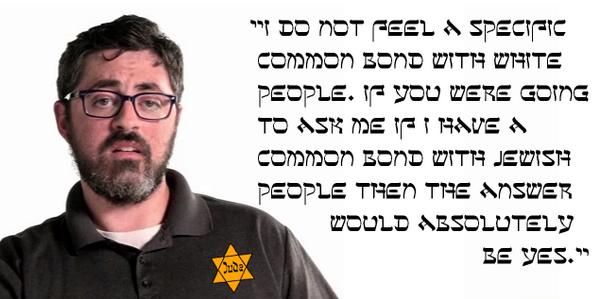
Dow must be aware of this. Alex, the “white” face Dow attached to his odd statement about jews, explains the distinction:

I don’t feel a common bond where, like, when I see another white person walking down the street I have to give them a high five or something along those lines. No. I do not feel a specific common bond with white people. If you were going to ask me if I feel a common bond with jewish people then yes, it would absolutely be yes.

Bullshit artists like Dow are able to make careers out of crusading against White supremacy only because Whites who identify positively as White are not in control, and because anti-White jews and people who think positively about jews are. It is exactly because jews have real power and privilege that “whites” of Dow’s ilk are not having epiphanies about jew supremacy and PBS will not be sponsoring any “Jewness Projects”.

So far the main response to Dow’s “Whiteness Project” has come from confused and consternated anti-Whites. The confusion is a direct result of the project’s misleading name and presentation. Their consternation is a result of the unthinkable injury of allowing Whites (or even “whites”) any kind of public platform to speak about race – even our own. Luckily for Dow, the more seasoned anti-Whites in the jewsmedia get his agenda. They have been happy to offer Dow and other anti-Whites a platform to make their distaste for Whites plain. Some examples are attached below.

White People Are Unironically Talking About the White Experience in New PBS Documentary, Tom McKay, Identities.Mic, 11 October 2014. (No White identity at “Identities.Mic”. McKay calls out just about every “white” except Alex the jew. Irony or coincidence?)

Twitter Users Reject The Whiteness Project’s Deposit, Trent Clark, Hip-Hop Wired, 12 October 2014. (14 pages of snarky twits “rejecting” the project because it isn’t overtly anti-White enough, see Anti-Whiteness is Trending.)

Anger at controversial PBS project on the ‘hardships’ of being white: Critics round on ‘The Whiteness Project’, Joel Christie, Daily Mail, 14 October 2014. (‘hardships’. Dow: “A bit nervous as I know it has a huge chance of being misunderstood” “White people have been very tentative about engaging.” “POC either get it right away or are hugely offended.”)

PBS under fire for documentary, ‘The Whiteness Project,’ on Caucasian hardships, Cheryl K. Chumley, Washington Times, 15 October 2014. (A rehashing of the DM article minus the sneer quotes on hardships.)

The Soapbox: “The Whiteness Project” Is A Pageantry Of White Ignorance, Tiffanie Drayton, The Frisky, 15 October 2014. (Angry black woman lectures Whites about “appropriation”, via the White internet, in White English.)

Why the Whiteness Project is so endlessly mortifying, Miles Klee, Salon, 15 October 2014. (“From our own vantage, it looks as if he was attempting a serious exploration of white identity in the tradition of Richard Dyer, but white people found a way to ruin it: by speaking their minds.”)

The Whiteness Project will make you wince. Because white people can be rather awful, Steven Thrasher, The Guardian, 15 October 2014. (Angry black man winces, wants to hear more.)

Why Would We Need Something Called ‘The Whiteness Project’?, Jessica Roy, NYMag, 16 October 2014. (Dow: “I expected white people to be outraged, and what’s actually interesting to me is the biggest critics of the project are white progressives on the web. They think it’s really outrageous, what I’m doing.”)

Making Sense of the Whiteness Project, Brigitte Fielder, Avidly – LA Review of Books, 16 October 2014. (“public responses to it have been so varied”, says yet another professional non-White who has literally made a career out of lecturing others about “Whiteness” and doesn’t think Whites should have anything to say about it.)

Race and Jews – Part 1

Rabbi_Solomon_Schindler

What is race? What are jews? The two questions are connected. Conventional wisdom is divided between two poles: jews are a race, or not a race. The truth is somewhere between. The jews are a group whose nature is racial, more race than not. To understand the jews you must understand race. To understand anything else (especially concerning history or politics) you must understand the jews.

Race/racial means heritage, birthright – everything bequeathed by parents to their children, everything inherited by children from their parents. Thus race is both genes and memes, biology and ideology. The latter includes culture, language, arts, traditions, history, legends, myths, and most critically, a consciousness of identity.

What is identity? A consciousness of who you are and the group(s) to which you belong.

Kevin MacDonald’s Multiculturalism and the Racialization of Politics in the United States provides this description of social identity theory, as stated by 19th-century anthropologist William Graham Sumner:

Loyalty to the group, sacrifice for it, hatred and contempt for outsiders, brotherhood within, warlikeness without—all grow together, common products of the same situation. It is sanctified by connection with religion. Men of an others-group are outsiders with whose ancestors the ancestors of the we-group waged war. . . . Each group nourishes its own pride and vanity, boasts itself superior, exalts its own divinities, and looks with contempt on outsiders. Each group thinks its own folkways the only right ones, and if it observes that other groups have other folkways, these excite its scorn.

The jews who dominate mass media and education have defined such identity as “hate”, something pathological, but only in Whites. Not in jews. Not in other non-Whites.

Jewish Crypsis – An Introduction is the first installment in a long series I produced last year, focused specifically on jewish identity. Crypsis – disguise, secrecy, duality – and the confusion it creates are a very important aspect of that identity. Race or not, race or religion, weak or enduring, adaptive or inflexible are examples of their dual nature.

Some describe the jews as an ethnic group, a finer-grained racial concept implying closer genetic relationship, common religion, common language, common culture (myths, heroes, holidays, music, literature). Classification as an ethny is as debatable as race.

One problem with seeing the jews as a mere race/ethny is that it imagines them as comparable or similar to other races/ethnies, implying there is some symmetry or congruence. The reality, in comparison to other groups, is incomparability, dissimilarity, asymmetry and incongruence.

Why do we do this? Why do we even try to imagine others as like ourselves? This is a White/Aryan personality trait, this tendency toward objectivity and universalism. A less charitable interpretation is that we are unsubtle, unintelligent, gullible even. At any rate, such traits are especially notable in contrast to the jews.

Occam’s Razor asks, Are Jews natural race realists?:

The question whether Jews are natural race realists might seem odd to some considering that Jews, since the 1950s, have been at the forefront of promoting the “race is a social construct” myth. In fact, Jews today, following the lead of people like Franz Boas and Israel Ehrenberg (aka Ashley Montagu), have almost single-handedly transformed the social sciences away from Darwinian models toward black-slatist / race-does-not-exist models.

But things were not always this way. Prior to WWII, Jews (and by ‘Jews’ I mean mostly Ashkenazis) were some of the most adamant race realists. Mitchell B. Hart’s 2011 book by Brandeis University Press, Jews and Race: Writings on Identity and Difference, 1880 – 1940 (reviewed here), shows that Jews, prior to WWII, overwhelmingly believed in the reality and importance of racial differences. Even Franz Boas, who later would promote the “race is a social construct” myth, early on believed in the hardwired reality of racial differences.

So what happened? In short, WWII happened, whereafter Jews decided race realism was bad for Jews and began to promote race denialism. Israel Ehrenberg (aka Ashley Montagu) and others even muscled the United Nations into declaring that race isn’t biologically real.

But things aren’t so simple. Although Jews today prescribe race denialism for the West, in Israel they are the ultimate race realists and ethno-nationalists.

The irony is that “whites” who self-identify as “race realists” tend to be jew-blindists. They espouse a cartoonishly black and white view of race in which jews are “white”. Jared Taylor, for example, is one of the best known “race realists” of this type. He claims jews look white, implying race is simply appearence or skin color. He sees race and jews as two separate kinds of “crankery”.

This kind of “race realist” is really a race surrealist, and they persist in it despite constant reminders of the racial animus jews feel for Whites. Taylor himself was recently condemned, in perfectly typical jewish fashion, by a jew at Salon. America’s virulent racists: The sick ideas and perverted “science” of the American Renaissance Foundation:

I would hope that most public venues would not allow a Nazi rally in their facilities. The history of the Pioneer Fund and the American Renaissance Foundation shows that there is little difference between the ideals and goals of these organizations and those of racial hate groups that have caused misery throughout the centuries. Modern science now undermines all of their basic premises, and there is no reason to tolerate their hateful, dangerous, ancient, and outdated assertions. If just one racially motivated hate crime is prevented by depriving attendees of the stimulus these conferences provide for some of its more radical and deranged followers, then we have ample reason to close them down.

This is the jewish narrative. The inversion of reality is a hallmark of this narrative, typically by transfering blame to Whites for the things jews are responsible for. In this case it is the jews who have caused “misery throughout the centuries” and invoke science to back their fraudulent claims about race. Their actions have stimulated untold “racially motivated hate crimes”, causing the deaths of millions of Whites and promising to cause millions more, leading ultimately to our destruction.

Brooks Bayne recently provided a sample of the book The Price of Whiteness: Jews, Race, and American Identity, by Eric L. Goldstein, published by Princeton University Press in 2006.

As with any story-telling jew, Goldstein’s story is entirely sympathetic to jews. Even so, and probably because the target audience is jews, Goldstein’s tale is quite blunt and informative, providing a window into the minds of jews, their constant and conscious strategizing, without inverting reality and without all that much of the usual woe-is-me.

The Google Books summary reads:

The Price of Whiteness documents the uneasy place Jews have held in America’s racial culture since the late nineteenth century. The book traces Jews’ often tumultuous encounter with race from the 1870s through World War II, when they became vested as part of America’s white mainstream and abandoned the practice of describing themselves in racial terms.

This book lays out the flip on race Occam’s Razor described above, though as we’ll see, the transformation from embracing racial thinking to pathologizing it was quite deliberate and began decades before World War II.

We’ll start with an excerpt from CHAPTER 1, page 11:

In 1887, Solomon Schindler, rabbi of Boston’s Temple Israel, delivered a Friday evening sermon to his congregation on the topic “Why Am I a Jew?” Schindler spoke of the universal task of Judaism, its superior logical foundation, and its concordance with reason in explaining why he was a follower of Jewish religious teachings. But first and foremost, he emphasized, his connection to Jewishness was a matter of “race.” Despite the fact that the Jewish nation had disappeared from the earth, Schindler told his congregants, “it remains a fact that we spring from a different branch of humanity, that different blood flows in our veins, that out temperament, our tastes, our humor is different…. In a word, we differ [from non-Jews] in our views and in our mode of thinking in many cases as much as we differ in our features.”

The use of “race” as a positive means for self-description among American Jews has not been well documented by historians and, given the contemporary implications of the term, most likely comes as quite a shock to the modern reader. Even more surprising is the fact that this self-description was employed by Schindler, one of the most radical exponents of nineteenth-century Reform Judaism, a movement usually seen by scholars as having distanced itself from strong expressions of Jewish particularism in its attempt to adapt to the American setting. What Schindler’s remark testifies to, however, is the pervasive use of racial language as a means for Jewish self-definition in late-nineteenth-century America, even among those most anxious to take their place in American life. By “race” nineteenth-century Jews meant something different from “ethnicity” in its present usage. Their conception of jewish distinctiveness was one rooted not in cultural particularity but in biology, shared ancestry, and blood. Such overt racial discourse has usually been treated by modern Jewish historians as the province of antisemites, yet racial language also served as an attractive form of self-expression for Jews. American Jews drew comfort from a racial self-definition because it gave them a sense of stability an a time when many familiar markers of Jewish identity were eroding. Despite its strong biological thrust, the racial definition of Jewishness did not impede Jews’ identification with American society and institutions during these years. Because non-Jews of the period generally saw the “Jewish race” in a positive light and defined it as part of the white “family” of races, Jews had few reservations about defining their communal bonds in racial terms. Race, then, fit the needs of Jews to define themselves in a changing social landscape, allowing for emotional security and a degree of communal assertiveness without threatening their standing in the larger white world.

Back then jews not only acknowledged the biological reality of race, but proclaimed their own distinctive racial identity. They did so for the same reason they ever do anything – because they saw it as good for the jews. As Goldstein put it, it “fit the needs of jews” “in the larger white world”. If and when the jews change their attitude toward race again, it will be because their need has changed, not their reason.

Yockey on Culture and Race – Part 11

German-Boy-Jewish-Boy

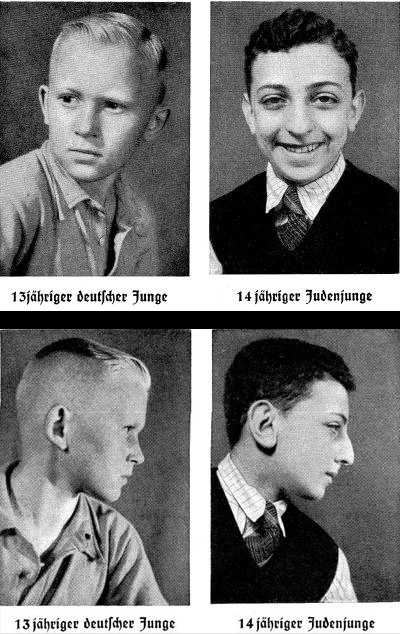
“Whenever I hear the word ‘culture’ I reach for my gun.” is the transliteration to English of a phrase used by Hanns Johst, a German playwright and SS officer. The more direct translation from German would be, “When I hear culture…I unlock my Browning.”

The meaning is clear enough from the context in which the phrase is used – an angry reaction to the perception of a swindle, a fraud, especially when perpetrated by deceitful use of words or concepts.

When I read Yockey’s thoughts on culture and race…I reach for my gun.

Picking up in Imperium, page 281, in the section titled “Race, People, Nation, State”:

From this point the fundamental misunderstanding of the 19th century materialistic interpretation of race appears clear and distinct:

282

Race is not group anatomy;

Race is not independent of the soil;

Race is not independent of Spirit and History;

Races are not classifiable, except on an arbitrary basis;

Race is not a rigid, permanent, collective characterization of human beings, which remains always the same throughout history.

The 20th century outlook, based on facts, and not on the preconceptions of physics and mechanics, sees Race as fluid, gliding with History over the fixed skeletal form determined by the soil. Just as History comes and goes, so does Race with it, bound in a symbiosis of happening. The peasants now tilling the soil near Persepolis are of the same race as those who planted or roamed there a thousand years before Darius, regardless of what they were called then, or what they are called now, and in the time between, a High Culture fulfilled itself in this area, creating races now gone for ever.

This last error — the confusing of names with unities of history or race — was one of the most destructive made by 19th century materialism.

Yockey makes a combination of fallacious, misleading and simply wrong assertions here, most of which we have previously addressed.

Race is only partly anatomical, there are characteristic mental/personality traits as well. Race is only weakly influenced by “soil”, usually over the course of many generations. “Chinatown” is a one word argument for that. As with species, race is classifiable on an objective basis. Racial characteristics cluster at a range of scales, especially when correlations between traits are considered. Contrary to Yockey, it is not science or rationalism which promotes the false notion that race (or species) are rigid and permanent. This is more properly attributed to dogmatic religious beliefs such as creationism.

If the present-day inhabitants of Greece have the same collective name that the population of the same area had in Aristotle’s time, is anyone deceived into thinking that there is historical continuity? Or racial continuity?

Yes, just about everyone is deceived by name games.

As far as the Race-History symbiosis is concerned, names are accidental. They do not indicate any sort of inward continuity by themselves. The same is true of language.

Once the idea is grasped that what we call history really means High History, that this is the history of High Cultures, and that these High Cultures are organic unities expressing their inner possibilities in the profuse forms of thought and happening which lie before us, a deep understanding follows of the way in which History uses whatever human material lies to hand for its fulfillment. It puts its impress on this material by creating historical units out of groups hitherto often very

284

[d]iverse biologically.

We see just how lopsided in favor of Amorphous Abstractions and against “human material” Yockey was, imagining more substance and agency in the former than the latter.

We have seen that Race influences History as well as the converse. We come to the hierarchy of races.

The materialists could, of course, not succeed with all their attempts to make an anatomical classification of races. But races can be classified according to functional abilities, starting from any given function whatever. Thus a hierarchy of races can be based on physical strength, and there is little doubt that the Negro would stand at the top of such a hierarchy. There would however be no point in such a hierarchy, because physical strength is not the essence of human nature in general, and even less of Culture-man in particular.

For some insight on Yockey’s attitude toward the negro consider this bit of biographical information from Alex Kurtagic’s Remembering Francis Parker Yockey 18 September 1917 – 16 June 1960):

In 1935 he was involved in a car accident, which led to his being assaulted by several Afro-Americans and losing his front teeth. According to a local newspaper, he was hospitalised, but released the following day. The incident shaped his racial views thereafter.

Continuing with Imperium, page 285:

The fundamental impulse of human nature — above the instincts toward self-preservation and sex, which man shares with other Life-forms — is the will-to-power. Very seldom is there any struggle for existence among men. Such struggles as do occur are nearly always for control, for power. These take place within couples and families, clans, tribes, and among peoples, nations, States. Therefore the basing of a hierarchy of races on strength of will-to-power has a relation to historical realities.

When I hear human nature…I reach for my gun. Yockey himself had earlier warned against this idea. At page 202, just before the section we discussed in Yockey on Liberalism – Part 2 he writes:

The name “humanity” became thus a polemical word — it described everyone except the enemy.

. . .

But yet the word humanity excludes no one, semantically speaking. The enemy is also human. Therefore humanity can have no enemy, and the “one State” liberals and the “humanity” intellectuals were involved in the very sort of thing they wished to abolish — politics and war. “Humanity” was not a peace word, but a war slogan.

We come to the fundamental disjunction between political thinking and mere thinking about politics. All intellectualistic thinking about politics posits a certain great non-existent characteristic of human nature.

204

The Two Political Anthropologies

The touchstone of any political theory whatever is its attitude to the fundamental ethical quality of human nature. From this standpoint there are only two kinds: those which posit a “naturally good” human nature, and those which see human nature as it is on the other hand.

When I hear the word will-to-power…I reach for my gun. The positing of certain great non-existent characteristic of human nature – like will-to-power – is typical of the philosophizing I’ve encountered since digging into Yockey.

Will to power:

The will to power (German: der Wille zur Macht) is a prominent concept in the philosophy of Friedrich Nietzsche. The will to power describes what Friedrich Nietzsche may have believed to be [[[the main driving force in humans: achievement, ambition, the striving to reach the highest possible position in life]]]; these are all manifestations of the will to power. However, the will to power was never systematically defined, and its interpretation has been open to debate.

Having derived the “will to power” from three anti-Darwin evolutionists, as well as Dumont, it seems appropriate that he should use his “will to power” as an anti-Darwinian explanation of evolution. He expresses a number of times[21] the idea that adaptation and the struggle to survive is a secondary drive in the evolution of animals, behind the desire to expand one’s power—the will to power.

Back to Imperium again, where Yockey explicitly identifies the men behind the “19th century materialism” he condemns:

Such a hierarchy can have, of course, no eternal validity. Thus the school of Gobineau, Chamberlain, Osborn and Grant was on the same tangent as the materialists who announced that there is no such thing as Race, because they could not discover it with their methods. The mistake of the former was to assume the permanence — backwards and forwards — of races existing in their time. They were treating races as building-blocks, original material, and ignoring the connections of Race and History, Race and Spirit, Race and Destiny. But at least

286

they recognized the existing racial realities of their time, their sole mistake consisting in regarding these realities as rigid, existing rather than becoming. There was also in their approach a remnant of genealogical thinking, but this sort of thinking is intellectual and not historical, for History uses the human material at hand without questioning its antecedents, and in the process of using it, this human material is placed in relation to the vast, mystical force of Destiny. This remainder of genealogical thinking tended to create divisions in thought between Culture-peoples corresponding to no divisions in actuality. The further materialistic tendency developed to extend the principles of heredity which Mendel had worked out for certain plants to the subject of human Race. Such a tendency was doomed to be fruitless, and after almost a century of barren results, it must be abandoned in favor of the 20th century outlook which approaches History and its materials in the historical spirit and not in the scientific spirit of mechanics or geology.

Nevertheless the school of Gobineau at least started from a fact, and this brings it much closer to Reality than the learned fools who looked up from their rulers and charts to announce the demise of Race.

Yockey wasn’t ignorant. He was an intelligent and knowledgable man who rejected the material, biological reality of race. In making his argument he went beyond simple denial. He explicitly named the most prominent advocates of race science and he misrepresented their arguments. Yockey distorted the truth. He claimed the racialists had produced no results. He strawmanned their premise as “permanence” and their interests as purely materialist.

Yockey was the one “on the same tangent”, or to be more blunt, on the same side as the prototypical anti-“racists”. Like the anti-“racists” Yockey opposed the scientific understanding of race rooted in genealogy, in biology. He used the same fraudulent style of argument they did, posturing as if he were advocating facts and reality even as he was actually contradicting them.

As much as Yockey talked about spirit, he failed to note the quintessentially European spirit, the objective, inquisitive, rational and honest Aryan nature which inspired the racialists he named. He also failed to recognize the deceptive spirit of their antagonists, the very jewish nature of the anti-“racist” Boasian cultural anthropologists he did not bother to name. He exaggerated and thus distorted the anti-“racist” argument too, giving the false impression that his ideas and arguments about race were distinct from theirs. But they were in fact very similar.

Like the Boasian anti-“racists”, Yockey did not assert that race does not exist. They undermined race by redefining it and attacking it’s significance. They argued that science had shown race is arbitrary, impermanent, not deeply rooted in biology, when in fact science was (and still is) increasingly revealing exactly the opposite. They argued the primacy of culture. They asserted that race is a product of culture, a mere “social construct”.

Yockey was not simply wrong about race. He was profoundly, fundamentally wrong. He argued against a biological understanding of race in the same way and to the same end as the jews, a racial group which is biologically distinct from and implacably hostile toward Whites/Europeans/Aryans, and whose parasitic interests are served by such obfuscation and disguise.

Though the work of the racialists Yockey disparaged pre-dated his by up to a hundred years, their understanding of race was closer to the truth, more in touch with fact and reality than his.

Arthur de Gobineau is best known for his book The Inequality of Human Races, published in 1853. On page 121 Gobineau directly contradicts of Yockey’s assertions about the influence of soil on race:

After the Arabs, I will mention the Jews, who are still more remarkable in this connexion, as they have settled in lands with very different climates from that of Palestine, and have given up their ancient mode of life. The Jewish type has, however, remained much the same ; the modifications it has undergone are of no importance and have never been enough, in any country or latitude, to change the general character of the race.

Houston Stewart Chamberlain is best known for his book Foundations of the Nineteenth Century. Here is Chamberlain’s view on the “permanence” of race:

The Aryan, or ‘noble’ race was always in the process of creation as superior peoples supplanted inferior ones in evolutionary struggles for survival.

Also:

Adolf Hitler was an avid student of his “Foundations”, and praised him as “The Prophet of the Third Reich”

Henry Fairfield Osborn, Jr. was a prominent paleontologist, eugenicist and “distinguished Aryan enthusiast”. He was a conservationist, longtime president of the New York Zoological Society, and son of Henry Fairfield Osborn, who was a geologist, paleontologist, and eugenist, and the president of the American Museum of Natural History.

And finally, Madison Grant:

is most famously the author of the popular book The Passing of the Great Race in 1916, an elaborate work of racial hygiene detailing the “racial history” of Europe.

Grant’s work was embraced by proponents of the National Socialist movement in Germany; Passing was the first non-German book ordered to be reprinted by the NSDAP when it took power, and Adolf Hitler wrote to Grant that, “The book is my Bible”.

Yockey has long passed as an eccentric type of spiritualist-racialist, a sympathizer and apologist for national socialism. Yet he opposed and argued deceptively against fact, against reality, against the very understanding of race which underpinned national socialism. In this respect, Yockey was in fact a charlatan.

Politics + Technology = Nonsense at the Speed of Light